Dr. Nicholas Pickwoad presented an informative lecture last night at The Institute of Fine Arts, New York University. This was the final venue of a three stop North American tour. Pickwoad is director of Ligatus Research Centre, University of Arts London. He has a doctorate in English Literature from Oxford University. He trained with Roger Powell, and ran his own workshop from 1977 to 1989. He has been Adviser on book conservation to the National Trust of Great Britain from 1978, and was Editor of the Paper Conservator. He taught book conservation at Columbia University Library School in New York from 1989 to 1992 and was Chief Conservator in the Harvard University Library from 1992 to 1995. He has published widely on book history and conservation.
Pickwoad’s thesis—and he took pains to make it clear he is far from certitude at this point—is that there is a previously unrecorded class of books, which he terms incomplete bindings. He noted that he has seen more than 130 of these types of books, which he feels is more than just an accident. This lecture was intended as a challenge, both to refute his thesis and stimulate awareness in these structures, hopefully discovering more of them.
Temporary bindings are different from incomplete bindings if they are sewn in a way that could later be covered. For example, a a tacketed sewing structure would not be covered in leather, but all along sewing on double cords most certainly could be. These unfinished bindings, which seem to start around the time of the invention of printing, seem to morph appealingly into the late 18th century paper covered boarded bindings.
Pickwoad presented numerous images of books that had never been finished, as well as visual evidence from paintings, and some tantalizingly cryptic entries in bookbinder price lists. An example of this type of binding, in this case from the early 16th century, can be found in Fine and Historic Bookbindings from the Folger Shakespeare Library on page 33.[1] The authors of the catalog consider this to be a temporary binding: Pickwoad, however, interprets the thongs as being meant to be laced into a wooden board structure without needing to be resewn, hence an incomplete binding.
These books fit into a continuum of how books could be purchased. A traditional, but inaccurate view is that books from the handpress era were printed, then the purchaser would direct the binder or bookseller to bind them. The actual situation seems more complex, with books available in various forms for different price points, at various times in history. Books could be sold in sheets, in temporary bindings [2], sewn, sewn with boards, and bound. [3]
Pickwoad has tentatively identified two main styles of incomplete bindings: sewn, and sewn with boards. The sewn binding is basically a sewn text block as it would have left the binder’s frame, uncut or sometimes trimmed. He considers whip stiching on the sewing cord ends to prevent unraveling a key aspect to identify an incomplete binding: it seems to point to intentionally stopping the binding process at a certain point. A sewn with boards style has also been identified, some that were trimmed, edge colored, and sewn with primary end bands, and with the supports were laced into boards. There are many variations of both of these.
Many questions remain. It is unclear if these books were actually sold as unfinished though some of the binder price lists suggest this.[4] Is it possible, as Pickwoad suggested, they were done so to save on transport costs or to escape taxation imposed on bound books? Out of the many hundreds of thousands of books, can a few hundred be considered a statistically significant sample? Could these bindings remain unfinished due to accident or neglect? A key, possibly unknowable point seems to be if were intentionally sold as unfinished. I would also consider if it were properly beaten a key aspect in differentiating these from more temporary structures.
Some of these incomplete bindings were later covered: this can create a complex situation of a book partially bound by one workshop and finished, possibly at a much later date and possibly in another country by a different bookbinding workshop. Thinking about these complexities obviously delighted Pickwoad, who seems hopeful one day this vast array of information can be put into a meaningful and accurate construct.
*******************
1. Frederick Bearman, Nati H. Krivatsy and J. Franklin Mowery, Fine and Historic Bookbindings (Washington, D.C: The Folger Shakespeare Library/ Harry N. Abrams, Inc., 1992), 32-33.
2. Would temporary bindings have been more or less expensive than these incomplete structures? The term “temporary bindings” is an imprecise term that generally refers to a wide variety of structures: vellum wrappers, publisher’s printed paper bindings, the french broche, and others. Bibliophiles often considered case bindings temporary well into the 20th century.
3. Obviously bound books often are be made to a number of different price points, from a simple trade calf, to an elaborately tooled morocco in 18th century France, for example.
4. Mirjam M. Foot, “Some bookbinders’ price lists of the seventeenth and eighteenth centuries” in De Libris Compactis Miscellanea, ed. Collegit G. Colin (Bruxelles: Bibliotheca Wittockiana, 1984) Foot discusses the complexities of these in this lengthy 45 page article.


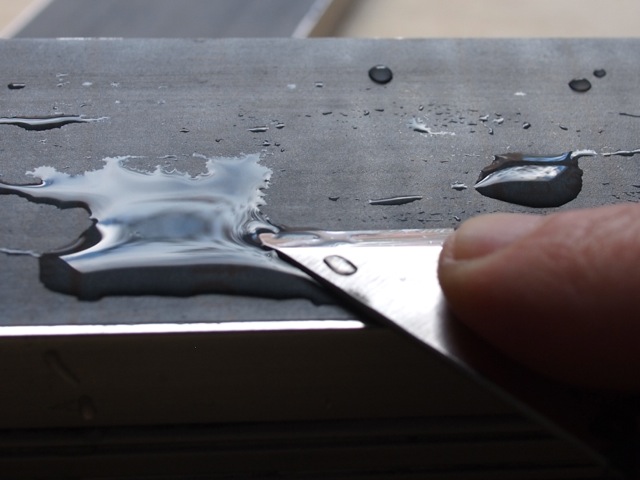
 The cutting edge of this knife is slightly wider than the narrow Swiss and French knife that I currently make, but the length of the blade is wedge shaped so the area that is gripped is still comfortably narrow. Also, it has a secondary bevel, which accounts for the strange looking, extremely acute 8 degree primary bevel. The advantage of a secondary bevel is that there is much less metal to remove when resharpening or stropping. This is especially the case with a thick and wide knife like this. The primary bevel is fairly roughly ground: only half a millimeter of the secondary bevel, which is the cutting edge, is fully sharpened and polished. In a normal knife of this thickness, the length of the bevel would be about ten times this amount. Although I don’t think the time spent sharpening the bevel corresponds one to one, it does take significantly less time.
 The drawback of a secondary bevel is that there is not really enough metal to feel it resting on your sharpening system, so this knife is recommended to those that have some experience in sharpening. This wide cutting edge is useful for hogging off leather for edge paring and also used in a scraping manner for headcap and spine areas. The slight wedge shape on the leather handled knife, and the rounded thumb holds on the wood version provide excellent control.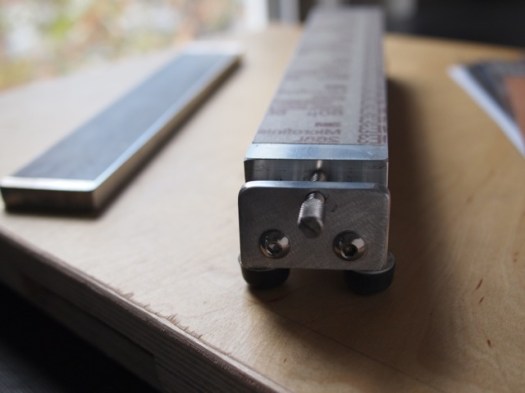


 Peachey Conservation