Pressure Sensitive Gold Foil

Figure 1. Front of the Goldmark Box.  Manufactured by Hastings and Co., Inc.   [circa. 1940’s-mid 1950’s ?]  Note the unregistered trademark and the pretty gold stars that can be made with this product.

.

Figure 2. Front and back of 23k Signature Gold. Chemical Rubber Co. [circa. 1960’s-1970’s?]  Note the “Goldmark” registered trademark and the EXCRUCIATINGLY detailed step-by-step instructions. 

.

A query on the Guild of Book Workers listserv about pressure sensitive gold foil reminded me that I had an example of this material, and after digging through some boxes, it turned out I had two versions.  Nora Lockshin then politely challenged me to describe them a bit. I haven’t found out a lot about them: any other information about pressure sensitive gold foils would be appreciated.

The Hastings & Co. Goldmark foil is likely from before the mid-1950’s, when Hastings was bought by Kurz. The advertising on the back of the box tends to emphasize its use for greeting cards and on wrapping paper. “Now—you can have the luxury of writing or drawing in gold—easy to do and so much fun.”  Indeed, it is fun to use and so luxurious to write in genuine gold. The advertising also mentions that the marks will not smudge on paper, but a coat of nail polish should be used to seal it on wood, metal or glass. Kurz still manufactures hot stamping foils, many of which I use and like quite a bit. Of particular interest to bookbinding historians is that in 1931 Kurz invented a vapor deposit stamping foil with real gold, used for hot stamping. Middleton, in A History of English Craft Bookbinding Technique dates the invention of real gold foil in England to 1933. (p. 186)  It is unknown when the earliest pressure sensitive foil was developed.

Chemical Rubber Company (CRC) foil packaging suggests it can be used for personalizing and identifying books, wallets, etc.  The CRC foil packaging sports a clever design, since the wrapper also forms a clear window that is used while writing, to prevent tearing through the thinner foil. The CRC began in 1900, when Arthur Freidman invented and sold a chemical resistant rubber apron for use by chemistry students. Later he and his brothers published the first Handbook of Chemistry in 1913: it is still in print, currently the 92nd. ed. The original 1913 edition is described as “apron-pocket size”, the current edition is considerably larger, perhaps necessitating a kangaroo sized pouch.

Both of these pressure sensitive gold foils have a similar thin film backing, a layer of gold, and an unidentified adhesive. The Hastings gold has a much more matt appearance, while the signature gold is quite shiny. Both have a bluish-green color when viewed through transmitted light, which indicates genuine gold. Curiously, the Hastings box does not contain a registered trademark, while the CRC gold does: both claim the name Goldmark. Did Hastings make both of these, or was there a trademark dispute with different companies trying to use the Goldmark name?

By the way, both of these pressure sensitive foils still work quite well.

Figure 3. Three gold stars made with 23k Signature Gold by the author.

Dr. Christopher Clarkson on Conservation Education

I could write a number of posts just introducing Christopher Clarkson. This is the very,very short version. He graduated from the Royal College of Art, London, then worked for S. M. Cockerell, and Roger Powell. In 1966 he was sent to Florence after the flood & taught in Italy and England till 1971. In 1972 Clarkson moved to the Library of Congress, concentrating in Special Collections. In 1977 Clarkson moved to The Walters Art Gallery, Baltimore to set up a book conservation studio, he also helped Dr. Lilian Randall, adding many of the parchment & binding descriptions  to her great manuscript catalogue. He returned to England in 1979 as the first Conservation Officer at The Bodleian Library Oxford. Concerned about training, in 1987 Clarkson moved to West Dean College, where he ran an internship programme & worked on many medieval manuscripts. Most recently Clarkson has reported on the early 5th century Ms. Syriac 30 & the ‘New Finds’ of Codex Sinaiticus for the Monastery of St. Catherine’s. Currently he is conservation consultant to Hereford Cathedral Chained Library & Mappa Mundi, The Bodleian Library & to The Wordsworth Trust.

Quite likely, he has done more to create awareness of traditional materials, research the context of older structures, and impart sensitivity to treatments than any other book conservator.  And he generously shares this knowledge through teaching and in publications. Many of his articles form the foundations of the field. In July, he was awarded an honorary doctorate from The University of Arts London. Chris describes that he “was given two minutes for a speech in which he wanted to try to heighten the profile of conservation within the University also to stress why an art school system is probably still right for the  subject.”

Like most of his writing, the speech below is quite dense and warrants reflection.

…..

CLARKSON’S HONORARY DOCTORATE SPEECH

“It is a great pleasure to be back amongst art school people. I started at Camberwell School of Art in the 1950’s when I was thirteen, when it was still very much academic & Arts & Crafts based. The observational, painting techniques & graphic printing skills I learnt there have been essential in my later career as a conservator.

Conservation is a subject that bridges many disciplines – history, chemistry, engineering, material science etc. Possibly because of this, specific educational committees have said, “this is not ours” & passed it on to other committees. Above everything, it is a discipline which requires a high level of visual & craft skills plus ‘historical awareness’, my phrase, meant to express a deeper knowledge, sympathy & thus respect for the integrity of a period artefact. The danger in poor restoration/conservation training is ‘facsimile’ – the misconception that past cultures & their artefacts can be recreated – they cannot.

What I have tried to develop and teach are the principles of conservation as applied to period book structures, the diversity and the unexpected is what I am trying to preserve. This means teaching a wide and ever growing variety of techniques, utilizing a wide variety of materials and treatments out of which imaginative and historically sensitive young people can begin to find the answers to the problems that damaged books will present.

I am very interested in the choices conservators make in their treatments and how these decisions may influence our interpretation of an object. Thus observational skills are central to any conservation programme, I mean traditional drawing skills – to train the eye is to train the mind.

Conservation belongs in the Humanities, which are suffering badly in the present educational climate. I do hope the University can continue to support, & if possible broaden its commitment to its conservation course. It is a resource intensive discipline, expensive in time, training & quality materials, tools & equipment; a high percentage of bench-work is essential.

There has never been a greater need for well-trained conservators who not only know the techniques but also the cultural significance of what they will be working on. The support that the University gives to such courses is of enormous value.

I would like to congratulate all the students receiving their degrees today & wish you a bright & interesting future.

To the University I thank you for the honour you bestow on me.”

-Christopher Clarkson, 16 July 2012

Centrale Montemartini Museum, Addendum

Three years ago I visited the Capitaline Montemartini Museum in Rome, Italy. In August 2012, I had a chance to revisit it; once again, it blew my mind. I wrote a post about my first visit, but wanted to add some new impressions and images.

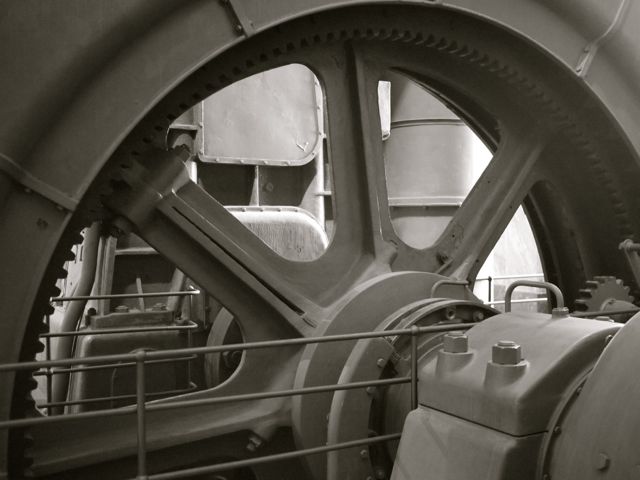
Briefly, the Montemartini Museum is an art nouveau electrical power plant that retains its original architectural details, and now functions as a museum which displays Roman sculptures alongside the defunct machinery.  Montemartini originally used both diesel and steam engines to create electricity. The largest one is a 7,500 Hp diesel engine which was installed in 1933, and is about 20 feet high and 40 feet long.  The sculptures belong to the Capitoline Museums (Museo del Palazzo die Conservatori, Museo Nuovo and Brassio Nuovo) and were installed in 1997 as a temporary exhibition. The exhibition proved popular and was made permanent.  It is a uniquely powerful, stimulating and intriguing place.

This museum does not just contain, display, and interpret art: it is art.

Montemartini is a bit of a guilty pleasure for me. Frankly, I often find it more rewarding to spend time looking at industrial artifacts, craft objects, machines and tools rather than art. Quite likely this is why I am attracted to books: a few books are art, some contain art, but most are products of technology. Montemartini challenges the traditional divide between technology and art: here, we are not quite sure which is which. From some viewpoints, the statues visually merge with the engines. The functional and aesthetic aspects are in constant flux; at times becoming inverted, at times irrelevant, but always interesting.

Despite the omnipresent engines, machines and turbines, it is easy to forget you are in a factory. It is a beautiful space with elaborately tiled floors, symmetrically aligned turbines, lovely light fixtures, and elegant cast iron stairs and handrails.  Massive windows on two sides of the engine room make it a clean and bright place, in stark contrast to the matt black engines. The statues are arranged around the engines as if they are guarding them.

The machines and statues feel like they belong together; equally portentous and aesthetically rewarding. This is perhaps the oddest thing about the museum. These objects, which come from radically different cultures and intended functions, exist naturally and peacefully together. Art is conflated with the Machine—perhaps the most unholy union imaginable—but it works.

Montemartini is a museum of fragments, not complete arguments or a comprehensive history. The paring of these machines and statues creates many entry points for inquiry: Art vs. Machine, blackness vs. whiteness, functionality vs. representation, art vs. craft, applied vs. abstract, technical vs. aesthetic, and possibly most importantly, body vs. machine. Machinery becomes aesthetically endowed; the statues appear as workers from the past tending the machines, not art. The statues are almost all damaged: torsos without arms, half a head, most with a nose or ear missing. The machines themselves are dysfunctional and only their shells remain. They are now disconnected from the grid, as mute and powerless as the damaged statues. Is this museum of pieces reflective of an unpleasant essence of all museums?  Artifacts on display stripped of their original functions and significance? Is Montemartini a critique of musemification in general?

Although the machines and sculptures are visually balanced, primordially, the smell of the machines predominate. They smell of dark earthy oil, grease, and metal filings. They seem to have stopped only moments ago. The sculptures emit no smell. These white, etherial ghosts have been clawed from eternal repose only to be redeposited into an eternal waiting to begin work once again.

Superficially, there are corollaries with the Barnes Foundation. But in the Barnes the Art seems to dominate, while the smaller objects around the art function as a decorative frame, albeit a stimulating one. I need to think more about this.

For some reason, Montemartini also reminded of the temple complex of Angkor Wat, Cambodia. There is an analogous tension in Angkor, not of Machine and Art, but of architecture and nature. In Angkor, the stones of the temples are carved and decorated, slowly overtaken by the ficus tree roots and limbs, which both destroy and support the massive constructions. It is the peaceful coexistence of two extremes that form their commonalities between these unique sites.

“Expressions of power” was the essence of my first response to this place three years ago.  This time, however, I was more struck by the fragility of the machines and sculptures. They both seemed delicate, as if a loud voice could disturb their equipoise. A handful of other visitors to the museum spoke in subdued voices, and walked quietly. No one wanted to disturb this postmodern tableau. Or was this mashup so disturbing in its conflation of traditional categories that we did not want our presence noticed—perhaps, so that we would not be obligated to recall it?

The Centrale Montemartini Museum is a complex, contradictory place. It raises many questions. If the ability for a work of art to generate varying interpretations with repeated encounters over time is a mark of quality, Montemartini is not only art, it is great art.