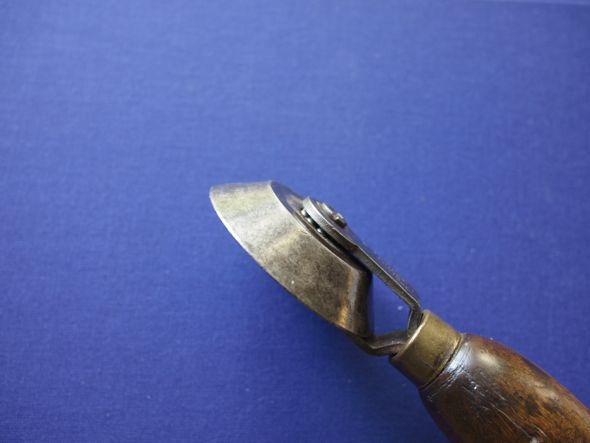
Everhard Ball Bearing Beveled Stitcher

Fillet or creaser?

At the massive Brimfield Flea Market last month, I picked up this unusually well made tool. Note the ball bearings barely visible around the axle. Not only does is spin freely, but there is zero play side to side. And the wheel is very heavy.

At first I thought it was an unusual fillet, used for marking lines in leather. But it turns out it was made for the tire/ rubber industry. It is marked “The Everhard Mfg. Co.”, and is known as a beveled stitcher,  used to smooth wavy edges of uncured rubber. It also bears a striking morphological resemblance to a leatherworkers wheel. Even if it can’t be usefully adapted for bookbinding work, it is still a wonderfully well made object to have.

Yikes! Have I started down the slippery slope from tool user to collector? Is this a problem?

Naturally Packed Sewing


spine2

I first noticed what I call “naturally packed sewing” on an early 16th century quarto. Usually, a pack sewn book has extra windings around the cords to fill them in even with the thickness of the signatures. I believe it was Peter Franck who first described pack sewing, which he called “arch sewing”.[1] For naturally packed sewing, if the sewing thread is fairly soft, and the signatures relatively thin, the paper pretty thin, the book can be sewn packed without additional windings. Here, there are 39 signatures and 39 windings around the double cords. This image is larger than life size.

The paper is 60lb. Mohawk Vellum Soft White from New York Central Art Supply. Folded down to quarto, 2 folios, 4 leaves,  8 pages.

The cord and thread are from Colophon Book Arts Supply. The cord is Garniture Linen Cord, the thread Londonderry Linen, Ash Grey, 18/3.

***


Peter Franck. A Lost Link in the Technique of Bookbinding and how I Found It. Gaylordsville, Conn: n.p., 1941.
