
Susan Mills has started an audio interview project called Bookbinding Now. She interviewed me last week, and we talked for about fifteen minutes about book conservation, my background, and tools. I have to confess I haven’t listened to it, since hearing the sound of my own recorded voice makes me cringe. But apart from Susan and myself, I encourage everyone else to check it out.
The Bookbinders’ Pension and Asylum Society

From: The Bookbinder, London, Raithby, Lawerence & Co., 1889.
Unusual Leather Decoration
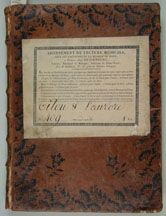
Kristen St. John, a book conservator at UCLA, has an intriguing post on their Preservation blog. She has found an unusual method of leather decoration. The book is French, from 1753. It appears to be some kind of block print, although it she mentions it might be a stencil. There are many more pictures on the blog, including some close ups. I haven’t seen any decoration like this before, and there is no reference in either Diderot, Dudin or Gauffecourt about the use of stencils in leather decoration, in eighteenth century bookbinding. ?
____________
J-V Capronnier de Gauffencourt, Traite de la Relieure des Livres, W. Thomas Taylor, Austin, 1987.
Diderot & d’Alembert, Encyclopedie, Neufchatel [Paris], 1765.
Dudin, M. The Art of the Bookbinder and Gilder, The Elemente Press, Leeds, 1977.

