
The Metropolitan Museum of Art, NYC, is currently exhibiting ‘Looking In: Robert Frank’s The Americans‘. (1) The first edition of this book is the title that I have worked on the most over the years, currently five copies. The reasons are simple– the original Grove Press edition was perfect bound, so the pages are generally detached, or detaching. (2) When this is coupled with the fact that a first printing in good condition sells for up to $20,000, it becomes economically advantageous for the owner to have the book conserved. I even had a magnesium die made from the title page for stamping the exterior of the drop spine box, since I tend to see this book every couple of years. Since I have spent many, many hours looking at this book, I was curious to see how I would interpret the images in a museum. I also think this is the first time I have seen all the images from a book displayed in a gallery.
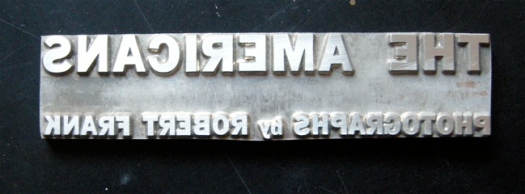
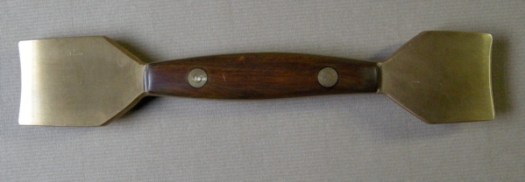
Above is a magnesium die, reproduced photographically from the title page, used for hot stamping.
What follows are some haphazard observations on the differences between interpreting images in books verses looking at photographs in gallery setting, tempered by my experience as a conservator. (3)
Overall, there was more a sense of the similarity of the experience, rather than huge differences, in reading the book or looking at the images in the gallery. Perhaps it is because I’m already used to seeing this book in single sheets, rather than intact. Perhaps it is because the exhibition follows the exact chronology for the 83 images. Maybe is because there is virtually no text in the book, thus reducing the dichotomy between looking and reading. The sequence of the book has always puzzled me a bit. They aren’t arranged chronologically, thematically, narratively or even with a clear sense of formal relationships. In fact, as I have spent many, many hours removing traces of deteriorated adhesive from the spine edges of the pages, they often tend to get out of order. Viewing the images out of order reinforces the impression that it is not in the sequencing that its power lies, but in the massing of the images coupled with a sense of disorder, that creates this powerful, poignant snapshot of America.
Gallery viewing is public, but viewing books generally takes place in private, with the reader able to choose the pace of their viewing. Typical of a busy museum, especially when looking at smaller format images, I was forced to stand in a line and everyone tended to move along at the same rate. If you got tired of looking at the image in front of you, you could look back at the previous one or ahead to the next. The book, however is laid out with one image on the recto, and a simple title, often nothing more than a place name, on the verso of the previous page. Each image in the book is encountered in isolation, and is related to the previous one only by memory, not active viewing. The layout of the images mirrors the subject of the images as well– the often mentioned pervasive loneliness and sense of isolation that Frank documented.
One aspect of Frank’s work that came through more forcefully in the gallery setting was his use of reflections, shooting through curtains, windows, etc. The fact that the photos were framed in glass, with its own reflections, and the verticality of the picture plane emphasized this. I interpreted the photographs more like windows, rather than like portraits in the book, both because of their verticality and large size. Many were much larger (some impressively large for 35mm) than the reproductions in the book, and the size varied from image to image. I suspect each photo was printed as large as he could, and they were printed at various times during the past decades. The regular size of the images in the book, albeit with some variation in horizontal and vertical orientation, tends to reinforce the homogeneous nature of this tour through America. (4)
I am used to looking at this book through my “conservation eyes”. When viewing the book during conservation treatment, I generally tend not to “look” at it as a whole, but only look at the small area of damage that I am treating. Even when I sleep on it, or step back and try to assess the whole, the areas where I have devoted so much attention to continue to beckon. Sometimes, when I’m looking at art, I catch myself looking at a repaired area of an object, or some damage, or how it is mounted, rather than trying to appreciate it as an artistic experience. I think it is a bad habit, possibly dangerous, in the sense that it forces my perception onto very small details, possibly at the expense of a more holistic interpretation. When I look at the book, memories of what I treated, what was repaired, etc. constantly resurface and interfere with the intent of the artist.
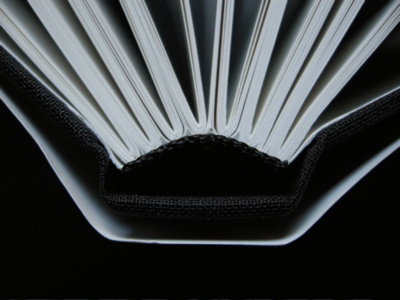
But after viewing the exhibition, the book form beckoned– this time a 2008 facsimile for sale in the museum shop, with sewn signatures, for only $39.95.
NOTES
1. J. Hoberman has a solid review of the show in The Village Voice which places the book in the context of late 1950’s American culture.
2. Take a close look at open first edition displayed at the beginning of the show, in the middle of the case. Notice that the top and bottom of the page displayed is detaching. Heads up to whoever is de-installing this case- close this book very, very carefully! The glue is already very brittle.
3. I’m going to leave aside a discussion of the most obvious difference, the difference in the visual qualities of reproduction. Gelatin silver photographs and offset printing look quite different!
4. Differences in various editions of the book also change the reading. Towards the end of the show, there was a case containing three various editions of the book, all open to the same image to allow easy comparison. Needless to say, the print quality varied quite a bit, and these differences influence how the images are interpreted.


 Peachey Conservation