A pair of August Eickhoff french style paring knives, made in New York, 19th century.
A side benefit of my regrinding and knife sharpening service is that I get to see some interesting antique knives. These August Eickhoff knives are beautifully made, have a wonderful balance, a lovely patina, and given the amount of distal taper (both on the blade and the tang) must have been forged. Eickhoff also made round knives (aka. head knives) for leatherworkers which occasionally show up for sale today. In the late 19th century, Eickhoff was located at 381 Broome St, NYC, making scissors, woodworking tools, and resharpening knives. He served on the NY Board of Education, and advertised his wares in a Teachers College Educational Monograph. It may be time to make a few reproduction Eickhoff knives.
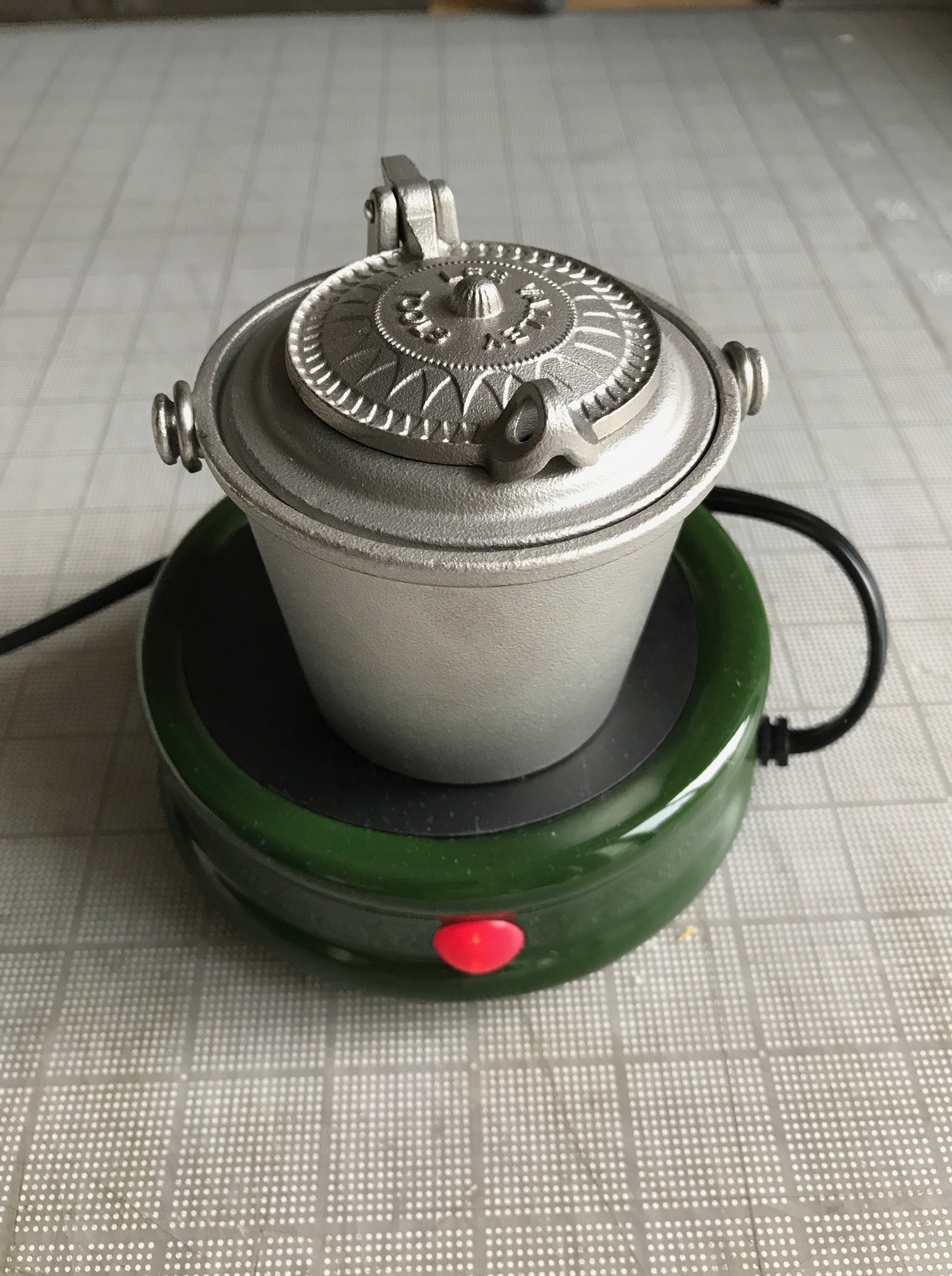
It works great with gelatin in conservation work or with hide glues for historic models. The heavy cast steel double boiler gives a very gentle and even heat. It is based on a Landers, Frary & Clark glue pot from the 1870’s. There is an image of the original, which was cast iron, in Stephen Shepherd’s hide glue book. (1)
The cup-warmer is cheaply made, but it only costs a dollar when purchased with the gluepot. If the interior of the pot was finished a little smoother to make cleaning easier, it would be perfect. A steal at $35.00.
Arthur Green described his investigations using gelatin on the spines of books in the blog post, “Revisiting Animal Glue: Gluing-up with Gelatin” Traditionally bound books used animal glue on the spines, and paste for the covering and paste-downs: there must have been a reason. He tested starch paste and gelatin separately, and primarily for adhesion.
I find the real magic happens when gelatin and paste are used in sequential layers, or mixed together. Dudin, in the 18th century, described the “marriage” that happens between animal glue and paste. (2) A mix gives the book better resistance to torquing than paste alone, makes it feel more solid, and gives a more secure — yet still easily reversible — bond with a Japanese tissue for the first spine lining in conservation work.


 Peachey Conservation