Most books I work, especially the ones that have been around for a while, have a name, bookplate, or other inscriptions in them. Sometimes I can read these, sometimes I can’t. They are preserved as evidence of how the book circulated, how readers responded to it, which institutions collected it, dispersed it, and so on. This evidence of use makes many printed books unique objects.
Even among private collectors and dealers, there is much more awareness of the importance of these marks, and a corresponding willingness to leave them in place. A couple of decades ago, many owners would want them to be removed, and I would have to persuade them to keep them.
I’m especially thankful that no previous binder or owner cleaned up the inscriptions in the book below.
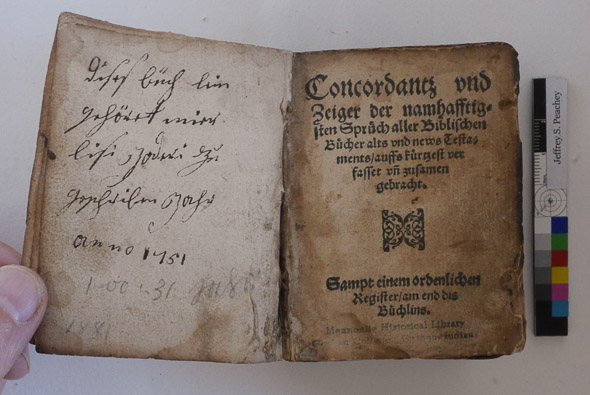
Concordantz, ca. 1550. Inscription and title page. Courtesy Mennonite Historical Library, Goshen, Indiana.
When initially examining this book, the Concordantz, the curator of the Mennonite Historical Library dropped a bombshell on me. He informed me that the inscription on the left in the above image, is from my sixth great-grandmother, written in 1751. “Wow, this is pretty cool!” was the most coherent professional thought I could express at the time. I wouldn’t have been able to decipher this inscription.
The inscription reads, “This little book belongs to me Lisi Joder, written in the year Anno 1751.” It is also signed by my fifth great-grandmother in 1787. In 1811, the book went to an older sister of my fourth great-grandmother, thus breaking the direct connection to me. It entered into the Mennonite Historical Library in the 1940’s. I promised the curator not to repatriate it to my family!
I intend to write a longer account of my treatment, the importance of books, and my relationship to this treatment, after some more reflection.
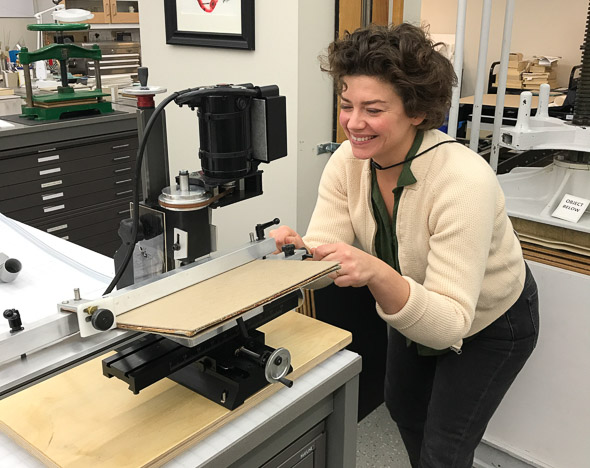
Jennifer Jarvis, Conservator in the John Hopkins Department of Conservation and Preservation, demonstrates how fun book conservation is using the Peachey Board Slotting Machine.
John Hopkins Department of Conservation and Preservation recently acquired a Peachey Board Slotting Machine as another technique in their book conservation arsenal to reattach detached boards. Detached boards are likely the most common place books fail. This machine accurately cuts a very small slot, as thin as .015″, to allow a hinge to be inserted without disturbing the covering material or obscuring evidence of lacing, board attachment, etc…. The machine is manually operated, and can accommodate boards up to a 18″ high. The start and stop of the slot is controlled by setting adjustable stops.
No matter which side of the fence you are on regarding the use of leather in book conservation, board slotting with a cotton or linen hinge is a strong and durable base. The fabric can be left alone or colored with acrylics for fast repairs. Or board slotting can be combined with other treatments — such as tissue repairs, cast acrylic repairs, and leather onlays — to achieve a high degree of aesthetic integration. Board slotting is especially suited to nineteenth century leather bindings with a made hollow. More information on different structures for board slotting.
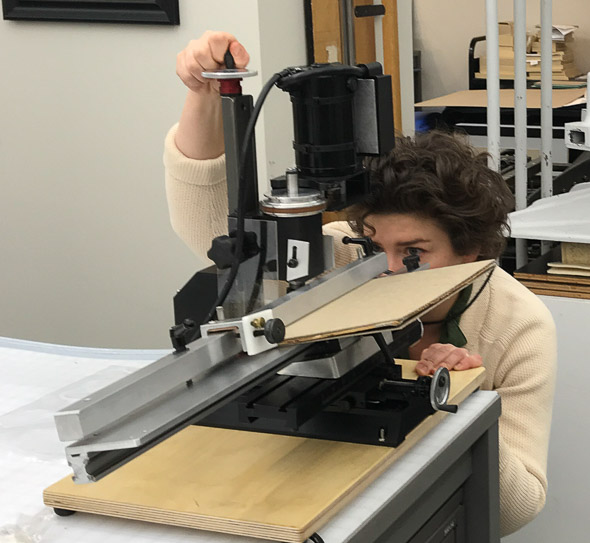
Jennifer Jarvis aligning the height of the blade where it will begin making the slot. This is much easier on the new machine, since you can sight the length of the board from the end of the machine.
Traditionally, leather paring knives either have round or straight cutting edges. I discuss the advantages and disadvantages of each in this post. I usually use an English style straight blade, but became tired of the fact it could only be used for edge paring. Partially inspired by the rounded corners of a spokeshave blade, I made a couple of other modifications to a standard M2 English style knife so that it can be used for more than edge paring.
A slightly curved cutting edge on essentially an English style knife allows it to scoop out leather, necessary for the spine area, headcaps, and decorative work. The blade is oriented at a 45 degree angle, like an English knife, so right and left handers need to purchase different knives. The corners of the knife are rounded so that the tip or heal will not cut through the skin while performing this scooping action. The tiny secondary bevel allows quick resharpening.
This knife can be used for all types of paring necessary in bookbinding: edge paring, reducing spine and caps, paring deep into a skin (similar to a spokeshave’s action) and even for overall scraping, if you are into that.
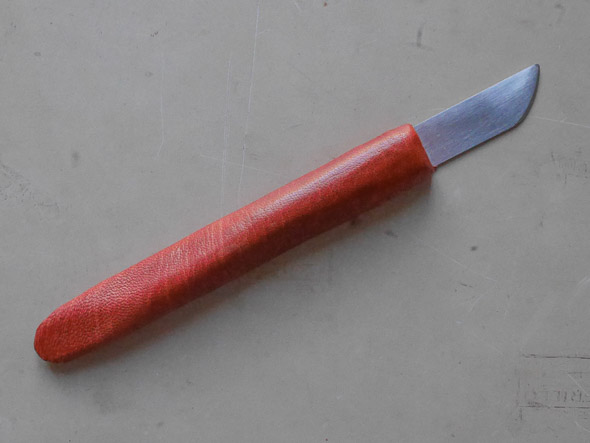
M2 Hybrid Knife. Around 8 – 9 inches long, and 1 inch wide. Since the grind marks on the primary bevel go along the length of the blade, the primary bevel is not apparent when looking at the top of the knife. The exact curve of the cutting edge varies a bit from knife to knife.
A lower angle primary bevel cuts down on the amount of time it takes to resharpen the blade, since there is less metal to remove. The 13 degree cutting edge is only a millimeter or two. The disadvantage is that there is not a large enough bevel that you can feel when you put your knife on the sharpening substrate; you have to trust your hands and the angle you are holding it at. This is quite similar to sharpening a kitchen knife by hand. Another advantage of the small secondary bevel is that it can be stropped back into shape very quickly, again because not much metal has to be removed. This is a perfect blade for sub-micron stropping. M2 steel seems easier to strop than A2, for some reason.
Cross section of primary and secondary bevels.
The slightly curved blade creates more opportunity to find a sharp area as the knife dulls, so it can be used longer. Straight blades, as they become dull, don’t seem to bite the leather enough to get started with a cut. The disadvantage is you can’t just rub it back and forth like a standard straight edged knife when resharpening. Stropping takes a slight twist of the wrist, to keep parts of the cutting edge in contact with the strop throughout the stroke.
The rounded areas allow you to work into a skin, for headcaps and the spine. But the shape also allows you to use it like a standard English style knife for edge paring.
The third change is that the tip and heel of the cutting edge are rounded. This prevents the knife from cutting through the skin when you are working away from the edge, similar to how a spokeshave blade works. In practice, I don’t miss having a pointed, sharp tip. A rounded tip also makes it less likely to dig into your paring surface.
The M2 Hybrid used like a standard English knife for edge paring.
All of these aspects combine to make a sensitive and versatile knife intended for professionals. An analogy for cyclists might be this is more like a track bike than a road bike. This knife, in addition to edge paring, can do most of what a spokeshave can do, albeit with more “workmanship of risk”. If you want the most versatile knife on the market, look no further.
Close up of a piece of goatskin feather pared,, so that the valleys of the grain are cut through. The middle of the blade was used for this, almost parallel to the edge of the leather..Progressively paring towards the center. The rounded edges keep the blade from cutting through the leather as it stretches.
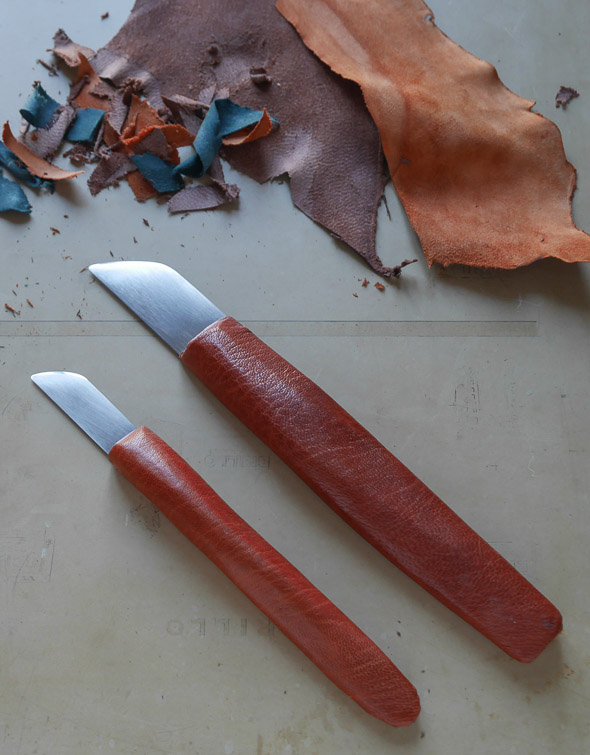
M2 Hybrid Paring knife. M2 Steel. The handle is hand carved wood, covered with vegetable tanned goatskin, and ergonomically shaped. The metal is .040″ thick, the handle around 5/8″ at the thickest point. It is about 1 inch wide and around 8-9″ in overall length. The secondary bevel is 13 degrees. Hand sharpened to .1 micron.
Small M2 Hybrid knife. The best knife for onlays and intricate leather decorations. Also great for paring paper. M2 Steel. The metal is .025″ thick, about 5/8″ wide and 6-7″ long. Leather covered wood handle. The secondary bevel is 13 degrees. Hand sharpened to .1 micron.
The Small M2 Hybrid Paring Knife. $150.00. Order here.
Small M2 Hybrid knife bottom left, regular size next to it.





 Peachey Conservation