A Hollow Question

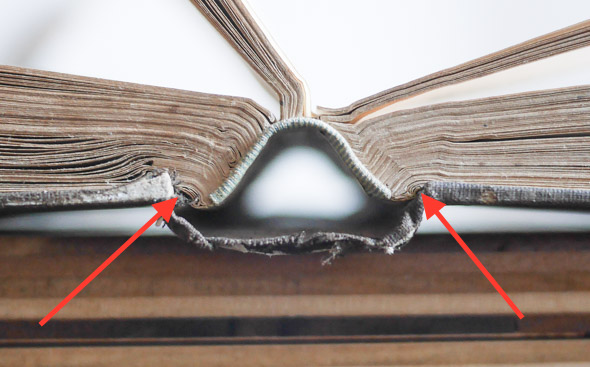
Adding a hollow (aka. Oxford hollow, tube) is often used to repair books that originally had a hollow, which makes sense. What makes less sense is using it on books that originally had a natural hollow, like case bindings. It adds at least three layers of paper, and only adds the strength of one thickness of paper. Admittedly, a strong sheet of handmade paper can be incredibly strong. Adding a hollow can dramatically change the opening, sometimes in unexpected ways. Often other hinging options with airplane cotton, linen or stout tissue are preferable. Adding a hollow is best suited to a quick and fast repair of circulating collections, or on relatively recent bindings with strong covering cloth. There are times when it should not be used.
hollow2
The movement of the spine would not be significantly changed by the addition of a hollow, since the textblock hinges from the tip of the shoulder. Remember that he significant stiffing caused by the adhesive and paper of the hollow is not addressed here, it also changes the movement, and can be damaging to a fragile covering material or spine linings..


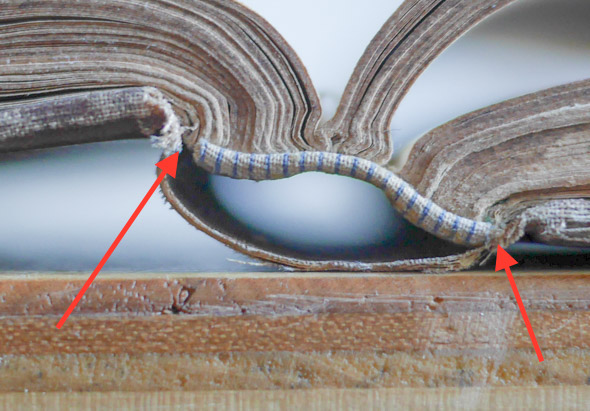
hollow2
The movement of the spine would be significantly changed by the addition of a hollow, since the textblock hinges from the base of the shoulder. The changes in movement can cause severe stresses to the covering material and spine lining, possibly resulting in creasing, tearing or even failure. Remember that the stiffing resulting from the hollow can also cause damage by significantly changing the movement. Because of the interaction of the case, spine linings and hinging points, cloth case bindings are sometimes more complex to successfully conserve than leather bindings.


***

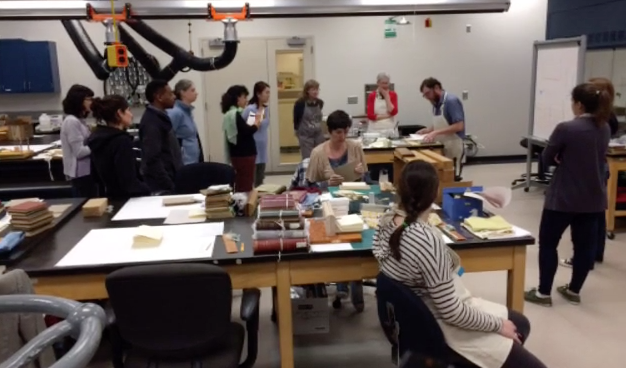
This was one of the complexities we investigated in the recent workshop I taught at the Georgia Archives in Atlanta October 24-28, “Cloth Case Bindings: Their History and Repair.”
screen-shot-2016-11-01-at-5-46-36-pm
Georgia Archives Conservation Lab. Photo Kim Norman.

Click on the links to see a slide show of images from each day. Images courtesy Kim Norman, Preservation Manager and Conservator, Georgia Archives. Thanks for hosting, Kim!

Day 1: https://quik.gopro.com/v/PNwC9SDNeW/

Day 2: https://quik.gopro.com/v/5v0ARgYFEo/

Day 3: https://quik.gopro.com/v/0Akz24qveU/

Day 4: https://quik.gopro.com/v/1EWV9WiqcD/

Day 5: https://quik.gopro.com/v/hPB5y1FonH/

There is talk of scheduling a complementary workshop in October 2017 at the same venue, dealing with rebacking, board attachment and repair of 19th century leather bindings. This would include leather paring with English and French knives, spokeshaves and the Scharffix paring machine, as well as methods of consolidating and dying leather. Check this blog for more info as it becomes available.

Craft Knowledge

“Artisanal ways of knowing, in contrast, are revealed in objects, not books, and so have largely escaped the historian’s scrutiny. This kind of knowledge was transmitted through practice, a combination of talking about and showing techniques that were learned by observation and imitation.”

James Richard Farr, “The Disappearance of the Traditional Artisan”, in A Companion to Nineteenth Century Europe, 1789-1914. ed. Sefan Berger (Malden, Mass: Blackwell Pub., 2006), 100.

The Right to Repair

photo-41
Fire hydrant on the corner of Broadway and Nagle Avenue, New York CIty.

As a conservator, broadly speaking, I “repair” old books. I’ve always been interested in old things and being a conservator is a great way to spend a lot of time with them. It is an essential need, I think, for humans to have a tangible, material link to the past. History is sometimes defined as anything that happened before you were born.

The fire hydrant in the above photo has a patent date of “2-05-02”. Some might read this as another sign of New York City’s aging infrastructure, but I’m impressed it is still functioning after around 100 years. At least I hope it is still functioning.

I’ll never forget tearing apart a 1973 VW bug engine in high school, rebuilding it, reassembling it — and amazingly! —  it worked. Many objects can’t be fixed now, however.  Our throw-away culture, the cheapness of manufacturing of new parts, and patent law are all reasons.

The newish looking nut on top of the fire hydrant fits a special wrench that firemen have, to keep kids from opening them up and playing in the spray during hot summer days.  This special wrench is analogous to security screws many companies now use to keep the average consumer from doing any repair on their phones. Or to lock down the software that controls mechanisms.

General Motors and John Deere are arguing that you don’t own the software in your car. And without access to the software, there is no way you can fix anything automotive. In the coming internet of things this issue will only grow larger. Do you want to own something you are not “allowed” to fix, hack, repair, alter, improve, or conserve?

Thats why groups such as Right to Repair  and The Electronic Frontier Foundation are important.  They advocate on a wide range of issues concerning security, surveillance, tinkering and repair. More info.

There is pending legislation concerning the Digital Millennium Copyright Act, and anyone can comment online until October 27, or in writing until November 16.  1201 Study: Request for Additional Comments. Check it out, it is a complex, important issue that I need to do more research on it.