The End of Rolling. Sort of.

My 2013 essay, “Beating, Rolling, and Pressing: The Compression of Book Signatures Before Sewing” in Suave Mechanicals, Vol. 1, ended with many questions concerning when bookbinders generally stopped using the rolling machine. Endings are much messier and imprecise than beginnings. We know that the rolling machine was introduced to the trade in 1827. But when did binders stop using it? Many tools and machines in bookbinding are used for centuries.

rolling
Rolling Machine from Joseph W. Zahnsdorf, The Art of Bookbinding, 6th ed., London: George Bell and Sons, 1903. (11) My Collection. Bonus question: what is missing in this illustration?

We know that the use of the rolling machine gradually declined at some point during the nineteenth century. Yet It is still referenced in several 20th century bookbinding manuals, including Zaehnsdorf’s 1903 edition of Bookbinding. Zaehnsdorf had a deeply personal connection to the machine: his father’s right hand got trapped  between the rollers, and even after many months in the hospital, he never regained complete use of it. It had an impact on him, so to speak.

A couple of weeks ago, while looking through the Richard M. Hoe and Company records, 1824-1953 (MS#0599) at Columbia University’s Rare Book and Manuscript Library, I read a fascinating typescript, written by Steven D. Tucker, who began working for Hoe in 1834 as an apprentice mechanic. It is filled with recollections of mechanical details of machines, the evolution of the factory, and the types of machines they were making.

In particular, he writes that in 1856,  “There was also brought out (sic) a Book rolling or pressing machine, but few of these were ever built, bookbinders seeming to prefer the large embossing press for that purpose.” (43)  To me at least, this seems a good indication of the transition time. Hoe thought the rolling press was still in demand, at least enough to  warrant the development and manufacture of one, but he was slightly behind the curve, as many binders moved on to using an embossing press to compress signatures before sewing, ending the era of rolling and beginning the era of smashing.

R.I.P. the Rolling Press, 1827-1856 ish.


A Box for Oversize Books

box1
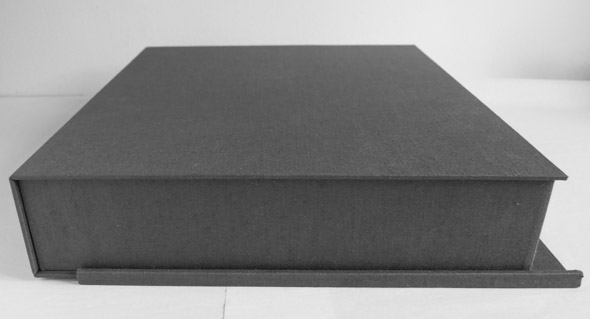
A drop-spine box for heavy and oversize books. The cut out areas on each side of the inner tray allow both hands to lift the book out.

For large, heavy books there are a couple of ways to beef up a regular drop-spine box.

Like most people, I usually make them with double walls.

I also make a modified inner tray, so that both hands can lift the book when removing it. The book this is for is around 19 x 15 inches, and quite heavy.

For even larger books, a lift off lid is a good idea, so the box doesn’t take up so much table space when open.

Since this book will be stored flat, on a metal shelf, and the client intends to read it once a week, there is a a slide off bottom piece to wear out.  Even a durable cloth, like this canapetta, can wear quite quickly when slid on and off the shelf, there is an example here. It is adhered by friction, and when it wears through the client can mail it back for a new one, much cheaper than a new box.

box2
The partially removed bottom piece. It slides off, but stays in place by hooking over the edge of the head and tail squares.

Review of the Delrin Folder by Benjamin Elbel

I’ve been following the career of Ben Elbel for a while.  Originally his onion skin binding structure caught my eye. It has a cleverly elegant design, and is one of the few genuinely new binding structures I have seen in the past 25 years. I met him in Amsterdam earlier this summer, and he was kind enough to write up a review of my large Delrin folder in his current newsletter, which is well worth subscribing to. 

Screen Shot 2016-08-21 at 4.16.15 PM
Benjamin Elbel

Benjamin (French nationality, 1983) fell in love with bookbinding while studying art in Strasbourg, France. From the beginning his interest has been towards the experimental side of the craft; however, determined to learn the ‘proper’ ways he embarked on a journey that took him to Switzerland (Ascona- Centro del bel libro), Germany (Göttingen- die Buchmanufaktur) and England (London- Shepherds Bookbinders, Book Works). After these years of working in the trade he started his own bindery, Elbel Libro Bookbinding in Amsterdam providing bespoke bookbinding services. Ben is known for his research in bookbinding and over the years has developed a number of innovative book and album structures such as the onion skin binding, which he shares via workshops and printed tutorials.

THE DELRIN FOLDER by Benjamin Elbel

In May, Jeff Peachey gave a workshop in the Netherlands (the workshop was organised by Herre de Vries, Natasha Herman, Wytze Fopma and Restauratoren Nederland, and took place at bindery FopmaWier). Jeff is an American bookbinder, conservator and tool maker, whose work I have long admired so when I heard he was going to be around I jumped on the occasion to invite him to the bindery.

Jeff made me a gift: a special folder that he’d made, called the ‘Delrin’ folder.

Screen Shot 2016-08-21 at 3.52.25 PM

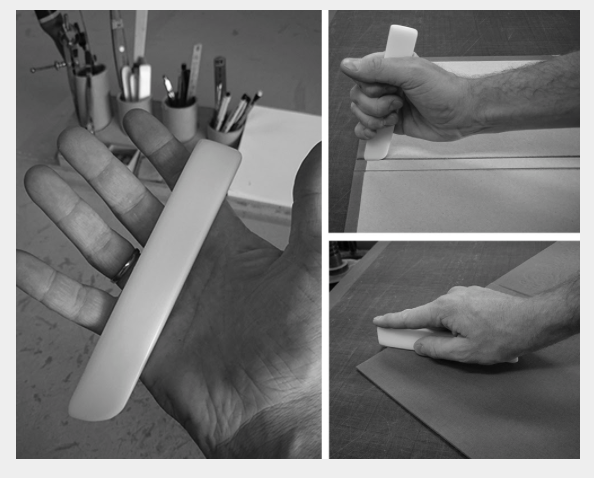
Delrin is a plastic with a very low coefficient of friction, similar to Teflon, which means that it doesn’t leave shiny marks on materials. However, unlike teflon, it is hard.

I wasn’t sure at first, thinking ‘what do I need a new folder for?’ Also, I was suspicious about the low friction qualities. Only after a while did I start trusting it and seeing its qualities:

1. The friction really is very similar to Teflon. I now use it without fear on virtually anything, except perhaps very rough and very dark papers.

2. Its big size is really comfortable for rubbing down. If held like on the picture above, one can really cover large areas very quickly and apply a lot of pressure with less effort than with a small tool.

3. The thin tip is brilliant for rubbing material in grooves without leaving shiny marks and again, the large size means it can be held like a knife and used with maximum pressure.

As one can see on the pictures I have already used it a lot but it shouldn’t be a problem to re-grind it to refine the tip. Thanks a lot, Jeff, for introducing this new tool!

Republished from Elbel Libro Bookbinding, Newsletter, Summer 2016.  Sign up for it here.