Miniature Books and Gargantuan Books

Miniature books are like cheap crack for many bookbinders and collectors. Once you get a taste, you want more. Miniature books are usually defined as being less than three inches in every dimension, though some accept them up to four. For me, the ultimate miniature book — which is quite likely unattainable — would be one that not only looks like its big brother, but also replicates its function.

There are 14 book dealers who specialize in them, there is a tiny book show tour, they are often displayed together, and they are collected by many major institutions. There is a a Miniature Book Society. There are special tools and equipment scaled for miniature books. There are a number of workshops on how to make miniature books. Miniature books easily cross the line into toys or jewelry. They are fun and social, and addicts seem to find catharsis in hanging with their own, admitting their guilty pleasure.

Gargantuan books often stand alone.  Most of us only make one. And swear not to do it again. If you make one, you are not only faced with the expense of materials, difficulty in finding equipment large enough to bind it, but then have to store and exhibit it somewhere. They are proud and boastful; I am the largest, the tallest, heaviest, etc… . Many rare book collections have one special display case for their Audubon, and keep it on more or less permanent exhibition. I’ve never heard of anyone who collects them, or a class devoted to making them.

There isn’t even a standard definition of what a size they should be. So I’ll propose a gargantuan book exceeds 33 inches in any dimension, just slightly larger than the longest side of normal handmade paper.

Many gargantuan books are made with non-traditional materials; some may not have pages, so it is not inappropiate to question if they should be considered books at all. They might be blooks or book shaped objects. Having a sequence of pages, or somehow referencing the idea of a sequence, is a critical difference in my opinion. Of course, it can be argue that any book contains the two basic seeds of a narrative, a before and an after. Eric Kwakkel considers a “real” big book one that is meant to be read, not created as a gimmick. Quality rarely enters the discourse: it’s all about quantity.

Wikipedia and the Guinness World Book of Records offer different accounts of what is the current largest book in the world is; significantly, both are religious texts. Symbolic monuments designed to impress us with their authority and power.

Below are a few gargantuan books I find noteable.


Appearing around 39:12, and again around 1:46:09 is a very well crafted book. It appears to be tooled in gold and blind, with deep type impressions and indentations around the bands on the (leather?) spine. Even the decorative paper sides realistically match the scale of the book. Sensitivity to the scale of details is where the wow factor comes in, both in mini and big books. Thanks to Tom Conroy for bringing this to my attention. The entire opera is spectacular, BTW.

 

Screen Shot 2016-08-13 at 8.15.18 AM
Photo: Benno Haglleitner. http://bregenzerfestspiele.com/en. Source: http://twistedsifter.com/2011/08/outdoor-opera-on-the-lake-stages-of-bregenz/

Exhibit two is the The Opera on the Lake of Bregenz. Yes, those are lilliputian actors standing on the open book. The 1999-2000 performance of Verdi’s Masked Ball had the entire stage made up of a book, held open by Death. Thanks to John Townsend for this reference.
 

Screen Shot 2016-08-13 at 10.31.39 AM
Source: http://www.lib.washington.edu/specialcollections/about/past-displays/bhutan-the-worlds-biggest-book

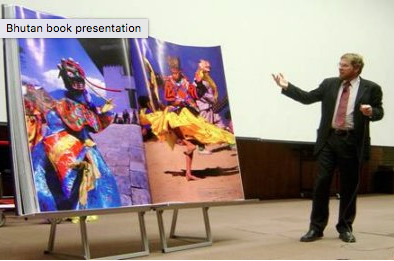
Slightly more prosaic is this edition titled Butan: A Visual Odyssey Across the Himalayan Kingdom, which weighs in at 133 lbs, and open is 7 feet by 5 feet.  There are a few copies for sale on ABE books in the $300- $500 range, which must make it one of the cheapest books per square inch available. I imagine the materials alone would have cost more. There is a very nice write-up about it on the University of Washington’s Special Collections site.


The making of this book was well documented a few years ago.  It took a crane to install it into the exhibition space. A heroic production.

I wrote about a 16 foot high book from 1918 bound in cowhide a couple of years ago, which was used to advertise War Bonds.

Other favorites?
 

Shop Kinks: Rust Removal with Ink Erasers

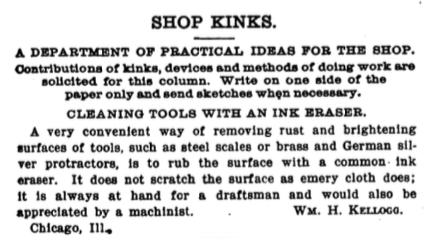
Daniel Mellis send in this useful info concerning surface cleaning rusty tools; which, ahem, some of us may have a small number of.  Originally this idea was published in the column “Shop Kinks” from Machinery in 1907. It’s a wonderfully provocative title — I may have to steal it — a refreshing take on usual “Tips and Trick”. A kink, in this sense, is a new aspect, twist, or take on something.

Daniel makes artist’s books and is currently working on a English translation of Tango with Cows, a Russian Futurist book printed on wallpaper with important early experimental typography.   www.danielmellis.com

Screen Shot 2016-08-06 at 7.21.38 AM
Source: https://books.google.com/books?id=x_RMAQAAMAAJ&pg=PA177&lpg=PA177

He writes:
Recently when trying to clean up a ruler and straight edge, I hit upon the use of ink erasers to remove rust. This is not a new idea, Wm. H. Kellogg from Chicago noted in January of 1907 in Machinery Magazine that:

A very convenient way of removing rust and brightening surfaces of tools, such as steel scales or brass and German silver protractors, is to rub the surface with a common ink eraser. It does not scratch the surface as emery cloth does; it is always at hand for a draftsman and would also be appreciated by a machinist.

Compared with other methods of rust removal, the ink eraser is convenient, especially for small areas, and it does not require any noxious chemicals like naval jelly or even any liquid. As noted by Kellogg it also does brighten surfaces. Caution should be exercised as ink erasers will scratch softer metals like cast iron.

The biggest difficulty is actually locating them. Common enough in the 90s and probably early 00s, they are no longer a standard item in office supply stores. The site www.jetpens.com carries the Tombow Mono Sand Eraser, as well as the Seed Sun Dolphin 3 Electric Eraser for which you can get 60 count ink eraser refills. These are relatively small, the larger size strips for heavy duty electric erasers, #72, were discontinued about 5 years ago. Boxes are still available on ebay, starting at $59, which works out to about $5 per strip. Some of the descriptions state they are for abrasion testing; a specialized industrial use may justify the price. Perhaps small drafting supply houses might have some in a corner somewhere.

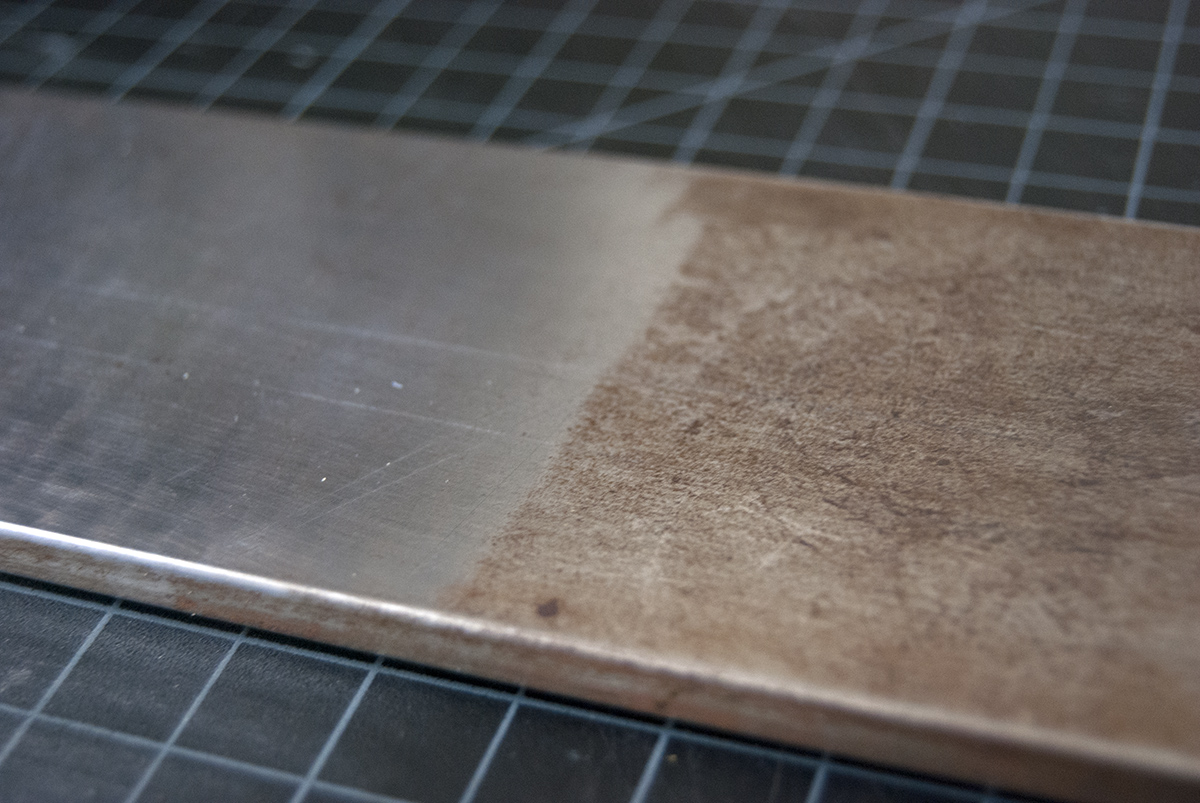
When cleaning a straight edge, I used one of the larger strips; the in process shot shows its effectiveness. The electric erasers can leave a pattern on the surface due to variable reflectiveness, but that is easily removed with a quick polish with something like Mother’s Mag and Aluminum Polish.

Straight Edge cleaning in process
In progress shot of cleaning a rusty steel straight-edge with an electric eraser. Photo: Daniel Mellis

Can Anyone Identify This Binder’s Stamp “REPAIRED BY……”

OLYMPUS DIGITAL CAMERA
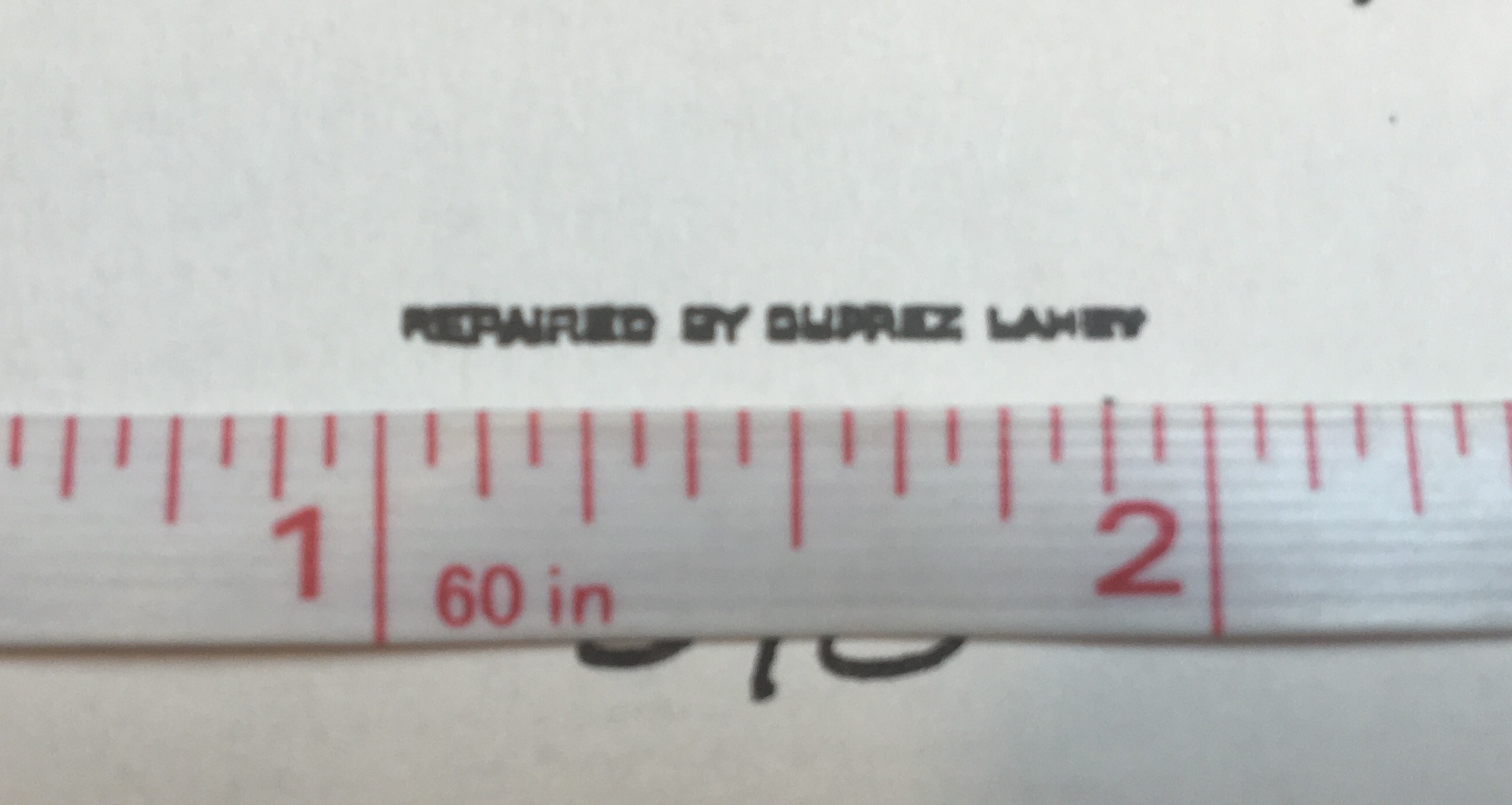
Binder’s Stamp. Private Collection.

This partially effaced stamp is unusual, in that it says repaired by, rather than bound by. But who repaired this book? “REPAIRED BY DE xxxxxxHSY” or maybe “REPAIRED BY DAVID  xxxxHSY”? The letters are .5mm high, and it is positioned in the bottom left corner of the front board pastedown.

retroReveal, which can sometimes aid in legibility of fragmentary marks didn’t help in this case.

Robert Milevski, author of “A Primer on Signed BIndings”, was not familiar with it. He did send a useful overall typology of binders stamps, however:

In research done in Princeton University Library about 15 years ago (before many 19th c books were transferred from the open stacks to offsite storage), my recording methods were necessarily primitive and thumbnail (because I had to get through half a million books rather quickly), lacking in detail, usually, other than a call number, binder’s name, and type of mark. When I went back to these records and books (a couple of years later after their going offsite), I ignored anything not obviously English. Some of the bindings represented by these ignored minimal records probably had some interesting stamped signatures, similar to yours. (A sad thing, however, is that in that interim, some of the books, because of condition, had been rebound, thereby losing their binder’s signature history.)

I did look at my main spreadsheet of English signed bindings (3600 records at present, with more than 1000 yet unrecorded) and found a couple categories of mark other than ‘bound by’ but nothing like your mark. These others include: 1. just the last name of the binder; 2. last name of binder and location; 3. name of binder, address and designation as binder, usually in a two or three-story stamp. Of course, there is 4., the category of ‘bound by x for y’, usually a department store. And 5., ‘bound by x, successor to y.’ And 6., name of binder with a month and year, or more fully, 7., name, address and year. And 8., there is also the rare upside down stamp, usually only the surname, probably from getting the front and rear boards mixed up. That’s all I can say.

Generally, before modern art conservation principals began to be applied to books in the mid-twentieth century, most restorations and repairs attempted to be as invisible as possible.  So why try and point it out by stamping the book? And then why did someone else try to crudely scrape it away?

***

Added 8 August 2016

Below is an image of the stamp Maria Fredericks mentions in the comments.

FullSizeRender