EEK!

Surface cleaning an entire book can evoke a range of emotions, from mind numbingly boring, to mind numbingly repetitive, to mind numbingly tedious. The problem is that you have to remain acutely aware of tiny changes in the paper surface, dirt composition, tears, soiling, stains, etc. to avoid damaging the pages. After hundreds of pages (hours of cleaning) of back and white text, I almost fell over when I suddenly saw colored fur.

mouse3

OLYMPUS DIGITAL CAMERA

Certaine Sermons or Homilies appointed to be read in Churches…. London: Printed by John Bill, 1623. Collection David Kastan. Top: Hair on mouse skin. Bottom: detail of the flesh side. Why did someone put it in this book?

In section 3, on page 123, I found the remains of a very cute mouse.  When I inspected it, it appeared tanned with the hair on, the tail and legs removed.  Even more oddly, it was not causing any staining or damage, so I left it in place. The homilie where the mouse was found is titled “Concerning Prayer”, and for the curious, there are no textual rodent references on the adjacent pages. It is difficult to believe that this was an accident, and there were half a dozen other more usual items put into this book: leaves, ferns, seeds, scraps paper with notes.  It is tempting to concoct a story why the mouse was put there: possibly as an alert from a teacher to see if the student was actually reading these dry sermons?  A wake up call? A reminder of the inevitability of death for living things, as compared to the longevity of the written word?
Hymen Lipman and the Winterthur Museum and Library

During the month of February 2014 I will be continuing research into early nineteenth century bookbinding while on a Fellowship at the Winterthur Museum and Library.  Conservation and tool business will be on hold until March 3, 2014, but feel free to email me. Apologies for any inconvenience.

The Winterthur has one of the premiere collections of decorative arts in America, and one of the premiere book conservation programs, Winterthur/ University of Delaware Program in Art Conservation. The librarians seem to have a good sense of humor. Below is a excerpt from a blog post about their collection of trade cards, which mentions Hymen L. Lipman, who was a stationary bookbinder in Philadelphia:

“Hymen Lipman, born in Jamaica to English parents, immigrated to Philadelphia in 1829. Eleven years later he succeeded Samuel Stewart as the city’s leading stationer remaining at the 139 Chestnut Street address until 1849. His real claim to fame may be either as the first person to patent the revolutionary invention of a pencil with an attached eraser in 1858 or as having one of the five funniest names in history as posted in a YouTube video  http://www.youtube.com/watch?v=r8c9mRklqQM.”

In The Pencil: A History of Design and Circumstance, Henry Petroski notes Lipman did indeed patent a pencil with an attached eraser, though after some litigation with Eberhard Faber in the 1860’s, a judge declared both patents invalid. Petroski’s book is very readable, encyclopedic and highly recommended.

Don’t miss the image of Hymen Lipman’s trade card on the Winterthur blog.

Two Reprinted Catalogs

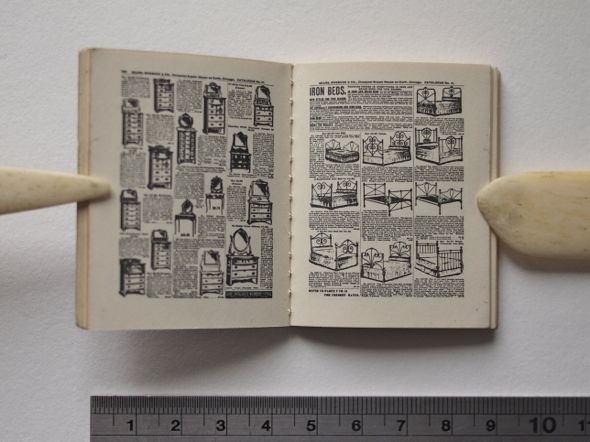
Mini Sears

A mini facsimile (ca. 1970-80) Sears and Roebuck catalog. Orig. 1902.

I’m not sure when, where, or why, but I acquired this mini Sears and Roebuck catalog when I was a kid. I do remember reading it with a magnifying lens, and I kept it in a stash of prized possessions.  I think the childish thrill of wishing I could go back and time and buy a dozen of one thing or another then bring them back to sell at todays prices was part of its appeal. The lure of a wood burning porcelain clad kitchen stove for $14.95 is strong. Since this catalog had images and prices of real things, it somehow seemed to me more of a time-travel-portal to the past than story books, which were fiction. Maybe something about it being in miniature intensified the secretive nature of this little time travel machine?

***

Today, the appeal of older catalogues, though perhaps less for prices than for other types of information.  And I have to confess that most of the time it still doesn’t matter all that much if it is a reprint or original. For example, the 2014 annual reprint from the Mid-West Tool Collectors Association, which is free (and ONLY available with membership, just $25 per year) is Otto Bergmann’s Woodworking Tool Catalog from Berlin, 1928-29.  This is a beautiful facsimile: cleanly laid out, well printed, the cover design even incorporating small details such as three staples from the original, both on the front and back.

bergmann catalog

Facsimile Otto Bergmann’s Woodworking Tool Catalog from Berlin, 1928-29.

At first I thought it would be useful to have a german words for a number of tools familiar to bookbinders (winkel, schabhobel, ziehklingen, spitzzirkel, bogenzirkel, leimtopfe, etc…) but soon I recognized a familiar friend: a hilfskantenzwinge, as it is called in the image below, or single screw edge clamp. I bought one very similar to this last year—since it seemed incredibly useful for something—I just wasn’t sure what. Mystery solved.

Bergmann catalog

Facsimile Otto Bergmann’s Woodworking Tool Catalog from Berlin, 1928-29. Detail page 13.