Bone Folders: Our Nearest and Dearest Friend

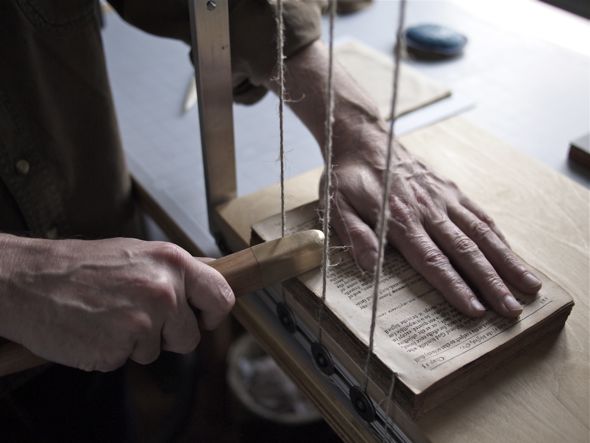
John Farleigh, in a chapter about Sidney Cockerell from his book The Creative Craftsman, gives a particularly observant account of the relationship between a book binder and a bone folder.

“Another man is at work putting down a leather joint on the inside of a bound book, using a folder with quick, skillful movements reminiscent of the grooming of a horse.  The folder, a small ivory instrument that has to the ordinary eye the appearance of a paper-knife, is in fact a most important tool to the binder. Its shape is fashioned with great care and according to the habits of the craftsman himself. Every facet of its surface, every curve and subtlety of its edge, is known and used for a purpose, and no craftsman will readily part with this tool. This particular craftsman tells us, as he would talk of the loss of his nearest and dearest friend, that he has just broken his folder—an extra thick piece of vellum needing rather more pressure than usual found a weakness in the ivory—and we are shown the sad remains”

The finest bone folders on earth are being made today by Jim Croft, pictured below.  He processes wild deer and elk bones with his teeth and hands.  He also offers intensive workshops on making books from raw materials: toolmaking, processing fiber, papermaking, and wooden board binding with clasps. Below he is wearing his signature bone folder vest.  Check out his website, traditionalhand.com, or email him to purchase raw or finished folders: traditionalhand AT gmail.com

croft

***

John Farleigh  The Creative Craftsman (London: G Bell and Sons, 1950) 92.
Profitable Hobbies: A Short Course In Bookbinding

profitable hobbies

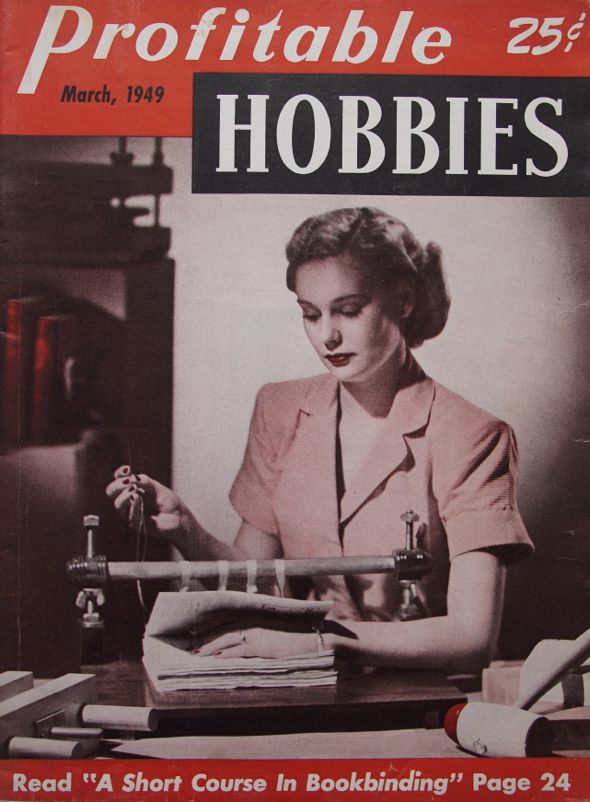
Profitable Hobbies, March 1949, My Collection

Manly Banister’s “A Short Course in Book Binding” barely presents the rudiments of bookbinding, but it is well worth the price of admission for Banister’s entertaining hubris and the highly stylized cover imagery. The woman sewing seems to have an expression somewhere between extreme self consciousness—”how do you want me to hold the needle?”— and a seething annoyance at having to pose yet again. It also appears she is sewing a newspaper? The black and white cover with red is almost noirish in its use of shadows. Despite Banister’s minimal knowledge of the field, his diagrams of DIY equipment, the sewing frame, press and plough above, may be of use to some. But like many introductory bookbinding manuals, it is not so much the information they contain that is important, but the sense of the audience for the craft that I find of interest. Binders might question how profitable bookbinding as a hobby might be, yet according to Banister bookbinding is pure profit! His recollection about how he began bookbinding is a gem:

“I got started on bookbinding when I was confined to bed for a week with a touch of the flu. There was a forty-year old book on book on bookbinding lying around which I read for the lack of anything better. I had not read far when my fingers began to itch for the feel of needle and thread. Of course, I had no tools to work with, but I went ahead anyway, propped up on pillows. I had two boards brought to me and some cord, and their combination served as my press. My wife’s  old Bible was rapidly going to pieces, so I finished the process. The job was absorbing. I sewed the book and glued it and cut up an old leather jacket to cover it.”

“Bookbinding is easy. Anyone can bind a book—you and you and you! You just set your mind to it, and that’s all. If you can thread a needle, cut and fold paper, you can bind a book.”

The power of positive thinking aside, this issue of Profitable Hobbies does contain an important description of the Flash Dry method of printing, which was used by R.R. Donnelley & Sons for printing this very magazine, as well as Time, Life, Fortune, Farm Journal and Pathfinder. It supposedly is responsible for the “fine halftone work.”

Some Christmas Gift Ideas for Bookbinders

Loaded stick OLYMPUS DIGITAL CAMERA

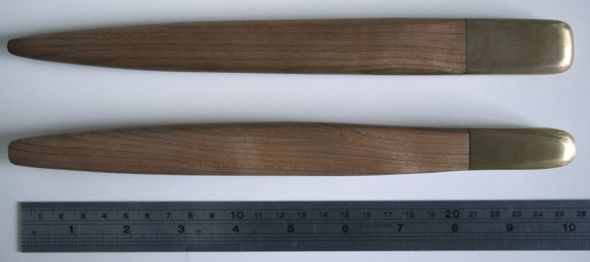
A loaded stick (aka knocking down stick) is great for firmly compressing signatures while sewing. A gentle tapping can accomplish this task much more effectively than leveraged pressure.  This stick has a comfortable waxed cherry handle and a brass head.  The head is screwed into the handle and gently rounded on the edges to avoid damaging the leaves. This tool has a wonderful balance. The head is 2 inches (5cm) long, 1 inch (2.5 cm) wide, and .75 inch (1.75 cm) thick.  It is generally used on the wide portion, though the narrow area can be used if the supports are closely spaced, or there are specific areas that need more compression. Overall length 10 inches (25 cm), and overall weight is approximately 8 ounces (230 g). This is a safe christmas gift for any bookbinder, since this is the first public announcement of my version of these, and I’ve only given one to a friend.  $125.00

*

Geartie

Gearties are essentially a twist tie on steroids, and are available is a variety of lengths. The one pictured above is 32 inches long.  They consist of an unhardened (steel?) core and some type of rubber (silicone?) exterior that is waterproof.  I’ve used them for numerous purposes in and out of the studio: to hold a flashlight, support a book board, keep a frozen duck breast underwater for a quick thaw. The possibilities are endless. Gearties are on sale everywhere, and are made by Niteize. Various prices for different sizes.

*

Sugru

A self setting, air hardening rubberized clay like material called sugru is great for pimping out your favorite knives as well as other (non-book) repair necessities.  I made some more comfortable finger rests for my favorite utility knife,  the Olfa Model 300. Again, it seems to be some kind of silicone, the ingredients list Methyltris (methyl-thylketoxime) silane, Gamma-Aminopropyl Triethoxysilane. Available from Sugru. Various prices for different sized packets.

*

Wren Haven Sharpening Card

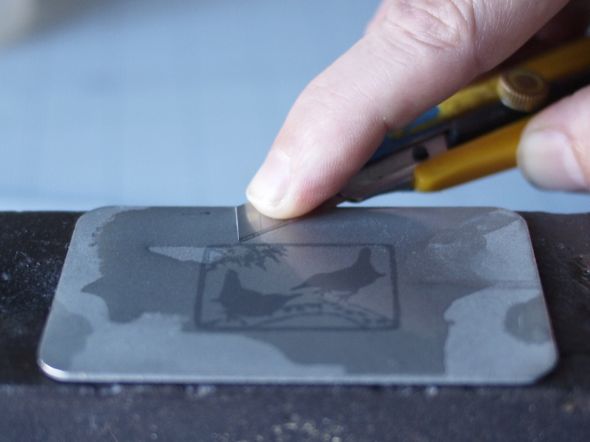
This .25 micron diamond sharpening card from Wren Haven Tools is perfect for keeping small blades sharp. Only $12.00.