Tools for Reading

“Tools that once were the common stuff of everyday life are tools of a different sort to us.  They no longer are the implements we use routinely to sustain ourselves; instead, they are tools we can use to understand the past.”

Gaynor, James M. And Nancy L. Hagedorn. Tools: Working Wood in Eighteenth-Century America (Williamsburg, Virginia: Colonial Williamsburg, 1993) xii.

I often think of this quote when I am looking at old tools for sale.  It is hard to shake the idea that a tool should be restored to the point it can be used or functions, and a common practice among dealers is to restore a tool to the (imaginary) point it left a craftsman’s hand.

But books are tools. A fairly broad definition of a tool: a device held in the hand to perform a specific task. Which sense of a tool that Gaynor mentions are books?

Questions quickly arise about the reasons for fixing a book. Is it necessary to return function—the original use—to a book if it no longer needs to function in the way it once did? If a book is restored to some point in its history, is its use for understanding the past compromised? How much of its history is erased? How does the physical movement or tactile function of book help us understand the past, if it is no longer used as a tool for reading? Too many questions, but maybe this is a fundamental difference between conservation and restoration: conservation asks a question about an object, restoration gives an answer.

Amish Punk Books

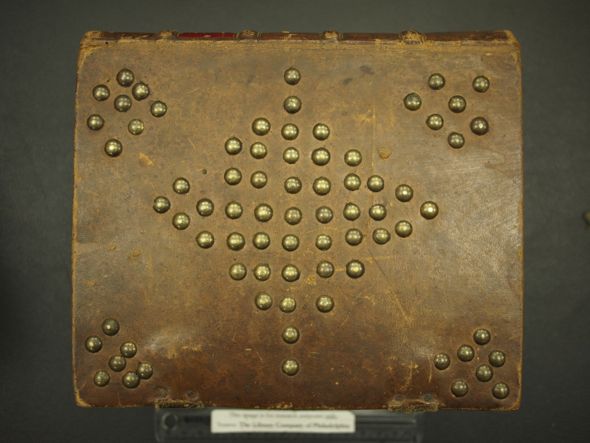
amish punk OLYMPUS DIGITAL CAMERA

Both images courtesy The Library Company of Philadelphia

Eighteenth and early nineteenth century Pennsylvania German Wood Board Bindings often resemble Gothic bindings. They often have thick wooden boards, bosses, center pieces, corner pieces, and clasps.  These bindings also share design elements with other Amish and Mennonite folk art traditions, including Fractur, needlework, carving, etc….  The books pictured above, however, with their studded spine straps and covers, look more like a punk rock wristband or studded motorcycle jacket.  Although Amish and punk culture may be at opposite ends of the spectrum, both embrace a locus of identity outside of mainstream culture and use their distinctive clothing styles to visually represent this.

Screen Shot 2013-11-10 at 4.43.23 PM

Lifting Knives…Not Just For Lifting

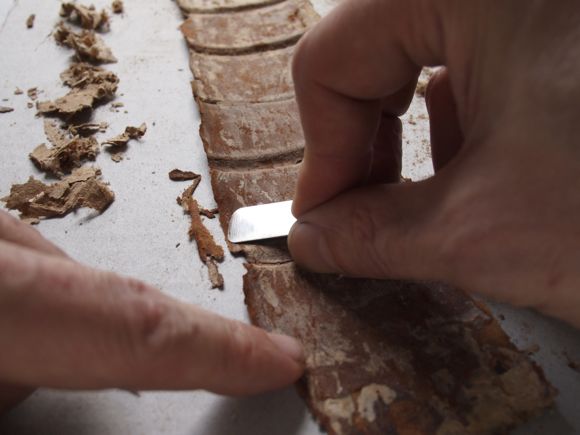
Paring the spine with a lifting knife

Although the small and large set of lifting knives that I make and sell are intended primarily for lifting, I find the smaller knife also useful for paring the edges of a spine that has been removed. The edges need to be pared to achieve a smooth join when it is replaced.

Some binders use a Dremel or Foredom tool, and Jim Reid-Cunningham demonstrated this at the Guild of Book Workers 2013 Standards Conference in Washington DC last week. He used a conically shaped coarse grinding stone. Some binders use a scalpel for this, though I haven’t found a blade shape that is easy for me to use.

I generally use a small lifting knife which gives me a lot of control, especially when paring a spine with raised bands intact. Notice that I am working with the knife bevel down. This raises the angle I hold the knife at considerably so that I do not have to flatten out the spine. It also allows me to quickly adjust the angle of the knife to match the curve of the leather of the bands.

Whichever method you use, likely the most important aspect is to lift the spine as smoothly, cleanly and evenly as possible in the first place.