The Antiques Garage Flea Market

If you think everything in Manhattan is overpriced, overhyped, trendy, useless, distracting and a disgusting display of conspicuous consumption, you are partially correct. However, there are three great flea markets in Manhattan that I regularly visit.  The Antiques Garage, West 25th Street Market, and the Hells Kitchen Flea Market are open all year on weekends, 9:00 to 5:00. Last weekends haul—

die

13 pound die. Flea Market price: $10 

First, a 13 pound die that was originally used to stamp medallions or belt buckles for the 1991 Daytona Bike Week.  This is a great heavy weight, a nice compliment to the smaller dies I use for paper repair. All of these are hand carved out of steel and the vendor thought it was something in the “D” series. Drawback: I had to carry it home, a 3 mile walk. Bonus: If my conservation work dries up, I could do a second stamping of these (possibly) collectible belt buckles.
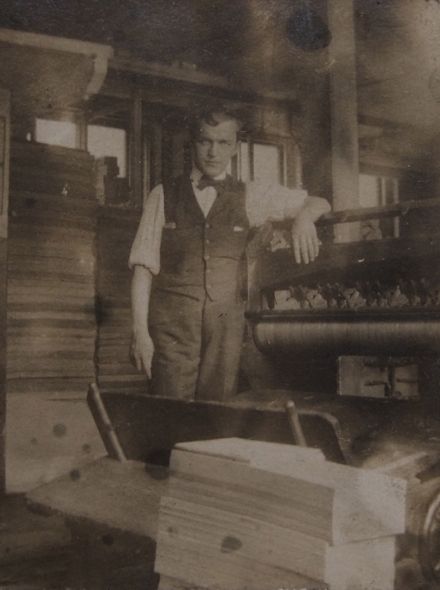
worker

19th century photograph of a worker, but in what trade? Flea market price: $4

I also picked up this photograph.  Some type of conveyer belt and height adjustment?  Is it a stack a papers or thin wood in the foreground? Plywood manufacture?
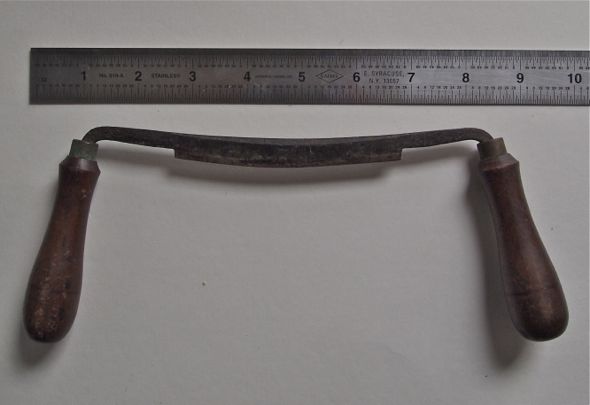
drawknife

A Charles Buck 4″ mini drawknife. Flea market price: $20

This will be perfect for shaping tool handles.  Given its rust, I relunctly plunked down $20 because this knife will take two or three hours of work to get it into useable condition.  However, after a little research at home, I found pristine collector example selling for $130. The Davistown Museum indicates while Charles Buck was part of the Buck Brothers, who still make edge tools today. Charles had a falling out with the other brothers and also made tools under his own name. Reportedly, his were of better quality than the others. Apparently tools marked with his name were made between 1872 and 1915.

Flea markets—another reason to come visit NYC.

Accidental Book Art

needle

A Millennium of the Book, Edited by Robin Myers & Michael Harris, contains seven important essays on book history.  Likely the best known to book conservators is Nicholas Pickwoad’s  “Onward and downward: how binders coped with the printing press before 1800”.

Standing upright in the middle of a section of my copy of this book is a manufacturing error— a broken sewing needle.  I can feel it’s impression on about 30 leaves before and after it.

A material manifestation of Pickwoard’s argument in the 20th century? Accidental book art?

The Movement of a Well Bound Book

Walter Thomas Rogers.  A Manual of Bibliography. London: H. Grevel & Co., 1891 ( p. 95)

Although a nineteenth century fine binding should operate as Rogers describes, many earlier books were rebound at the time and forced into this style of binding; not a good thing for a parchment manuscript, for example. However, this ideal in binding is quite difficult (impossible?) to achieve, since the binder generally does not have control over important variables such as leaf size, drape, thickness, and number in each signature.

In fact, I’m not sure if I’ve ever experienced a “good” binding such as this. While the technical aspects of craft were high, the quality of materials was generally low. Possibly one of the most interesting aspects in making historical models is an attempt to understand and recreate book movement from various time periods. This is somewhat speculative since many of the details of craft techniques are unknown, and modern materials differ substantially from historic ones. Materials also change over time:  “Binding materials stiffen with age; Binding materials weaken with age; Binding materials are weakened by use; Binding materials are made more supple by use.” Tom Conroy’s, The Movement of the Book Spine (Book and Paper Group Annual, Vol. 6, 1987) is required reading for anyone interested in this topic.

Movement in and of itself is not the most important aspect of a book, but it is critical to understand so that a book can be safely handled, used and displayed. There is also fascinating research on the relation of haptics, memory, and learning. Much of a book conservator’s work is concerned with increasing and preserving— sometimes incrementally— a book’s movement.