William Dunton. Occupation Therapy: A Manual for Nurses (Philadelphia and London: W.B. Saunders and Co., 1918), 156.

Book Conservation
William Dunton. Occupation Therapy: A Manual for Nurses (Philadelphia and London: W.B. Saunders and Co., 1918), 156.

 The cutting edge of this knife is slightly wider than the narrow Swiss and French knife that I currently make, but the length of the blade is wedge shaped so the area that is gripped is still comfortably narrow. Also, it has a secondary bevel, which accounts for the strange looking, extremely acute 8 degree primary bevel. The advantage of a secondary bevel is that there is much less metal to remove when resharpening or stropping. This is especially the case with a thick and wide knife like this. The primary bevel is fairly roughly ground: only half a millimeter of the secondary bevel, which is the cutting edge, is fully sharpened and polished. In a normal knife of this thickness, the length of the bevel would be about ten times this amount. Although I don’t think the time spent sharpening the bevel corresponds one to one, it does take significantly less time.
 The drawback of a secondary bevel is that there is not really enough metal to feel it resting on your sharpening system, so this knife is recommended to those that have some experience in sharpening. This wide cutting edge is useful for hogging off leather for edge paring and also used in a scraping manner for headcap and spine areas. The slight wedge shape on the leather handled knife, and the rounded thumb holds on the wood version provide excellent control.
A2 cryogenically quenched steel, HRC 62. Length: 6.75 inches (171mm). Width: 1.875 inches (48mm) at cutting edge, tapering to 1.375 inches (35 mm). Thickness: .094 inches (2.4mm). Weight: about 5 oz (142 g). Primary Bevel: 8 degrees. Secondary Bevel 13 degrees.
ITEM# WRKL: Leather Handle $125.00
ITEM# WRKW: Wood Handle $225.00
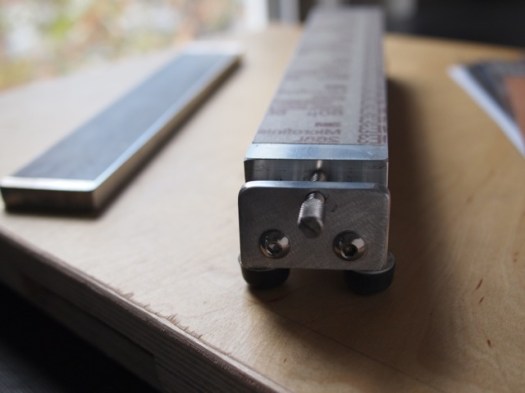
 I’ve made three significant improvements to the aluminum plate sharpening system. First, the plates themselves are now a half of an inch thick, rather than a quarter. This aids in their stability if used without the holder. Secondly, the plates are now machined with a flycutter, which results in a flat surface and regular pattern. Thirdly, the plate holder has been redesigned. Now, a knurled adjustment knob allows quick and easy flipping and switching of the plates without tools. It now only takes 3 seconds, even if you work slow. The stand is all aluminum with stainless steel screws so there is nothing to rust.
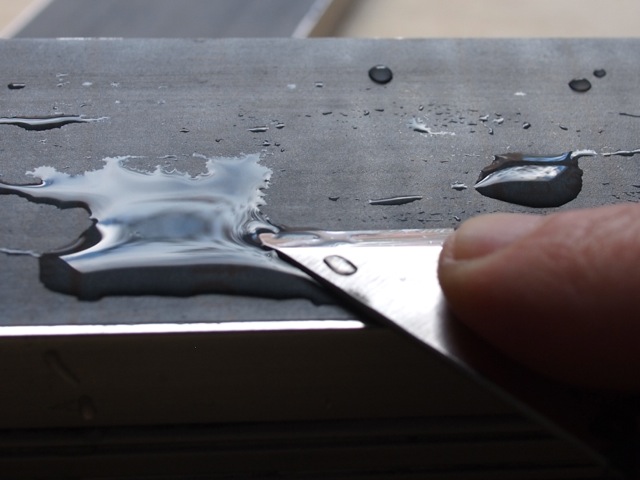
These plates are used the same as any sharpening stones. The plate holder has four rubber feet to keep it from sliding around. I generally use water as a lubricant to keep the metal particles from glazing over.
This is the system I use to make and sharpen all of my knives. People often ask how long each abrasive sheet lasts, and although there are many variables, I’d guess I can generally sharpen about 10 knives on each one. Of course, if you are trying to reshape a bevel angle or repair a major chip you might use up an entire sheet. When a sheet is exhausted, simply peel it off and stick a new one one. You must trim the edges of the edges of the finishing film when you put a new sheet on, so that it does not overhang the edges. Otherwise it may give you one of the nastiest, dirtiest, slow-healing cuts you have ever had, DAMHIKT. 80 micron replacement sheets are available from Rio Grande; the 40, 15 and 5 micron from Tools for Working Wood.

I’m convinced it is the easiest, quickest, and most convenient way to resharpen and keep all your knives and edge tools in peak condition, from scalpels to scimitars. This system is a lightweight, easy to store and unbreakable. Perfect for travel and classroom use.
The system comes with four 11 x 2″ strips each of 80, 40, 15 and 5 micron #3M PSA micro finishing film, a 12 x 2″ Genuine Horsebutt Strop, and 1 oz. bar of green chromium oxide buffing compound. The entire system is 13 x 3 x 2.5″, 3 lbs. 4 oz.
ITEM #SS2: Introductory price $225.00
Tips on sharpening are located here, and tips on stropping here.
 Peachey Conservation