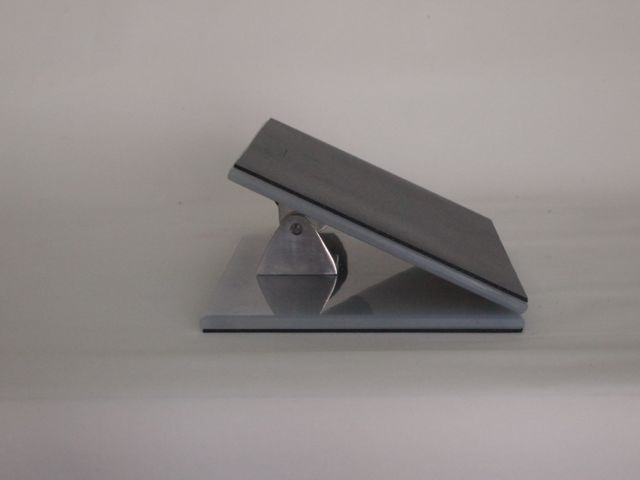
Book Jack

Many forms of book wedges are available for the reading room, ranging from the familiar Clarkson foam, wood ones, as well as some newer ideas from the At the Bench blog.  There are also many options for the safe display of books.  A third need — to secure books partially open while undergoing treatment and examination — seems to have been ignored, or commonly jerry rigged with weights and pressing boards as the need arises.

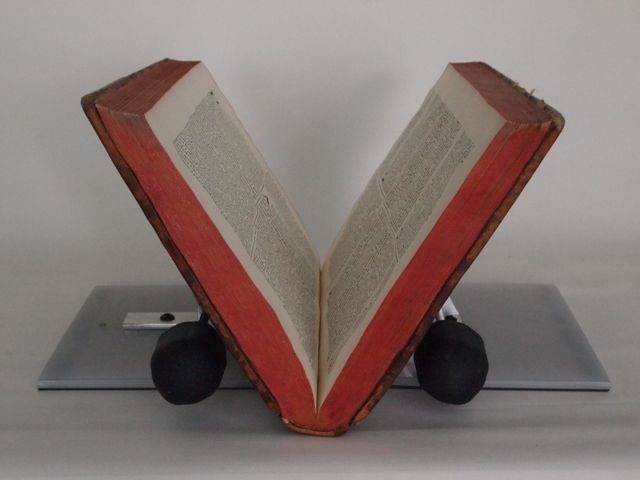
I developed the in-situ book conservation fixture to securely hold a textblock open while performing page repairs, working under magnification, media consolidation, etc. It is large and heavy, and can easily accommodate parchment textblocks.

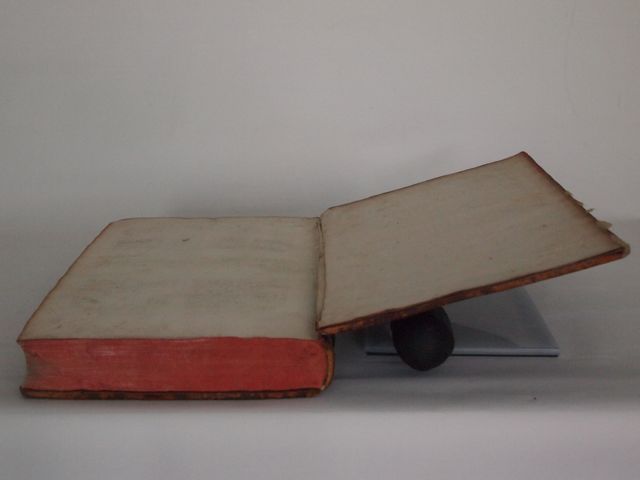
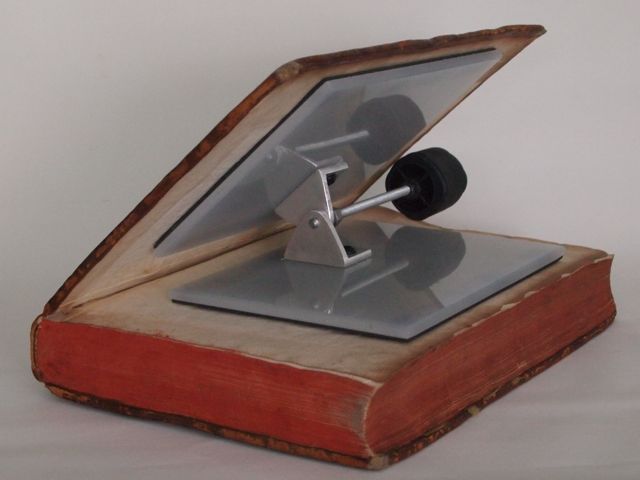
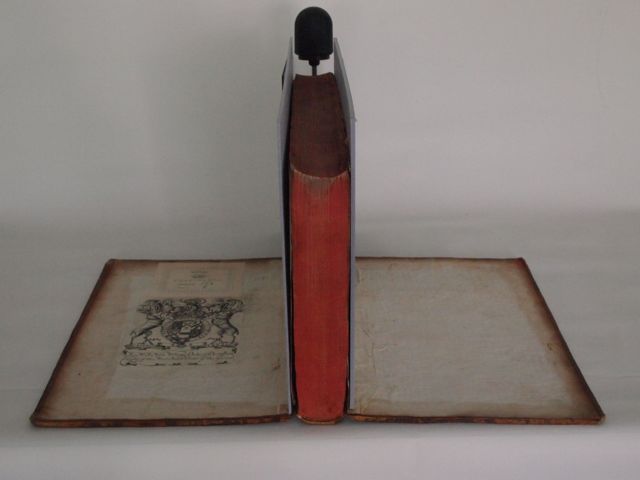
The book jack is small, lightweight, and designed for use on the workbench. It quickly and easily adjusts from 15 to 60 degrees, locks securely into place by a built in handle, and provides a more rigid support than foam. This fixture that holds the book, or boards, open in a wide variety of positions to reduce strain while performing treatments.   The small size permits it to be used inside a book to work on board edges and corners. It can also be used to support a textblock upright when rebacking or humidifying warped vellum boards, although additional weights may be necessary to stabilize it.  I use this fixture constantly, from initial examination throughout the treatment.

The natural, translucent .25 inch thick polypropylene platens are lined with an easily replaceable .0625 inch thick closed cell polyethylene foam ( aka. Volara). The adjustment mechanism is 6061 T6 aluminum and a comfort grip handle, which has a lower profile than the platens at any angle, so that relatively large books can be supported.

Item#  BJ-1 $125.00 for one, or $225.00 pair

.
.
.
.

.
.

.

.

An Easy Way to Strain Wheat Starch Paste

Wheat starch paste is widely used as an adhesive and size in bookbinding and conservation because it is long lasting, strong, reversible and non-yellowing.  After making wheat starch paste, it is generally strained, thinned, aged, or otherwise worked to give it the appropriate working qualities for the task at hand. A horsehair (or other non-metalic, ie. silk screen fabric) strainer is commonly used, however the technique below is quick, easy, fun and impressive. It results in a paste suitable for many bookbinding and book conservation purposes.

TWIST AND SQUEEZE: AN EASY WAY TO STRAIN WHEAT STARCH PASTE

.

.

OBSERVATIONS:

-Use an undyed, unbleached, natural fiber square of cloth that does not shed fibers.

-The cloth can be prewetted, to various degrees, to alter the final consistency of the paste.

-Rinse and clean the cloth immediately after use.

-Note the use of the thumb during the final squeeze.

Caution: Too vigorous a twisting and squeezing motion can cause the paste to fly out, in equal proportions, into your eye and onto the floor.

-I imagine different weave tightness or thread counts could change affect the consistency of the paste.

-The main drawback of this technique is that it is best suited for small quantities of paste.

.

Thanks to Clare Manias, Rare Book Conservator of the Museum of Biblical Art for sharing this tip.

The Best One Paragraph Summary of Nineteenth Century Bookmaking?

The entire nineteenth century history can be seen as a continuous struggle against bottlenecks, many of them caused by the sudden speeding up of a single operation previously performed by hand in a more or less leisurely manner.  Thus, the invention of the papermaking machine, which produces a continuous web of paper, calls for the rotary press into which this web can be fed; then there was need for the stereotyping process which allows the production of curved printing plates; and last but not least, composing machines which can produce a sufficient amount of set type to feed hungry presses.  And of what good to anyone would have been the accumulation of printed paper if there had not been machines developed which would cut, fold, sew and bind the sheets?

Lehmann-Haupt, Hellmut.  The Book in America, Second Edition. New York: R.R. Bowker Co., 1952. (p. 147)