Blank Book Sewing Frame, Part Two

Earlier this year I wrote a post about the  Hickock Blank Book Sewing Frame.  I finally got to see one in person this past weekend, thanks to Karen Hanmer, bookbinder and book artist, who brought it to the Historic Cloth Case Class I was teaching at Columbia College, in Chicago last week.

It is a very cool sewing frame, beautifully made, and works for all types of sewing supports: cords, tapes or thongs.  The brass t-slots are stamped with the a Hickock logo in the middle (barely visible in this image) and I think the brass is the same thickness and size as the large pressboards that they also manufactured. A small screwdriver type tool tightens or loosens the buttons.  She mentioned that the only drawback is that because of the size of the buttons, supports cannot be spaced too closely together.  I suspect that the only reason the top bar is adjustable is that the uprights were  a standard Hickock product.  Also the front keeps the frame from sliding around, although the lighter colored wood in the bottom picture appears to be either a replacement or later addition.  Because the supports are at the front of the frame, it is much easier to start sewing, or sew in the round.  The buttons make tensioning the supports a breeze, with no complex knots or keys to deal with.  In the 1920’s, this frame cost $15.00, verses $4.50 for a standard frame about the same size, which may be why it didn’t became more popular.

I was so impressed by the frame, that I have started experimenting making a modern version, out of aluminum, with closer spacing for the supports, and with a little luck I should have a prototype by the end of the summer.   I plan to make the uprights on a hinge, so that the frame, when collapsed, will be less than two inches in thickness for easy, dust-free storage.

Images courtesy of Karen Hanmer.
Free X-Ray Magnification Fluoroscopy Offer

Last week I attended the Atlantic Design and Manufacturing Show at the Javits Center in NYC.  There are similar shows around the country, and if you are interested in cutting edge technology that may have possible applications to conservation, they are well worth attending.

I noticed a couple of interesting items; super-fast absorbent sponges designed for Ophthalmic applications, sub $200 ( 10-70x) USB microscopes, and a very cool, open source 3d printer for less than $1000.  Three dimensional printers can print virtually anything, in this case up to  100 x 100 x 100mm out of ABS, HDPE or PLA plastic.

But perhaps the most useful offer came from Gil Zweig, President of Glenbrook Technologies Inc. He has invented a patented, real time, MXRA x-ray machine with magnification up to 20x.  If you have a bit of money left over in your budget, he sells a desktop machine for about $39,000.  Or you can rent lab time for $250/ hr in his Randolph NJ location.  He is primarily marketing his services for medical, industrial and forensic applications, but seemed interested in expanding his market to conservators, and offered a free hour on the machine if you have an artifact than needs x-rayed.

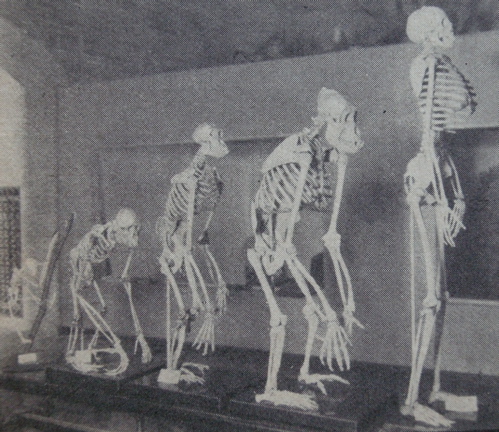
The Ascent And Descent Of Man

ascent-of-man-2

The above photo is from Popular Science Monthly, Vol. 124, No. 6, June 1934, p. 35.  This is an early depiction of the ascent of man, and it is taken from the Peabody Museum of Natural History, at Yale University.  It was featured in a section of the magazine that reports on new Science news, so it must have been fairly recently installed.  The succession is gibbon, orangutan, chimpanzee, gorilla and human.

Recently, I saw the sign below on 23rd. St., NYC, and it was an ad for some online food ordering company.   I thought it was clever in depicting technological tool use, and how we become dependent on the increasing size of our tools, thus returning us to our protohuman stature?

descent of man