The Thread That Binds: A Book Review

I recently reviewed “The Thread that Binds: Interviews with Private Practice Bookbinders” by Pamela Train Leutz in The Bonefolder, Volume 6, No. 2, Spring 2010.  Here is the beginning of the review:

“In a field as small as bookbinding, a book reviewer occupies a precarious position, since they often have personal knowledge of, if not direct relations with, the author. At the very least, the reviewer and author are usually connected by a friend, or friend of a friend. So reviewing a book that includes interviews with 21 of leading bookbinders currently working in the field places this author in a position beyond precarious – an ideal chance to anger friends, alienate acquaintances and antagonize colleagues. The book even featured a long, highly complementary blurb from the publisher of this journal, Peter Verheyen on the back cover.

Foregrounded by these preoccupations, my hands trembled as I unwrapped my review copy…”

Read the entire review here.

Round Knives

round knife

I noticed this egyptian relief of sandal makers in the Archeological Museum of Florence.  It dates from the 36-30th Dynasty, 664-343 BC.  The round  knife pictured in the middle has changed very little in the past 25 centuries.  Below is a modern one that CS Osborne makes, which according to one web site has been the world’s best selling 5 inch round knife since 1826.

csorndknftn2

Jig For Planing Thin Wood Boards

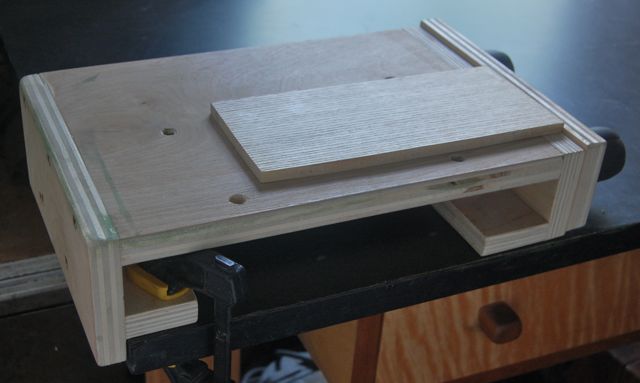
A couple of years ago, I devised a simple jig to make planing of thin wood boards easier.  I noticed Christopher Martyn, who writes the blog Finely Strung, and is a stringed instrument maker in Winchester, United Kingdom, came up of a surprisingly similar jig. We exchanged some information on the topic and he posted an image his jig and mine, although his is quite fancy compared to my pedestrian design!

Recently, I needed to plane some larger boards, so recently improved my design quite a bit.  This jig is also useful for book conservation labs who don’t have a dedicated woodworking bench, since it can clamp, with a standard “Quick-Grip” or  C-Clamp onto an existing bench while protecting your benchtop.  This one is about 12 x 9″, although it could be made to any size.  The adjustable, and replaceable, stop is held on with a 1/4 x 20 x 2″ carriage bolt, and tightened with soft grip knobs so that no tools are necessary to adjust it.  I find if convenient to rout a slot so that it can be raised up and planed flat if it gets damaged in use.  This one was made of birch faced plywood, and held together with drywall screws driven deep under the surface of the wood.  The height is 3 layers of 3/4″ plywood to allow for a variety of clamping options.  It can also function as a bench hook and can be used with tapered pieces of wood. It seems to grip the wood being planed better by not applying any finish to it.  I’m not left handed, but the light was better for the photo in this position.