Perfect Binding

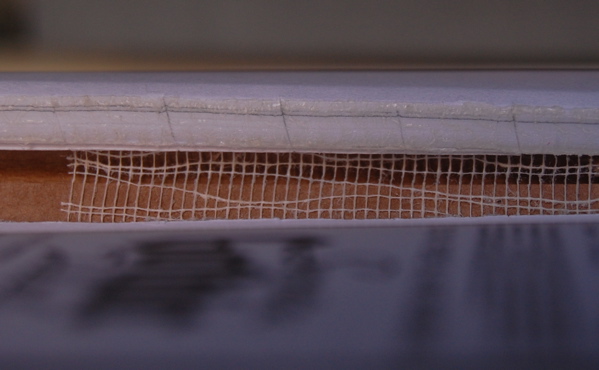
This is a brand new $26.95 hardcover book.  The very first time I opened it, the first 30 pages or so separated from the super and kraft spine lining. I’m quite accustomed to carefully handling delicate structures, so this totally surprised me. As you can see, there is barely a trace of adhesive residue on the super. I can only guess that after the spine was glued up, there was a delay, or a bad batch of glue that applied the super and  spine lining. I hope this is just a production error, or fluke.

Gary Frost , in Paper Book: BookNote #12 wrote, “Ultimately, paper books will persist as long as they exemplify a performance standard that electronic text media must achieve.”  If this book is any indication of the performance standard of currently produced  paper books, the electronic textual future could be nearer than I ever thought possible.

Espresso Drippings

Jeff Altepeter, Bookbinding Instructor at North Benett Street School, gave me a copy of John J. Pledgers’ “Bookbinding and its Auxiliary Branches” which was printed on demand by the Espresso Book Machine.  For expensive, hard to find books, the Espresso is great for people like me who basically want the textual information, and have difficulty concentrating while screen reading.

The Espresso bills the books it makes as a “Library Quality” binding.  I’m not quite sure what this means, or even if this is a good thing, but the book  is similar in quality to a mass produced paperback, with slightly better quality paper.  The cover is lined up and it is well trimmed, but there is a suspiciously dark colored glue on the spine. If the grain of the paper ran head to tail, it might even open fairly well.  For $8, however, it is cheaper and easier to read than a photocopy, though the images are a bit worse in quality.  In many ways, the Espresso is getting close to the ultimate goal of  bookbinding machinery inventors– to print and bind a book without human intervention, relatively inexpensively and reasonably durably.

Below is the same image from three versions of this book for comparison.

Fig. 1. Screen shot from Google Books.

——-

Fig. 2. Image from the Espresso Book Machine Printing, using the Google Scan.

—–

Fig. 3.  From a photocopy I made in the 1990’s, from the Revised edition of 1924.

—–

Long ‘s’

From:  Ferguson, Adam.  The History of the Progress and Termination of the Roman Republic.  Edinburgh: Printed for Bell & Bradfute; and sold by Longman, Rees, Hurst, and Orme, London. 1805.

A well placed long ‘s’ often gives me a chuckle.  My all time favorite was a scientific text that kept mentioning sucking on a pipette.