Homicide In Hardcover

Homicide in Hardcover ” is a new bibliophile murder mystery by Kate Carlisle.  The blurb on the back reads, “Brooklyn Wainwright is a skilled surgeon.  Sure, her patients might smell like mold and have spines made of leather, but no ailing book is going to die on her watch.”  Kate Carlisle has done our profession a huge favor by communicating to the general public some of the exciting things conservators do.  Of course there are many little inaccuracies, but it is a little too easy and unfair to nitpick about things that only those on the inside of conservation know. The most important point is that this book serves to raise our public profile in a reasonably accurate way; it even discusses minimal intervention and the importance of written and photographic documentation.

Amazingly this book also includes a reference to Peachey knives!  The protagonist, Brooklyn, and her arch-enemy, Minka, are sneaking around Abraham’s (a master restorer) studio fighting over who gets these knives, after he was found dead in a pool of blood.

“I’m just looking,” I said, and picked up a polished wood box with the initials “AK” engraved on the top.

Abraham’s personalized set of Peachey knives.

“I have dibs on those, ” she (Minka) said.  “Get your ditry meat hooks off them.”

I shook my head at her.  “You’re a pathetic thief.”

“Those are mine.”

“No, these belong to Abraham.”

She lunged for the box and I whipped my hand away.

“You’re such a bitch!”

“That may be true,” I said.  “But these still don’t belong to you.”

“He can’t use them and I found them first.”

My eyes widened.  I couldn’t help it. Her lack of a moral compass never failed to shock me.  “That dosen’t mean they belong to you..”

“God, I hate you,” she said through clenched teeth.  She swept the rest of her booty to her chest and stomped out. Then she turned back and glared at me. “I hope you die.”

“Back atcha,” I yelled after her.” (pp. 75-76)

I plan to make a set of these knives, in a polished wood box with the initals “AK” engraved on top.  Would this be considered theoretical product placement?  A real knife is the basis for a fictional one,  then the fictional knife is transformed into a real knife? 

This isn’t the kind of book I usually read, but I enjoyed it.  The  descriptions of bookbinders at work were realistic and there are a number of laugh out loud scenes.  And this book seems to resonate with the public:  “I always assumed that book-binding and restoration would be a dull, dry subject but the historical facts and bits of trivia sprinkled throughout this book were so fascinating that instead of being bored I found myself wanting to know more.”  “Who’d have thought book restoration could be so exciting?”   “Who knew leather and vellum could be so captivating?”  


Thanks to Marieka Kaye (and her open minded literary taste!) for bringing this to my attention.

Thin Profile Suction Platen

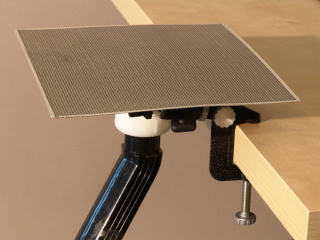
Robert Proctor has invented and manufactures a “Thin Profile Suction Platen” which I haven’t tried, but it looks incredibly useful and is very reasonably priced.  It is less than 1/6″ thick which would make it great for in situ textblock treatments close to the spinePlease contact him with questions.  

He describes the platen:

“About 12 years ago, dissatisfied with the suction platens available at the time, I decided to build one more to better fit my own needs. Encouraged by others who liked my design, I put together 20 platens, the majority of which I sold out of the trunk of my car at the 1997 AIC meeting in San Diego.Instructions for building this platen were published in the Sept 1997 WAAC Newsletter. This generated many phone calls from people asking “won’t you just make one for me?”  Since I considered my time better spent restoring paintings rather than building and selling suction platens, I offered these plans to a manufacturer of conservation equipment, free of charge. While they do produce a platen and continue to market it using my name, much to my  dissatisfaction, it differs considerably from my design. In the interim I made another run of 20 with an improved mounting device.

Unique to my platen is an easy to use light weight design with a combination of: an ultra thin profile; an interior baffle made of solvent resistant materials that maintains even suction across the entire surface of the plenum; construction that allows for the platen to be easily opened for periodic cleaning; and new to the design is a fully articulated a mini ball head mount that enables the platen to be attached to a tri-pod, camera boom or to the included clamp allowing the platen to be easily attached to an easel or table edge.  The platen sells for $425.00 including shipping and handling”   

Contact:
Robert Proctor
Whitten & Proctor Fine Art Conservation
1236 Studewood Street
Houston, TX 77008
Phone/Fax: 713-426-0191
www.whittenandproctor.com


dsca9064
dsca9063
dsca9065


Portable Press

portable-press


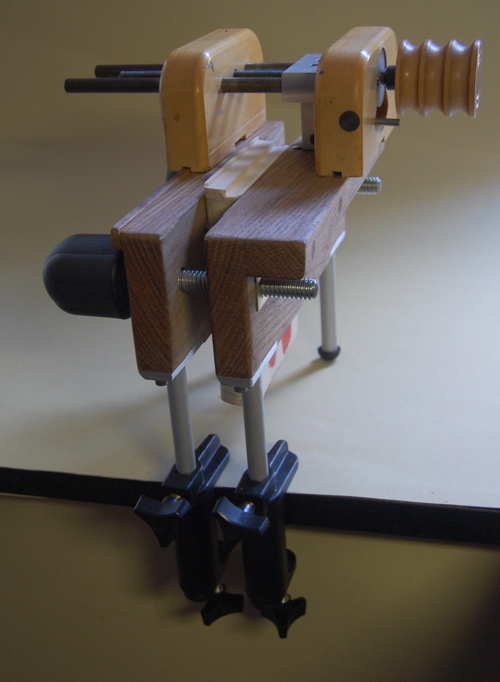
I needed a portable press to travel with.  The challenge was to make it as light as possible, be able to use it without a tub, and make it rigid enough to back books and use a plough on.   The oversize, rubber knobs combined with a 1/2″ acme screw can be tightened by hand, without the need for a press pin.  The aluminum legs can be unscrewed to easily fit into a backpack, and rigidly clamp to a work surface for use.  With the plough, the entire setup weighs in at 6 lbs, 4 oz.


plough-detail

The plough on this press is a circa. late 1980’s Derick Beck model. It is unusual, in that the blade travels independently of the cheek on the right hand side, and the blade is angled downwards, so that the length of the blade doesn’t mar the edge of the textblock after a cut is made.  To advance the blade, the knob is rolled towards you, which is opposite the way standard plough works, and takes a little getting used to. It cuts very cleanly.