Old Books Stink!

Many of my clients talk about the smell of old books as being one of the aspects that attracts them to collecting. 

In the 18th Century, M. Dudin in The Art of the Bookbinder and Gilder ends his treatise by recommending that the completed binding be perfumed.  “Very few people seek this refinement for their books but there is nothing simpler than perfuming a book.” (86) He explains two methods, one by sponging the pages with perfume, the other leaving the book in a cupboard for a long period of time with an open bottle.  Keep those noses going, fellow conservators, I would love to find an example of this.  

Now Christopher Brosius, and his store CB I Hate Perfume, has bottled the smell.  The scent is named “In The Library”, and here is part of his description.

“I love books, particularly old ones. I cannot pass a second hand bookshop and rarely come away without at least one additional volume. I now have quite a collection!  Whenever I read, the start of the journey is always opening the book and breathing deeply. Don’t you find there are few things more wonderful than the smell of a much-loved book? Newly printed books certainly smell very different from older ones. The ink is so crisp. I’ve also noticed that books from different periods & different countries also have very different smells. And then there are the scents of different bindings: leather is marvelous of course but I find a peculiar pleasure in musty worn clothbound books as well. Perhaps just a hint of mildew!  The main note in this scent was copied from one of my favorite books – I happened to find a signed first edition of this novel a few years ago in London. I was more than a little excited because there were only ever a hundred in the first place.” (From the CB I Hate Perfume Website)

I purchased a tiny, 2ml vial of this scent for about $12.  

I’m not much of a perfume guy– it didn’t smell bad, but it didn’t smell like an old book either.

Cobbler’s Bones


bones

    Hirth & Krause, Dealers in…Leather and Findings. Shoe Store Supplies, etc. Grand Rapids, MI: 1890.( p. 46) 

Kevin Driedger , who writes the interesting Library Preservation blog, posted a useful comment a couple of months ago, wondering if I was making an erroneous assumption about how a Turkish bone was used.  I guessed it was used for marking.  Lately while reading a old supply catalogue for the shoemakers I realized it that shoemakers have two distinct types of bones, termed scratch bones and slick bones.  Now I’m convinced that the Turkish cobbler’s bone I wrote about is a scratch bone.  Turkish shoemakers now make European style shoes, not Ottoman.

Judging from the catalog descriptions, it seems the scratch bones (similar to a scratch awl?) were used for marking, and slick bone was used for burnishing or smoothing.  I wonder if the right angles on the left end were also used to scratch a line?  This shape, seems to have served as the template for the most common shape that bookbinders use, with one flat and one rounded or pointed end.

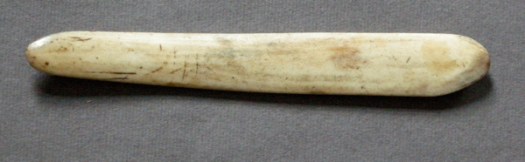
Below is a slick bone that I purchased with some other shoemakers tools.  It is thicker than most of the cow bone folders that are commercially available to now, and has a pleasing natural shape.  The facets of the somewhat crude shape are highly burnished, suggesting it was used with a far amount of force or speed, the accumulation of glue residue and deep scratches give it a gorgeous patina from use.

cobblers-bone

Going Cryogenic


a2logo


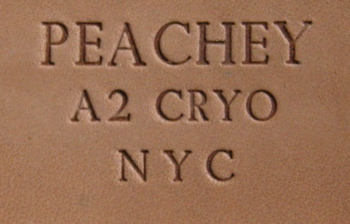
Above is an example of blind stamping, using just water and the heat of the type to create the impression on a piece of vegetable tanned horsebutt leather.  The font is Edinburgh, brass type from P & S Engraving in the UK, the top line 14 point, the bottom two 10.  I’ve had these letters for 20 years, and the wear, especially on the “Y” in “PEACHEY” is evident- time to get some replacement letters!  This is the stamp on the blade cover for the new, A2 knives which has been cryogenically treated.  For more technical information about cryrogenic treatments check out nitrofreeze. Please read more about the new knives in  the new tools page on the right, and the results of testing in the post below which convinced me to use this new steel for leather paring knives.