“One of the most admired skills in bookbinding is the paring of leather, yet only sharp tools and confidence are required. Confidence is gained by experience, and sharp tools by a zelous consideration and care for knives.” Arthur Johnson, The Thames and Hudson Manuel of Bookbinding, p. 89
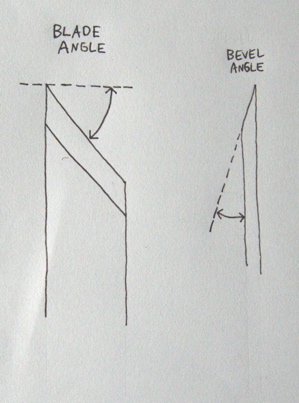
I would add that it is also critical to pay attention to the blade angle of the knife, since it affects how the knife cuts, the angle one holds the knife at, and consequently how the leather is cut. I’ve found that roughly a 40-50 degree angle works best for edge paring. First, a few terms defined. The blade angle is from an imaginary line 90 degrees to the length of the blade. I am calling a zero degree angle one that would be straight across where the dotted line is, pictured below would be roughly a 45 degree blade angle. The bevel angle is the amount of slope on the bevel, in the case of leather paring knives usually around 13 degrees. The diagram below is the style of knife a right handed binder would normally use. (1)
I’ve found there are two main issues that determine the optimal angle of the blade– how much the blade is skewed in use and how the knife is held. The way I hold and use an English paring style knife is outlined below, as are the reasons why I consider a 40-50 degree blade angle ideal.
Skewing the blade in use reduces the effective cutting angle, improving the initial cutting performance and not altering edge retention. Although the more acute the bevel angle is the sharper the blade will be, if it is too severe the cutting edge will be very fragile and quickly deteriorate. I haven’t figured out the math, but if the bevel angle is 13 degrees, I estimate an extreme skew reduces the effective cutting angle by a degree or two, which is significant.
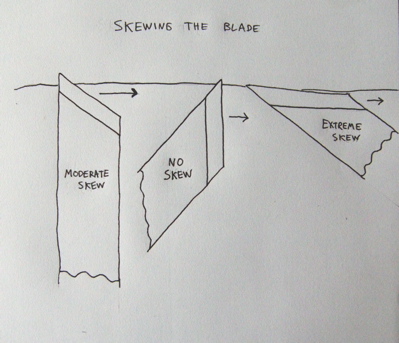
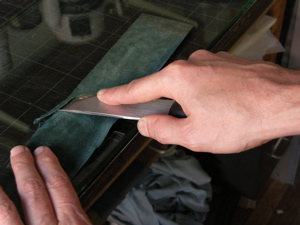
I tend to use an English style paring knife in three ways when I am edge paring- first to make a series of cuts using moderate skew, then a few finishing cuts using extreme skew, and finally use the knife with no skew, almost like a spokeshave, to smooth everything out. It doesn’t seem to make too much difference if you pare across the skin, as pictured above, or push the knife away from you.
To make a long, even bevel the angle of the knife held steady by my thumb and second finger on the other side of the the knife– they slide along the surface of the paring surface. In order to pare the leather evenly, the knife must be held at a consistent angle. (2) The angle the knife is held varies with the type of leather and skill of the binder- too high of an angle takes off virtually no leather, makes it more likely to slice through the flesh side of the skin and dulls the knife tip by digging into the paring surface. Too low an angle makes the knife difficult to control, since most of the cutting edge is engaged into the leather. Wide knives with long bevels exaggerate this problem. Right handed beginning parers may want to use the forefinger of left hand to push the knife along the leather. This allows one to concentrate on using the right hand to hold the knife at a consistent angle, as illustrated below.
One reason I dislike jigs for sharpening is that the hand skills to sharpen the knife are remarkable similar to the hand skills necessary to operate the knife– if you don’t have the hand skills to hold the knife at a consistant angle to sharpen it, you are not going to be able to hold it at a consistant angle to pare leather evenly. Some like to pare across the leather, as illustrated below, and some like to pare up the side of the leather, starting the cut with the heel of the knife rather than the tip. Since lithographic stones are now extinct, I prefer paring on a piece of glass and saving stones for printers wishing to experience printing on a real stone. There is no reason to pare on a litho stone other than tradition, and I suspect the only reason they were historically used is that they were a cheaper flat surface than glass, marble or granite

After a first cut is made, a second (and possibly third or fourth, depending on how long of a bevel is desired) is made by holding the knife at progressively lower angles. The depth of the cut can be judged by changes in the color of the leather or folding the leather in half, which doubles any errors. If the leather is disturbed to check the progress, it is imperative that any stray bits be cleaned from under the skin, otherwise the knife will cut through these thicker layers.
As the leather becomes thinner, it becomes weaker, so I adopt the second knife position. I skew the knife towards a more extreme angle and press down harder, which creates a lower effective bevel angle. This helps prevent tearing the leather. It is much easier to take the leather off in long even strips with the first cuts, rather than try to correct mistakes later on. If there are many irregularities, sometimes it is easier to use a spokeshave to even things out.
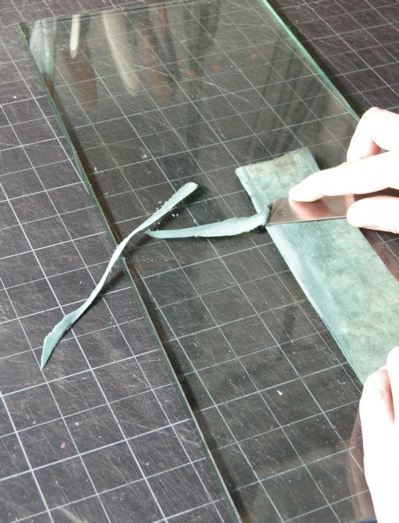
After the edge is pared to the length and thinness desired, I rotate the knife into the third position, so that it is not skewed, and push it forward to even the previous cuts out. This is almost more of a scraping action than a paring cut, and is meant to smooth out irregularities left from the previous cuts, not remove a lot of skin. The angle of the camera in the illustration seems to exaggerate angle that the knife is being held- in reality it is almost parallel to the skin. Again, a spokeshave could do this as well. The cutting edge of this knife is one inch, which is slightly larger than most turnins. Most of the time 7/8″ is a reasonable turn in width–compromising between giving a little extra room in case the leather is torn, and conserving leather. One unintentional consequence of the acidic nature of some leathers is that they rapidly stain the pastedown, making it possible to observe in detail the pattern of trimming and size of turnins. I admire the judgement (and frugality!) of some binders, capable of covering the book so economically that only a millimeter of two of leather extends under the pastedown in various places.
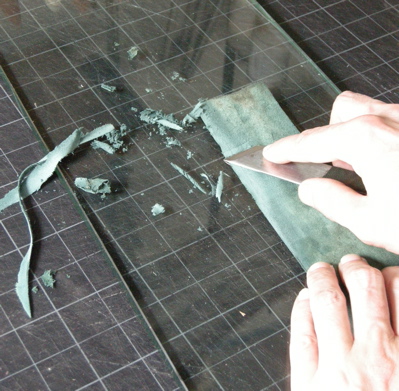
A roughly 45 degree angle seems to be the most comfortable in all three of the ways I hold the knife. I have a set of knives that I use when teaching which consist of 22.5, 45, and 67.5 degrees, in order to compare what is most comfortable for each individual, and most opt for a roughly 45 degree angle. Another consideration is the angle of the wrist when using the knife– I’ve found around 40-50 to be most comfortable. Keeping the angle of your wrist comfortable is important if you do a lot of production work, to avoid carpel tunnel syndrome. Any numbness or tingling sensation is possibly a very serious problem, and medical attention should be sought. Choosing a good quality knife, keeping it well stropped and sharp will also reduce the force needed to pare leather, reducing strain on the hand and wrist. Finally, a 45 degree blade angle is much easier to sharpen than a 67.5 degree angle for two reasons– it is easier to get even pressure across the entire width of the bevel (especially the tip), and there is less metal to remove, so the sharpening is more rapid. Paring leather is not difficult, as Johnson pointed out, it just takes some practice with a sharp knife, and an awareness of the blade angle.
_____________________________________________________________
NOTES
1. As a left handed binder pointed out to me, simply changing the direction of paring allows a right hander to use a left handed knife, or vice versa. Below I am comfortably using a left handed knife, holding the leather at the top and paring towards myself.
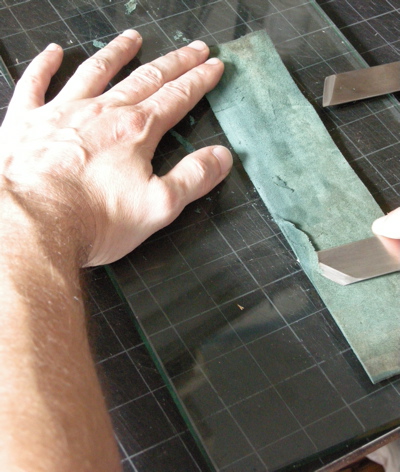
2. Some find it more comfortable to hold a knife with a handle. In this case, it is sometimes necessary to hold the handle area of the knife off the paring surface in order to achieve a low angle. This illustration also demonstrates side to side paring.