Ascent of Man

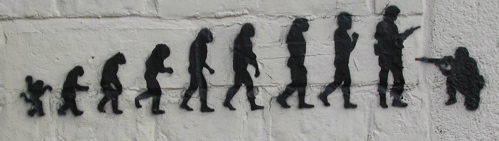
It is always heartening to find traces of resistance to technological culture, like the graffiti pictured below.

I noticed the first example last year in Oxford, England.  The monkey on the far left looks positively joyful, perhaps existing in a pre-technological garden of eden. The transition between the man making a fist and the one holding the gun is compelling, and it is with the appearence of the gun that the man stops walking–in the next picture he reverts to kneeling. The advent of tools, in this case a gun, threatens the entirety of past evolution and seems to put a halt to human progress.   I often think of fire as the original technology, but warfare might be earlier.   Kubrick had an extended scene about monkeys discovering a bone cub which they use to kill each other in the movie 2001. On the other hand, several of the technologies that are used in Book Preservation (such as microfilming)  were originally developed by the military industrial complex.
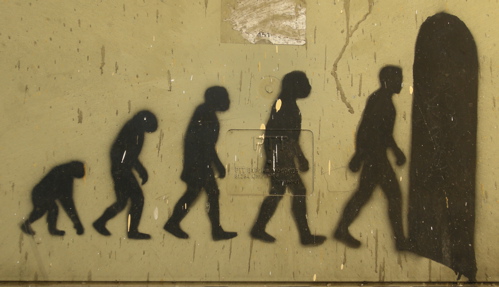
Another take on the ascent of man, pictured below, was found last month while in Istanbul, Turkey.  A similar message, but a bit more ambiguous.  Is the man’s final step through a black door?  Is it into a grave?  Or is it a representation of an unknown future that we are carried into by our feet, since we are walking upright?  It reminds me of the monolith in Kubrick’s movie, 2001.
Some of the earliest forms of art used stencils, such as a hand, and it is interesting to see how durable this technique is. For a quick means of reproducing and distributing a visual image, is is perhaps unequalled.  Most of the graffiti (or writing as it is now termed) I see in NYC tends to be mindless tagging or acid etching of windows, which is not very interesting to look at.  But it accomplishes some of the same basic functions as all graffiti by saying “I am here, I have left my mark.”

Come to think of it, blogging could be considered internet graffiti–there are millions of people leaving their digital mark of what they thought about something, not knowing who will see what they have posted. As much as I love using and thinking about tools, I am always aware of their dual nature as Marshall McLuhan summarized so succinctly in Understanding Media: The Extensions of Man.  “We shape our tools and thereafter our tools shape us.”  I wonder how using a tool like the internet will reshape us?

Whatsit #1


Often when I find tools at flea markets, and I don’t know what they are for, I buy them.  This one was particularly puzzling because it is so similar to a typeholder.  It must be a typeholder for something, perhaps rubber faced wood type?

It is very well made, and the knob on the top adjusts for different font sizes.  The ferrule is very strong and longer than I usually see.  It seems made for standard, type high letters.  The beveled area in the picture at the right suggests it was sighted from there.  The adjustable guides are very thin, suggesting it was used with a hard type– either wood, metal or rubber tipped wood.  There are no marks on the end of the handle so it was just used with hand pressure. The style of the knobs and attachment look early 20th C. I think the handle is beech.  The only marking is a number “2” on the front right side. It is 128mm long and the main metal part is 82mm wide, and most of the steel parts 3mm thick.

Comments or thoughts, anyone?

Blinded By Aesthetics

Conservation involves creative thinking, but mainly in a problem solving sense; how to accomplish a clearly defined goal when dealing with a unique object.  Respecting the object, not self expression, is a guiding principal. Even with bookbinding type projects, which I sometimes do, they often involve working with a designer or art director.  I do have some input, but  more often am hired to realize a preexisting idea.

So I am an amateur woodworker to satisfy a creative urge.  Tools for working wood (link on the right hand side bar) sells the metal hardware and blade to make a turning saw.  They also supply free plans, all you need to do is supply the wood.  Did I follow the plans?  Of course not!  As I spent a sunday afternoon spokeshaving the three main pieces, I became more and more interested in emphasizing their thin curves, thinking how elegant looking they were becoming and not thinking about how much tension they would be under when I tightened the toggle.


Did I loosen the tension when I was storing the saw?  Of course not! I wanted to be able to grab it and use it.  I did use a natural hemp to twist the toggle, which I was hoping would counter act some of the changes in humidity and keep the tension even, however it is apparent there was simply too much tension for the extreme curve.  The wood was a clear quarter sawn white oak, that I air dried myself.  

About 2 months after I finished the saw, I picked it up to use it and noticed that the wood had split right along the grain.  Looking at it now, the weakness in the curved area seems obvious.  I didn’t give it a thought when I was involved in the act of spokeshaving.

Often, the most common mistake beginners in any craft make is to overbuild, and they end up with a clumsy, heavy, wasteful and amateur looking product.  I went the opposite direction.  Lesson learned. Time to make another one, this time a little straighter and thicker.  Will I follow the plans?