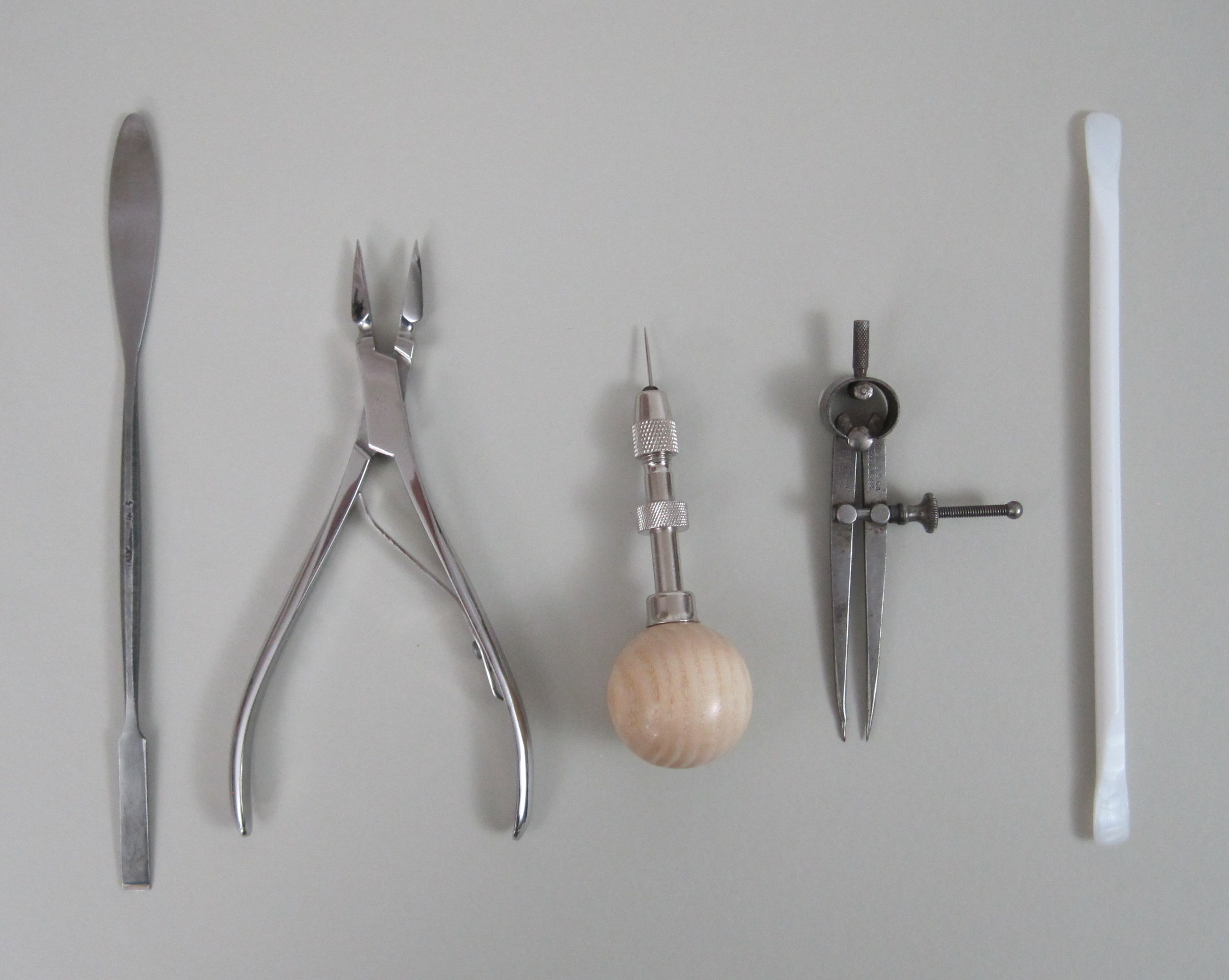
Caselli spatula: I’ve had this one since 1984 and I use it virtually
every day.
Splinter forceps: a cross between a tweezers and a needle nose pliers
that allows you to securely hold onto something very small.
Pin vise: for holding needles, drill bits, small files, etc. I have
30-40 pin vises of different shapes and sizes. This design is useful
because the wooden handle rotates in your hand so you can use it for
drilling very small holes.
Dividers: A four-inch divider bought at a flea market for $1, it was
made by the L. S. S. Co. in Athol, Mass. The design was patented in
1885.
Teflon spatula: I carved this from a lab tool called a “policeman,” used
for cleaning tubing. This shape of spatula has a thousand uses for
lifting and splitting.
Conservator at the New England Historic Genealogical Society
When Jeff asked me to pick my five most essential tools for bookbinding, I thought about what the most important ones were for making a book and so I chose a needle, a bone folder, scissors, an OLFA knife and a Swiss paring knife.
The needle was pretty obvious when I started to think about some of the first tasks involved with making a binding. You can fold and tear pages by hand to create signatures but page attachment for me involves sewing with a needle. The needle can also be used to poke holes, scratch line, and just generally pick at things (who doesn’t like to do that) so it has some versatility as well.
I use a bone folder for so many bookbinding tasks that it seemed a natural one to include. I’m showing the one that I also use for box-making; one end has been shaped into a 90-degree angle to be able to work in corners. I broke my favorite bone folder about 10 years ago, it was basically the only bone folder that I used, and since losing it I haven’t really found another one that I like that much to replace it.
The scissors and the OLFA knife might be a little redundant as they are both used for cutting but the way I use them is different enough that I decided to keep both. I tend to use them quite a bit and the thought of not having either one at my disposal is a little strange. There was some back and forth about dropping out the scissors and replacing it with a 90-degree triangle, a brush or a ruler, but I eventually decided to keep the scissors instead. I actually do a lot of measurements without a ruler by measuring materials against a book by eye, I can use my fingers or a scrap of board to apply adhesive and I think I can come up with a right angle some other way if I needed to.
Leather is such a beautiful material to cover a book with and I really enjoy working with it so my last tool is a paring knife, it’s kind of a must for me. I’m showing a Swiss version that I purchased in 1983 so it has gotten a lot of use and I like how versatile it is. I also own a right and left English knife but the curve of the Swiss knife kind of combines both so if I’m restricted to just one paring knife, I’ll include it.
I really hope that I’m never limited to only five tools but if that happens those are the ones I would choose.
Curved polished needle. As I sew only for conservation purposes I always use blunt needles that I made through the years, even though I use a specific needle for every sewing structure I still think as this as an essential tool, the curved shape is a must for linked stitches and for in-situ reinforcements.
Pin vice. In most of my work instead of using awls I tend to prefer a pin vice mounted with a curved, pointed, blunt or straight needle.
Try square in steel. For most of my work I use my selfmade tri-square in solid steel with a brass handle, it is useful both for cutting and scoring purposes.
Stanley 28-109 slim knife. I have many other knives around, some that I made and some that I bought, but most of the time my hand reaches for this one first.
Ivory folder. I made it from the handle of a kitchen knife that I bought at an antique market, even though I like to use more modern tools I think that my hand is used to it more than others, I polished it with micro mesh to 12000 grit and this make it very smooth thus leaving very little marks on the surface. The firmness compared to the teflon folder makes it more durable and its pointed shape reaches for every corner.
What I would still miss a lot, depending on the size of the book are: brushes for adhesives, tweezers for delicate work, a proper awl, if there is some wood involved my low angle block plane, if there is paring of leather involved my self made paring knife and my Stanley modified spokeshave. But I have to say that most of the paring work happens in rebinding work that I try to avoid, though this is not always possible.



 Peachey Conservation