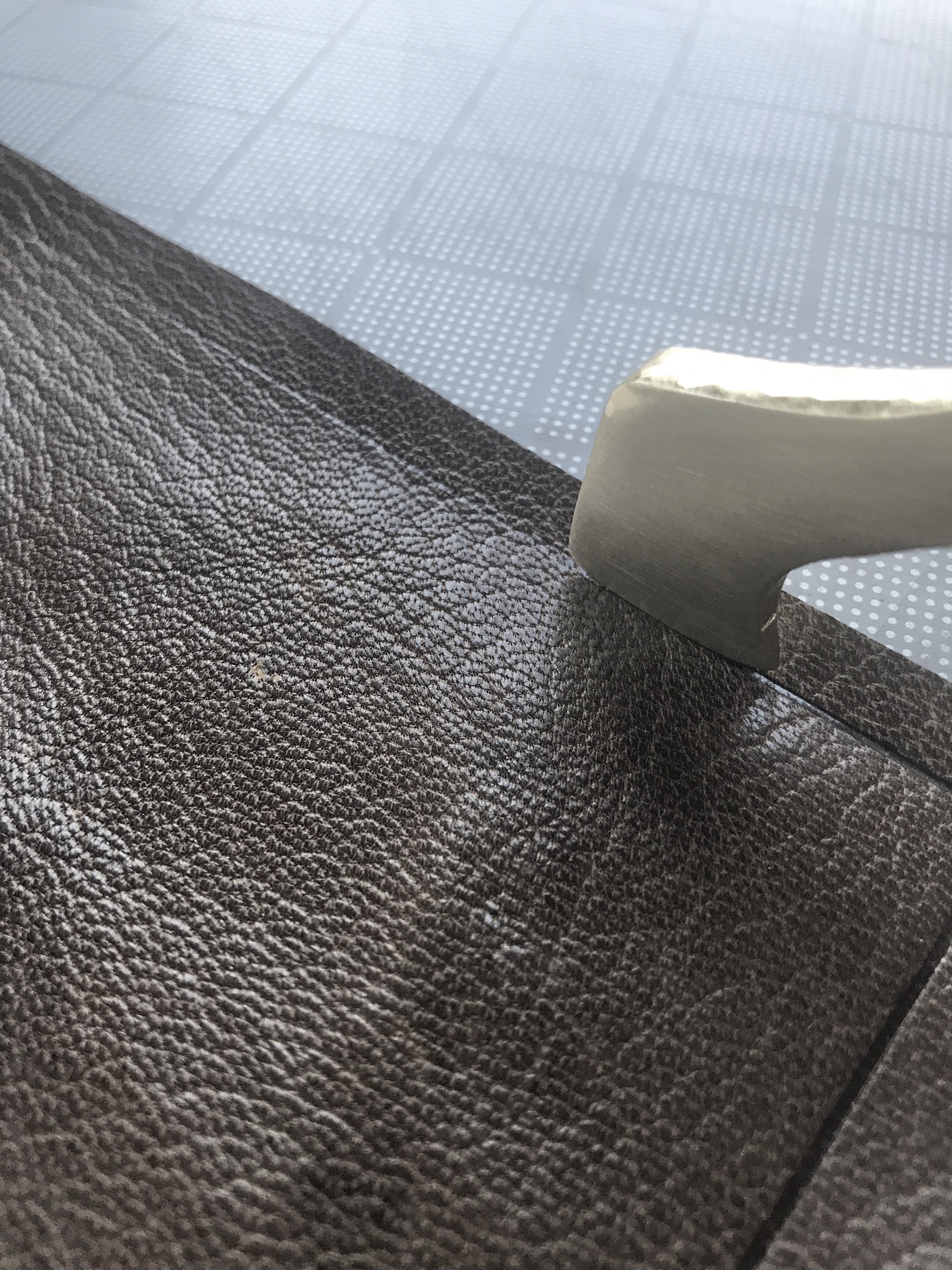
The creaser is making a dark line with a flat bottom even when used at room temperature.
Using a creaser is one of the easiest ways to impress a solid black line in leather. Simply dampen the leather overall, score a line with a bone folder and straightedge, then rub the creaser back and forth. Or some prefer to score a straight line on dry leather, wet the line with a small brush, then use the creaser. The lines I made in the images were done with a room temperature tool, though with some leathers a darker line develops if used warm — but not hot.
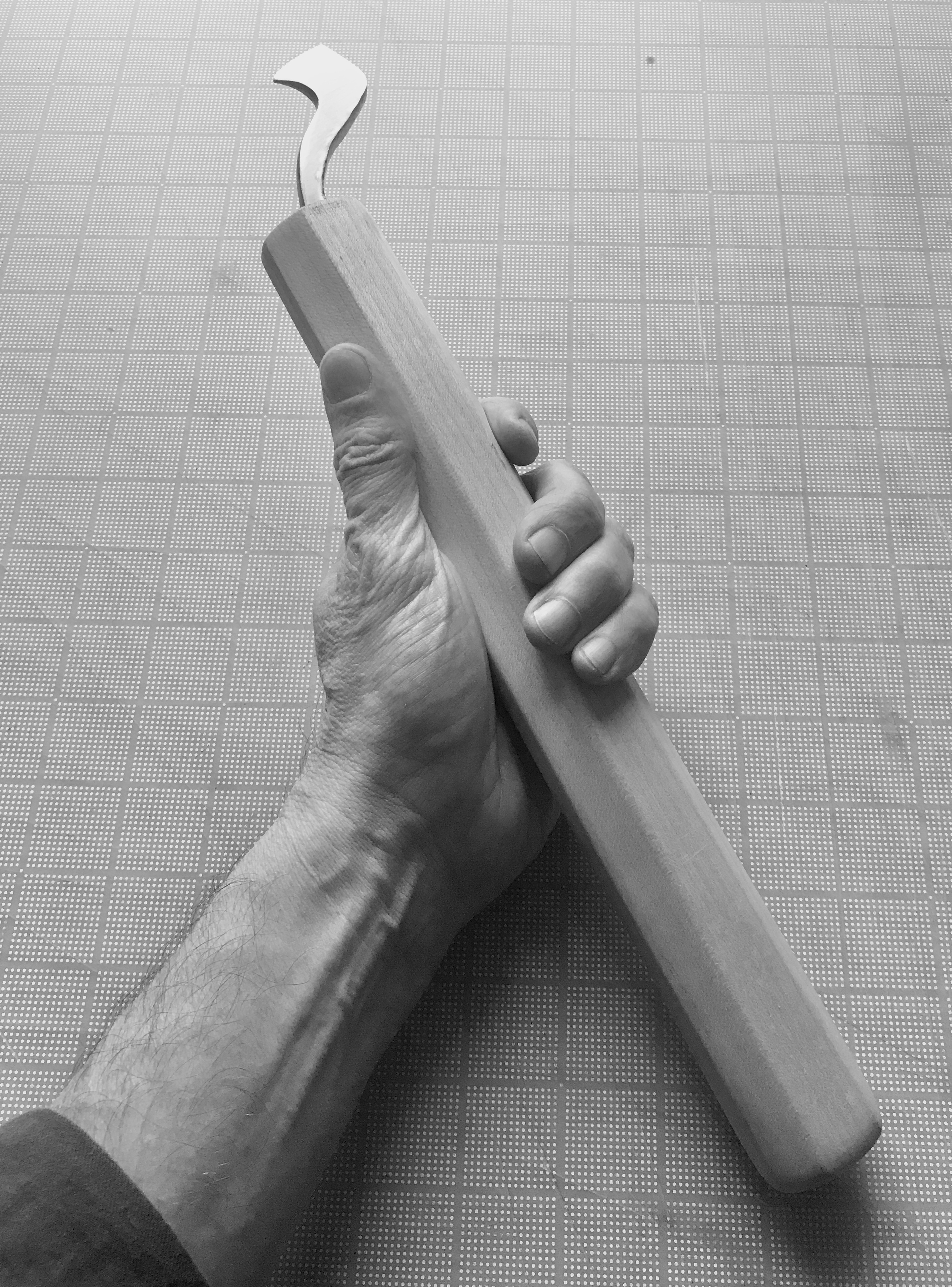
Overall length is about thirteen inches. The maple handle is eleven inches and octagonally shaped.
The design of this creaser is based on an early 20th century Frederick Westpfall tool in my collection. You can burnish the line you make by “jiggering” it back and forth, increasing pressure as it forms a groove. The burnishing gives the dark blind line a sheen. Once a basic depression is formed, the creaser slides like a cross country ski in a groomed track. The length of the handle allows for two-handed use to apply extra pressure, and you can even lean into it a bit with your shoulder.
The resulting blind line is flat on the bottom and reflects light evenly, unlike marking leather with a bone folder or other irregularly shaped object. Since the tool is usually used at ambient temperatures or only slightly warmed, there is no risk of burning the leather.
Top view of the creaser with hammering marks left in place.
The thick maple handle is easy to grasp with one or two hands, and lean into with your shoulder. Overall length is about thirteen inches. Brass head with maple handle.
Another fantastic looking lineup for The Montefiascone Project 2020! I will be teaching there week two, with a workshop titled “Early nineteenth century American and English bookbinding: machines, materials, structures, and tools” Monte is a special experience, everyone should go at least once.
The early nineteenth century models we will make in my workshop. A common boards binding, an extra boards binding, a tight back cloth binding, and an English style cloth case binding. We will also make dyed and textured book cloth from natural muslin.
…..
Montefiascone is a small medieval walled city about 100 k (80 miles) north of Rome, on Lake Bolsena. Since 1988, conservators, curators, art historians, book artists, and others interested in books and their history have come together to work, to learn and to enjoy this special place. Participants come to enjoy the medieval architecture, friendly people, a clean accessible lake, books and scholarship. The Montefiascone Project is a non-profit making organisation, set up to fund the restoration of the Library of the Seminario Barbarigo in Montefiascone. Participants may attend one, two, three or all four weeks.
Costs are £550 (or euro equivalent) for each week and include all lectures (which are in English). For more information and to enroll, contact Cheryl Porter: chezzaporter <at> yahoo.com
Week 1: 27th – 31st July
Recreating the colours on the Medieval palette: Western, Hebrew and Islamic.
Course Tutor: Cheryl Porter
This class will study the colours (made from rocks, minerals, metals, insects and plants) that were processed to produce the colours used by artists throughout the medieval era. The focus will be on manuscript art – Islamic, Hebrew and European. Participants will re-create the colours using original recipes. Illustrated lectures will address history, geography, chemistry, iconography and conservation issues. Practical making and painting sessions will follow these lectures. No previous experience is necessary.
Week 2: 3rd – 7th August
Early nineteenth century American and English bookbinding: machines, materials, structures, and tools.
Course Tutor: Jeffrey S. Peachey
In England and America, common book structures changed significantly during the early nineteenth century. A typical inexpensive calf or sheep binding was supplanted by even cheaper, new binding styles, such as paper boards bindings and the three-piece adhesive cloth case. In industrial binderies, the plough was replaced by two quicker machines, the guillotine and the board shear. The way binders worked, and viewed their work, also changed drastically.
We will examine this time period through PowerPoints, readings, discussions, and the hands-on construction of four models: an English common-boards binding, an American extra-boards binding, an American tight-back cloth binding, and an English adhesive cloth case. We will explore methods of replicating plain and textured nineteenth century bookcloth, starting with undyed muslin. Close readings from bookbinding manuals, analysis of bindery images, and the use of historic tools will enhance our understanding of this important time period. Often these binding styles are referred to as “temporary” and we will debate some conflicting evidence and definitions of this term. By the end of the nineteenth century, the cloth case became ubiquitous worldwide. This workshop will equip participants to better understand, interpret, and sympathetically treat nineteenth century books they encounter.
Week 3: 10th – 14th August
Recreating a late sixteenth-century Cambridge bookbinding
Course Tutors: Jim Bloxam and Shaun Thompson, with lectures from David Pearson.
Cambridge, heavily influenced by its university, has always been a place with books at the heart of its activities; a place where they have for many centuries been printed, sold, bound, owned, stored, read and used. Our Montefiascone course, a few years ago, was devoted to making a model of a late 15th century Cambridge binding; this year we will analyse a binding style from a century later and construct a model of a typical late 16th century Cambridge binding. At the end of the 15th century, leather-covered bindings usually had wooden boards and clasps and decoration depended on labour-intensive repetitive tooling using small hand-held tools. A century later, wood had given way to pasteboard or pulpboard, clasps had been replaced by cloth ties and decoration looked very different; gilt tooling, unknown in English binding work before about 1520, had become common.
Week 4: 17th – 21st August
A Chinese Qur’an
Course Tutors: Kristine Rose-Beers & Cécilia Duminuco, with a lecture from Alison Ohta
During this class, participants will make a model of Chester Beatty Is 1602, a 17th or 18th century Chinese Qur’an with its original binding. This small manuscript is distinctly Chinese. It is covered with fine patterned silk, and the pages are made of soft, fibrous, Chinese paper. In keeping with many Islamic bindings, it has an envelope flap, but this is squared off, similar to those seen in some south-east Asian Islamic manuscripts. This Qur’an is an example of how aspects of the Islamic book were combined with local decorative traditions influencing ornament, calligraphy and illumination.
According to the historical accounts of Chinese Muslims, Islam was first brought to China by Sa’d ibn abi Waqqas, in 651. Although scholars have not found any historical evidence that he visited China, they agree that the first Muslims must have arrived in China in the 7th century, and that the major trading cities, such as Guangzhou, Quanzhou probably already had their first mosques built during the Tang Dynasty.
Muslims in China have continued to practice their faith sometimes under very difficult circumstances. Today, the Muslim population of China is estimated as representing 0.45% to 2.85% of the total population with 39,000 mosques serving this congregation. This Qur’an represents the Islamic legacy in China and is a unique opportunity to examine this combination of traditions which were carried along the Silk Roads over the centuries.
COURSE INSTRUCTORS:
Cheryl Porter is Director of the Montefiascone Project. She trained as a book conservator in London and has worked as a conservator, collections manager and consultant for libraries and museums in Europe, Australia, USA and Egypt. She was deputy Director of the Dar al-Kutub (National Library) and Thesaurus Islamicus Foundation Manuscript Project in Egypt from 2008-2011. She has published widely and is a Professional Associate in the American Institute for Conservation.
She is currently commissioned by Yale University Press to write a book on the colours used to paint in manuscripts.
Jeff Peachey is an independent book conservator and toolmaker based in New York City. For more than 25 years, he has specialized in the conservation of books for institutions and individuals. He is a Professional Associate in the American Institute for Conservation, has taught book conservation workshops internationally, and has been awarded numerous fellowships to support his book history research, including the Rockefeller Foundation Bellagio Center (Italy) and Rochester Institute of Technology’s Cary Collection (New York). He is a Visiting Instructor for the Library and Archives Conservation Education Consortium (LACE) of Buffalo State University, New York University, and the Winterthur/ University of Delaware. “Ausbund 1564: The History and Conservation of an Anabaptist Icon” is his latest publication.
Shaun Thompson is a traditionally trained bookbinder with over thirty years’ experience and a passionate advocate for the importance of hand bookbinding skills in book conservation. He has worked for Cambridge University Library for the past 17 years and presently holds the position of Collection Care Manager.
Shaun has a research interests in early northern European book structures and has made good use of the Library’s collections to examine the physical aspects and historical techniques used in medieval bindings. He is also an experienced and highly skilled practical teacher, having taught hand bookbinding to conservation students in the UK, at both West Dean College and Camberwell College of Arts. He taught courses at Montefiascone since 2013 and is looking forward to returning to share his ever-widening knowledge and experience.
Jim Bloxam, Head of Conservation and Collection Care, Cambridge University Library, UK. Jim is an Accredited Conservator of the Institute of Conservation. His particular research interests lie mainly in the history of books; their structural qualities and their cultural context. He has taught historical book structures in the UK, Europe and the US, focusing mainly on European book structures.
David Pearson retired in 2017 as Director of Culture, Heritage and Libraries for the City of London Corporation, after a professional career of 35 years or so working in various major research libraries in London and elsewhere. He is now a Research Fellow at the Institute of English Studies in the University of London, and a member of the teaching staff of the London Rare Books School there. He has published extensively on aspects of book history, with a particular interest in aspects of the book as an owned and designed object; his books include Provenance Research in Book History (1994), Oxford Bookbinding 1500-1640 (2000), English Bookbinding Styles 1450-1800 (2005), and Books as History (2008). He has taught and lectured in these fields for numerous audiences and is a Past President of the Bibliographical Society.
Kristine Rose-Beers is Head of Conservation at the Chester Beatty in Dublin and an accredited member of the Institute of Conservation. Her research interests include the conservation of Islamic manuscript material, early binding structures and the use of pigments and dyes in medieval manuscripts.
Before moving to Ireland, Kristine worked at the Fitzwilliam Museum in Cambridge as Assistant Keeper (Conservator of Manuscripts and Printed Books); at the Chester Beatty Library with a particular focus on the Turkish manuscript collection; and at Cambridge University Library. She graduated from the Conservation programme at Camberwell College of Arts in 2002 and is a member of the Board of Directors of The Islamic Manuscript Association.
Cécilia Duminuco is a book and paper conservator. She graduated from the École Supérieure des Arts Saint-Luc of Liège with a Masters in Painting Conservation in 2013, before completing a Masters in the Conservation of Books and Library Materials at West Dean College in the UK in 2015. Cécilia joined the Chester Beatty in Dublin as Heritage Council Intern in Conservation 2015-16, before moving to Cambridge University Library to work on Charles Darwin’s Library digitisation project. She then worked at the University of Manchester, before returning to Cambridge University Library in 2019 to work on the digitisation of Greek Manuscripts. Cécilia has now relocated to Belgium where she continues to follow her passion for early bookbinding, non-Western book structures, pigments in illuminated manuscripts and painted surfaces.
Alison Ohta is currently Director of the Royal Asiatic Society of Great Britain and Ireland. She completed her thesis at SOAS (London University) on Mamluk bindings and has published and lectured extensively on the subject.
Jenny Hille, a book conservator who is perhaps best known as the co-author of the invaluable practical manual “Endbands From East to West and How to Work Them“, sent me some images of a plough she owns, and wondered what I could tell her about it.
Tom kindly shared what he knew about this plough, and he wanted to remind readers of this blog that his writing here is informal, unedited, and taken from email correspondence. All the lovely photos are by Jenny Hille.
Ploughs were traditionally used for cutting the edges of books, and seem to have started when book boards shifted from wood to paperboard boards, and textblocks from parchment to paper in the 15th century. Ploughs were a mainstay of binderies until the second quarter of the 19th century, when they were replaced by guillotines for most trade work. Some fine binders today still use them, since the resulting book edge is much smoother than a guillotine, and they are more portable.
Top view of a the plough.
Tom writes:
I’d say English or just possibly American, last third to quarter of the 19th Century. Not French, not German.
Blade and handle end cheek. Note the cut-outs on the top of the cheeks.
The cheeks are a slightly unemphasized version of what I call a “snail’s-horn” plough, the common English form in the late 19th century and first third of the 20th century. Cut-outs on the top edge, front edge, and back edge create little hornlike protrusions that remind my fancy of a snail’s horns. The Hickok variant of this, the commonest variant in America, has one cut-out at each rounded corner and a rounded-over corner, creating an s-shape. After WWI the plough was pretty much out of use in trade binderies in both England and America, with as far as I can tell just two makers surviving: W.O. Hickok in Harrisburg, PA for American style ploughs, and N.J. Hill/Hampson Bettridge in England. The half-sized ploughs made by Dryad for school arts-and-crafts binding classes were not worth professional attention. By 1960 Hampson Bettridge had shifted from the snail’s-horn profile to simple rounded-over corners. I have no precise dating criteria for the changes, because (metal process-engraved) blocks made for use by the 1870s were re-used in subsequent catalogue editions until the 1930s, and were loaned to publishers for use in manuals.
Profile of the handle and wrought iron wing nut on the end cheek. The wing nut shape is strangely reminiscent of a strong man pose. The checks in the wood do suggest some age.
As Jeff points out, the big wing nut is a diagnostic point; but to me it suggests English-not-American even more strongly than age. On Hickok ploughs the blade-holding mechanism and other metal parts tend to be machinists’ work, while on English they tend to be blacksmith’s work. Not a difference of function (in fact the English style is functionally better than the more highly regulated American form) but one of style of finish. However, by the end of the 19th century most of the Hampson Bettridge presses I have seen have cast brass wing nuts, not wrought iron, though of similar less formal workmanship; so the wrought iron wing nut suggests earlier to some extent, as well as English.
One other diagnostic point is the use of round-section rather than square-section guide bars between the cheeks. This detail points rather toward America, not England; all Hickok ploughs I have seen have dowels as guide bars, whereas all full-size English ploughs have has square-section guide bars (the half-size Dryad plough, one of the commonest and least useful at this point, has round-section metal guide bars; but this was made from the 1920s onward for the use of middle-school binding classes, the market Dryad’s whole operation was set up for, and is little more than a toy; as are the late-period English ploughs copied from Dryad after the 1970s). The mixing of discordant diagnostic indicators is common on ploughs, which are usually highly individual; so ascription of date and place are usually a matter of balance, except in the most clear-cut Hickok and Hampson-Bettridge examples. Even there – well, I have a Hickok plough with a “bolt knife” (i.e. non-adjustable, very wide and long to allow for wear), and I know someone with a post-WWII round-cornered Hampson Bettridge with a bolt knife, though in general the bolt knife was out of use in England by the 1870s, and never spread at all to America.
French ploughs generally use one runner on the press, and the plough has one cheek with a central groove along its base to engage with the runner. German ploughs tend to have circular blades, and run next to a single runner on the press. It is clear that your plough is neither.
Signature stamped on the top of the guide cheek.
The signatures on ploughs are normally on the end grain of the cheeks, like those of wooden binding presses and those of wooden woodworkers’ planes. With just a name it is possible that you have an owner’s name, not a maker’s name; but I have never seen a binder’s name stamp of this kind, though they were common among woodworkers. Reason: many planes were a woodworker’s personal tools, whereas ploughs were shop-owned tools in a bindery. Stamped-in touchmarks don’t last well on flatgrain wood, so where they are used professionally they are always on the endgrain (front and back surfaces of a plough). If a stamped-in mark occurred on the side grain I would assume it to be an owner’s mark without compelling evidence to the contrary.
If the plough were American I would rather expect the signature to include a city name: binding tool makers were rather localized in London, but were spread out over many cities in the U.S. If you live fairly close to a good research library and want to try a check of the London Post Office Directories for likely years. I can’t find them on line yet, but they may be available in the pay-for-it genealogical sites. The LPO Directories were published every year, but most American libraries have no more than half-a-dozen strung out along the century 1850-1950.
I did a bit of digging online and found what looks like a fullish set of Post Office directories put up by the University of Sheffield. The navigation of the site is a horror, but I managed the push my way to the volume of Classified Business Directory for 1884, and further to the page listing “BOOKBINDERS’ PRESS (AND PLOUGH KNIFE MAKERS” despite a mysterious disguise under a Sheffield directory:
Merriam wasn’t listed in the classified London list for 1884, but it is still possible that he was listed in the general alphabetical directory.
What needs to be done is to check the general alphabetic volumes year-by-year for Merriam, from about 1860 to World War I. If I were doing it I would start with a check every five years, and if I found him I would work backward and forward from that date. The whole process would be quick and straightforward with a run of hardcopy, but I’ll confess that I’m not up to it with the bad indexing. Still, I may have saved you a step or two.
Embossed mark on the end grain of the handle cheek.
Fast response to first new batch of photos: The “PD” mark in the end grain looks like an owner’s mark to me. This form of mark with the letters rising from a depressed background and a border of small vees to the background (a “serrated embossed mark”) is the classic form for woodworkers’ planes. There is a chapter on marks in Goodman’s British Planemakers from 1700; I have the posthumous 3rd edition which has become very rare and pricey, but I believe there is a 4th edition now. On planes, the embossed mark with just initials was used for both makers’ and owners’ marks and is very common. Since you could buy one cheaply from pretty much any blacksmith, I would bet it is an owner’s mark on a binding tool. All the marks I can remember previously seeing on binding tools were “incuse” marks (letters sunk into the tool) and were rarely just initials. A maker’s mark is advertising, so it needs the full name and, often, place, which demands an engraver’s skills. An embossed mark can be made by anyone by taking a standard set of letter stamps and punching the end of an iron rod, then filing the border close to the initials and filing the little triangles into the edge with a triangular file. Since an owner’s mark won’t be used all that often you don’t even have to harden it if you want to save money.
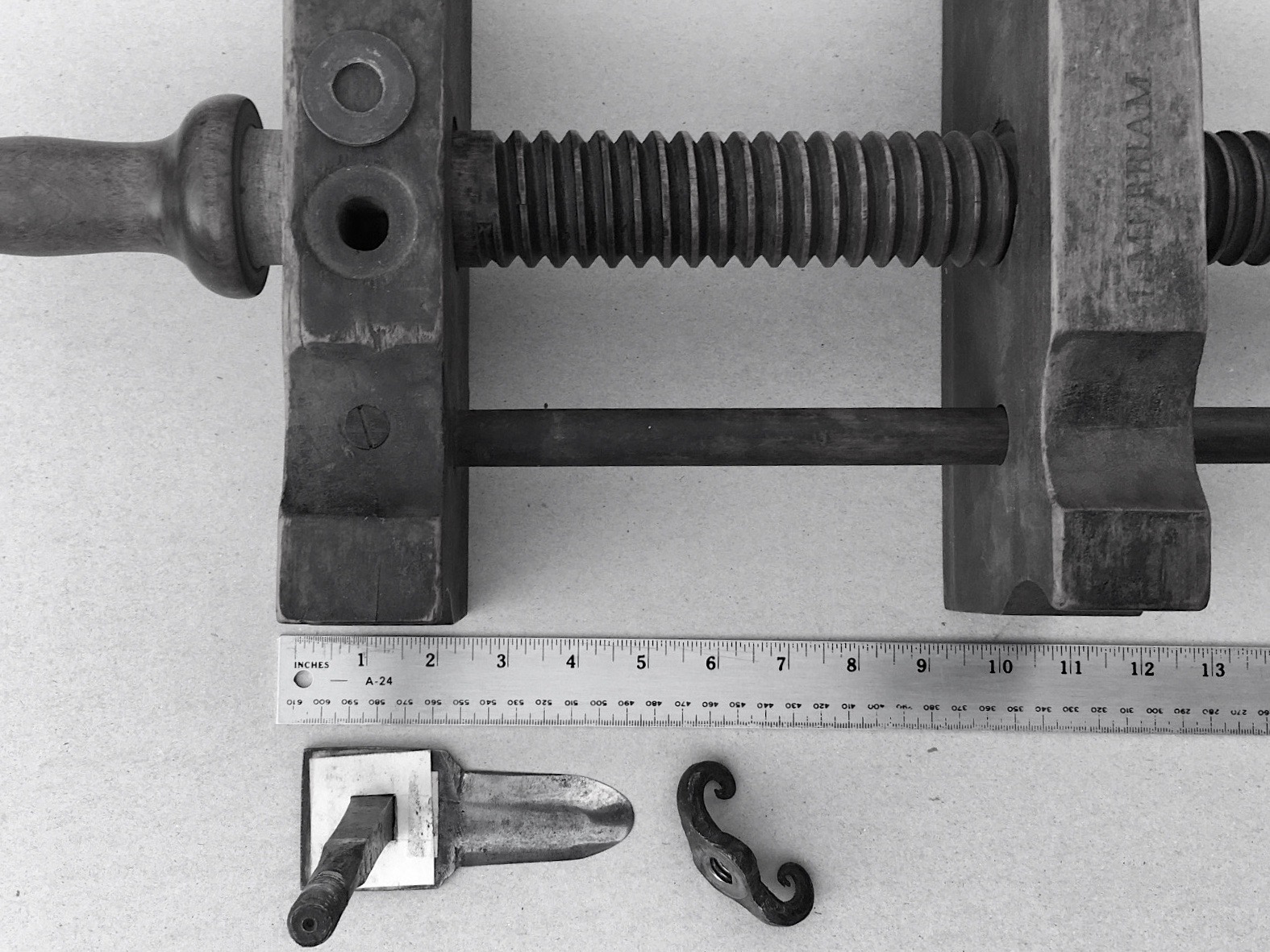
Top view with blade disassembled. Note the square attachment on the blade holder bolt which also fits into the keyway on the handle. Also note the common compression in the wood from the washer on this attachment.
The blade and mechanism is a classic “bolt knife,” the earlier and universal form in the 18th century. The “sliding knife” or “scotch knife” appeared early in the 19th century, but took many decades to completely replace the bolt knife, since the bolt knife was significantly cheaper. Crane’s Bookbinding for Amateurs has an 1870s or 1880s discussion of the two forms. On balance the bolt knife points toward an English origin and an earlier date; though, as I think I mentioned, I have a late Hickok “amateur” (small size) plough that is probably middle 20th century (small screw size) and know someone with a Hampson Bettridge bolt knife plough that is certainly post-WWII.
Bottom view of knife attachment. Larger bolt heads, like the above square, are generally earlier.
Back to Jenny’s photos, I notice that the butt end of the knife is not nearly as wide as the cut-out for it in the cheek; this suggests to me that it is the second knife for this plough, the first one having been sharpened down to nothing. I have seen bolt knives with five inches and more of blade, and I believe I have seen then with two inches or less remaining.
Not much to say here. The use of the bolt knife bolt (or of the analogous bolt for a sliding knife) to do double duty to make the cheek “follow” the screw in and out is usual for English presses, and frequent if not quite as common for American ploughs; it is found, with some variants that seem to come from lack of understanding the mechanism, on some French ploughs. The large diameter of the bolt is typical blacksmith-made English; machinist-made Hickok ploughs are usually thinner and lighter-weight.
$ $ $
I don’t know what ploughs would be worth now, since they are so rare. Fifteen or twenty years ago I was following binding equipment on eBay, and at that time you could get a new, real, plough from Frank Wiesner for around $500, suggesting a used price around $250; but the few that appeared on eBay didn’t sell for anything like that, and the market didn’t seem to distinguish between crap amateur-made ploughs and good professional ploughs. So few people know how to use them, or want them. I wouldn’t be surprised to see one with an asking price of $80 or $500 or more, I wouldn’t be surprised if one lingered unsold at either price, and I wouldn’t be surprised if one sold very rapidly at either price. I just don’t know. I have a small collection of ploughs, including good English, Hickok, and French ploughs, and two or three good ones I made; but I never paid more than $25 for one.




 Peachey Conservation