Last chance to order inexpensive bookbinding and conservation tools for the Holidays! Please note orders received after midnight Friday December 20 will ship January 6, 2020.
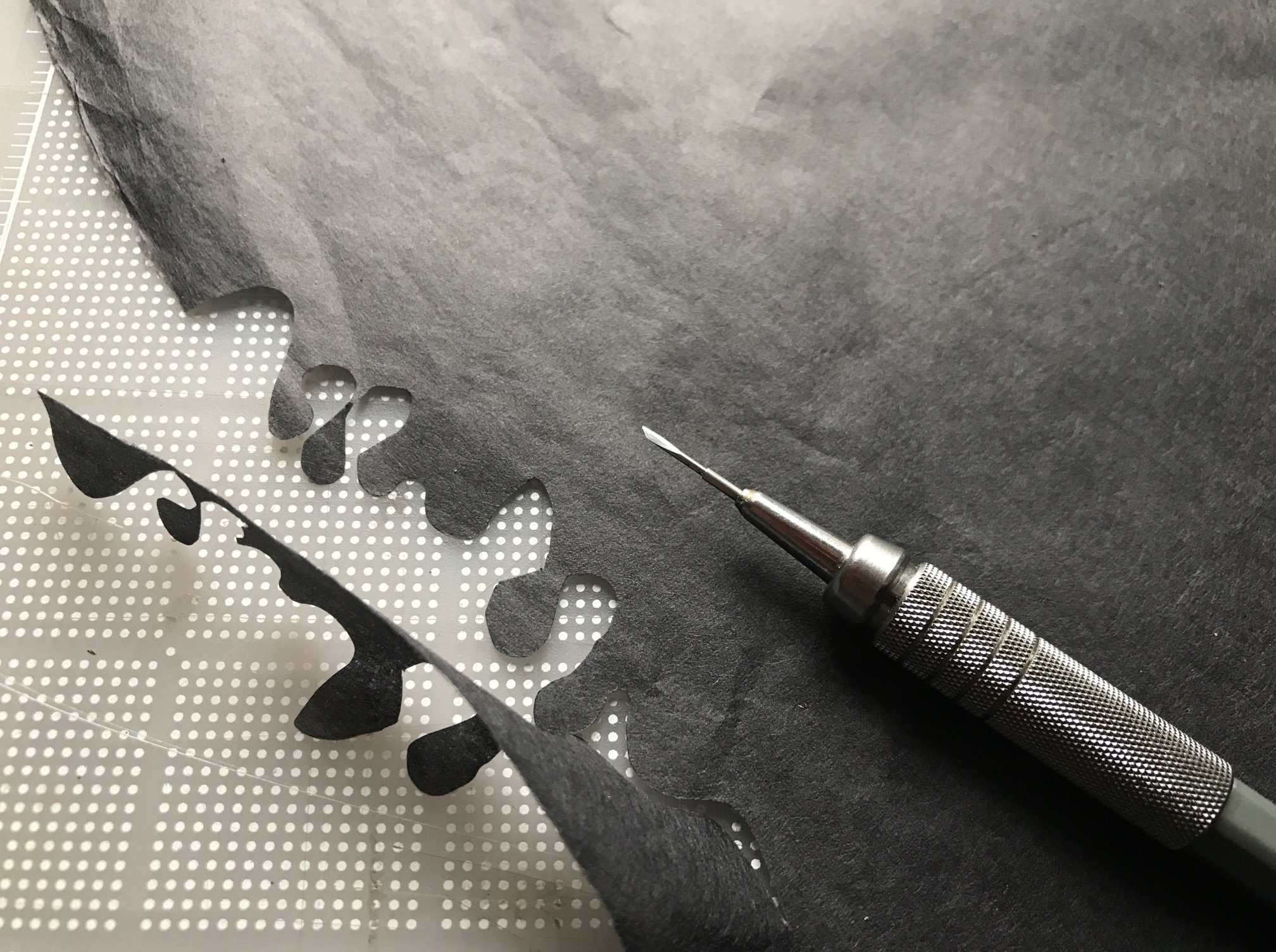
This was my best selling item at the Guild of Book Workers Conference a few months ago, and is new for this year. Perfect for intricate cuts in tissue and paper. Paper conservators love it for infills. Artists love it to make stencils. And everyone loves the cleaver design that retracts completely into the standard supplied .9mm mechanical pencil handle. Order your micro knife for only $35!
Delrin Hera
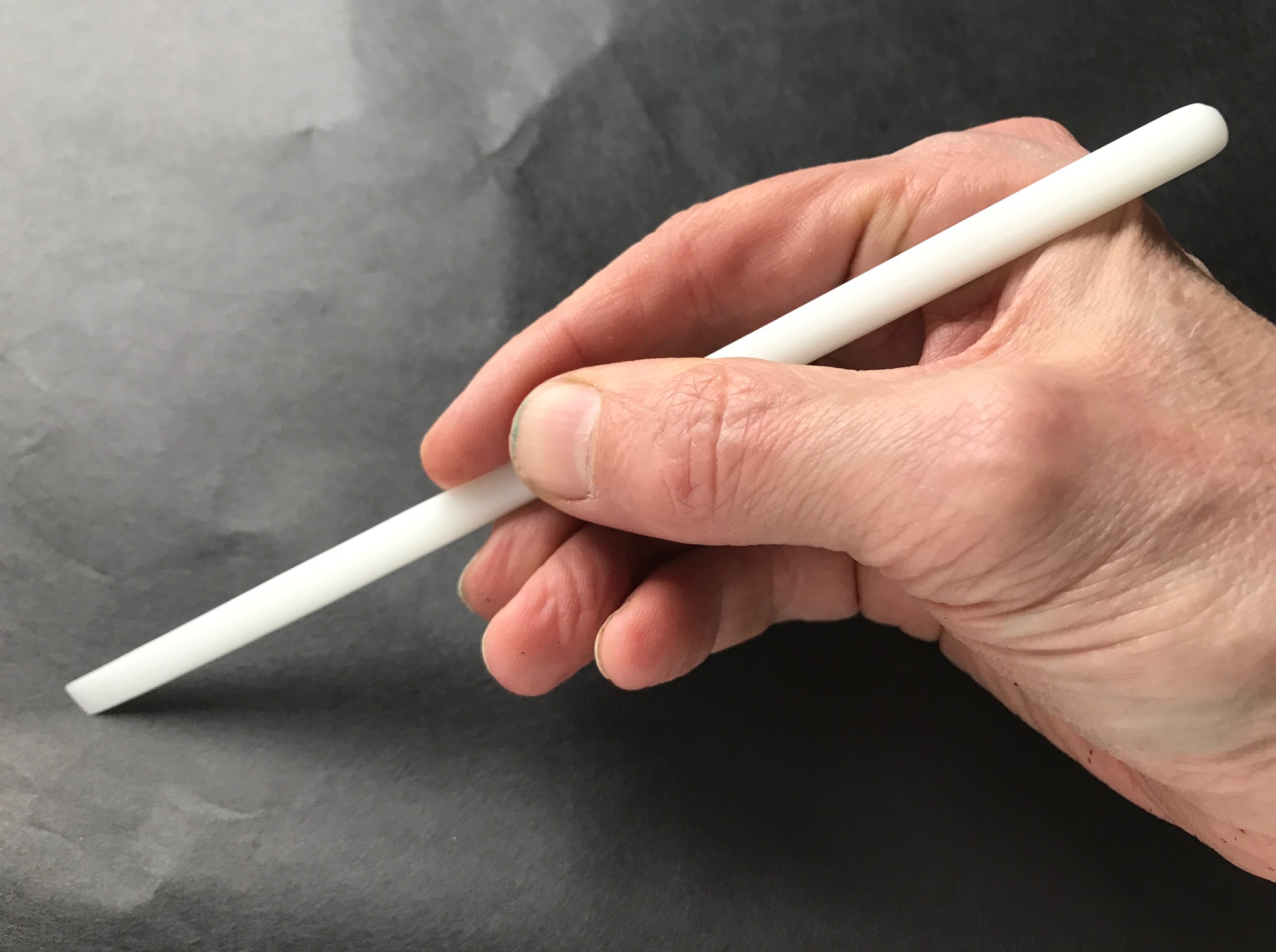
A delrin hera rapidly becomes indispensable for many bookbinding and conservation tasks. I use it to gently turn leaves of fragile books, delaminate hinges of matted artwork, hold leaves down during photography, insert adhesive into bent book corners, score tissue for dry tearing, and to pry apart covering material when rebacking. But you won’t pry this beauty out of my hand. Get your own delrin hera for only $45!
Some common sizes of linen thread for bookbinding, ranging from 18/6 to 80/3.
Bookbinders likely know that linen thread is classified by a two number system, such as 35/3. And most know that the second number represents the number of threads plied together, and the first number how thick or thin the thread is. But what does the first number actually refer to?
It turns out that two different systems, an English system and a Metric system that use a similar two part description of size separated by a forward slash. However, these two systems are not the same. Most thread sold by bookbinding supply companies uses the English System.
The English system (aka. Number English, Lea, NeL, Linen Count) is based on how many skeins (of 300 yards) make up one pound in weight. I *think* this means that twelve 12/1 skeins would weigh one pound, or thirty-five 35/1 skeins would weigh one pound. I’m still not sure how adding the plied threads results in the classification. Would a 35/3 thread weigh 3 pounds?
Tex — How many grams 1,000 meters of a thread weighs. In this case, the larger the number, the thicker the thread.
Denier — How many grams 9,000 meters of a various thread weights. Again, the larger the number, the thicker the thread. This is useful for very thin threads and microfibers.
Grist — Yards per pound. For example, a 20/1 linen is 3,000 yards long per pound. Different fibers have different weights.
I’m still not sure what system the Londonderry Linen Lacing Thread in the image above uses. It is labeled only a mysterious “#4”. I love sewing with this thread, though, since it is thick, soft, easy to untwist, tangle free without waxing, and remarkably compressible. It is possible to sew a book naturally packed with it. It consists of five plies, and is roughly equivalent to a 20/5.
If you are wondering what size thread you should use to sew a book, check out my Guide to Swell.
Finally, Colophon Book Arts is a reasonably priced, one stop shop to purchase a wide variety of sewing threads.
Cor Knops, of Knops Boekrestauratie in the Netherlands, kindly sent me these images of some antique thread he owns.
Great name!
These packages contain hanks of thread, and all weight about a pound. I think the package on the left is 25/3, and on the right 12/3. So if my calculations are correct, the 12/3 should contain 1200 yards of thread, assuming a 12/1 would contain 12 – 300 yard skeins = 3600 yards. Enough thread for a lot of books in any case!
What: A Lecture, The Conservation of Dante’s 1477 La Commedia
Who: Jeff Peachey
Where: Schlesinger Library, Harvard University, 3 James Street, Cambridge, MA
When: 6:00 – 8:00pm, November 19, 2019
The conservation treatment of of Dante’s 1477 La Commedia will be detailed in this profusely illustrated lecture. An examination of the remains of earlier binding structures, and decisions that lead to its resewing and rebinding in an alum tawed goatskin conservation binding will be discussed. During the treatment, evidence was found suggesting that the Inferno and Purgatorio cantiche may have circulated separately at one point. Differences between historic 15th century binding practices and modern conservation binding techniques will be highlighted, as will the difficulties of achieving a sympathetic relationship between original and new binding materials. Observations on the history, nature and idea of conservation rebinding will conclude the lecture, followed by an audience discussion. Conservators, bibliophiles, bookbinders, librarians, Italian scholars, and anyone curious about the physical structure of books will find this lecture of interest.
Dante rebound in a alum tawed calf.
Peachey Bio
Peachey is an independent book conservator and toolmaker based in New York City. For more than 25 years, he has specialized in the conservation of books for institutions and individuals. He is a Professional Associate in the American Institute for Conservation, has taught book conservation workshops internationally, and was awarded fellowships from the Rockefeller Foundation Bellagio Center (Italy) and the University of Toronto’s Fischer Library (Toronto). He is a Visiting Instructor for the Library and Archives Conservation Education Consortium (LACE) of Buffalo State University, New York University, and the Winterthur/ University of Delaware. “Ausbund 1564: The History and Conservation of an Anabaptist Icon” is his latest publication.
Sponsored by the NE Chapter of the Guild of Book Workers.




 Peachey Conservation