It has been quite a while since I vended at the Guild of Book Workers Standards of Excellence, so I decided to pull out all the stops this year and start to sell off some of the used tools and books I’ve collected over the years. Of course, all the new tools I make will also be available to inspect, test drive, and purchase.
I have a big bag of free horse butt scraps, no purchase necessary. Perfect to make small strops and blade covers.
You don’t have to be registered for the conference to attend. The Lowes Philadelphia Hotel is the venue in downtown Philadelphia, and vendor hours are Thursday October 24, 10 – 6, Friday 8 – 8, and Saturday 8 – 3:30.
I’m bringing around 75 books about books to sell, including these.
I’m also bringing a huge bargain box, filled with used bookbinding related tools: Starrett dividers, weights, knives, some prototypes of tools I currently make, a few older versions of tools — kind of a garage sale, really! All super discounted.
Even if you don’t want to buy anything, please stop by to say hi! It is always fun for me to meet those who read this blog.
A peek at the Bargain Box. First come, first serve!
A collection of handmade rug hooks bought in Prince Edward Island, CA.
I purchased this small collection of rug hooks while on vacation in Prince Edward Island, Canada, this past summer. Most of them have handmade hooks, and the handles are repurposed, altered, or custom carved. There is a compelling beauty to these humble and utilitarian objects.
Not only are they simply constructed, but they are extremely well used, which implies a degree of excellence. A poorly designed or made tool usually does not see much use! They are purely functional, with no decoration or even extra polishing on the hook end. Things that are well used and worn are an increasing rarity in our current culture. I sometimes refer to this as “use value”, but there must be a better term.
A precisely shaped hook at the tip.
They all have a square shaft end where the handle is mounted, and look hand forged. The overall length is almost exactly the same, so that they fit into the palm of a hand and the tip reaches near the end of a slightly bent index finger. Gravers have a similar length, and one of them has what looks to be a graver handle that is missing the ferrule (the second one on in from the left on the bottom).
Several of them have file marks near the hook, indicating they were sharpened, fixed, or altered. The thickness of the shaft in relation to the size of the hook makes perfect sense: I imagine the thick area pushing apart the backing, and the hook small and sharp enough to pull the material efficiently through.
The first one (top row, far left) reminds me of a Jim Croft awl handle, with its comfortable looking hand carved handle, worked just enough to knock any sharp edges, but not going overboard with sandpaper to make it smooth as if it were lathe turned.
Simple and ergonomic handle.
I imagine them gradually being shaped to the hands that used them over a long period of time. None of them seem to have any extra finish applied, so they feel like natural wood and oil from the hands. The shapes of the handles are all different, and likely the most individual choice.
They all demonstrate the two key aspects of successful tool design; the tool fits comfortably in the hand and fits efficiently with the material worked. They all look like they could comfortably jump into your hand and go to work.
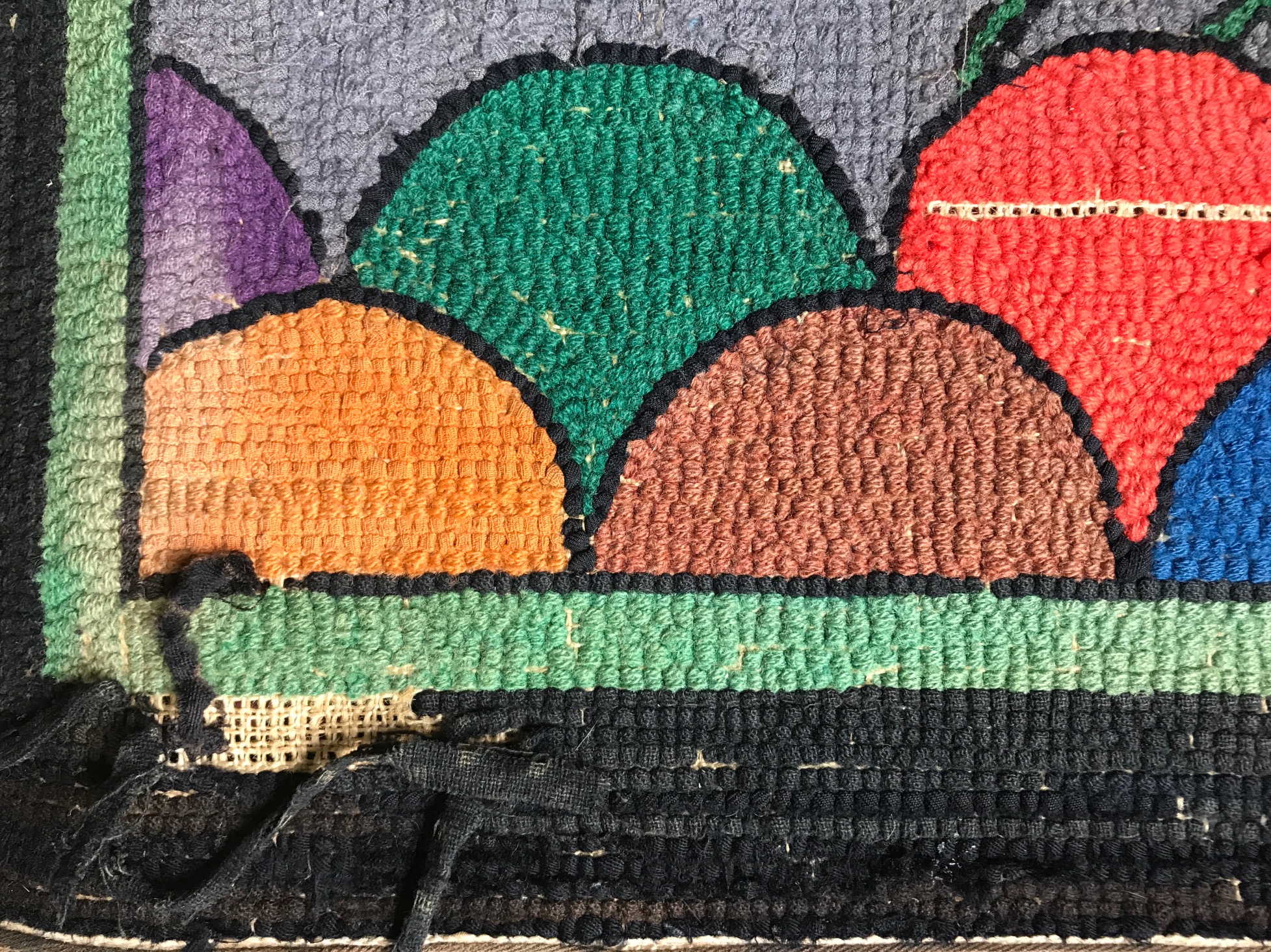
Detail of what a hooked rug looks like. They were often made of strips from worn out clothes.
A couple of weeks ago, Shiwan Rong and her crew from New Tang Dynasty News interviewed and filmed me in my studio. I recounted how I entered the field of conservation, explained some of the differences between conservation and restoration, and demonstrated a few bookbinding techniques. It was interesting to see what made it into the final cut, and despite some quibbles, overall it presents a reasonably accurate summary of what I said., considering that a three hour interview was cut down to two minutes!
One of the first questions was something like “How does it feel to be a master craftsman in the dying art of book restoration?”. This allowed me to explain that first of all, I am not a master craftsman, though I suppose anyone can call themselves one. Secondly, I discussed the differences between restoration, conservation, and bookbinding. Finally, I argued that the study and importance of the material nature of the physical book is thriving, not dying, in a large part because we as a society are not dependent on books simply for textual information. All in all, I hope the interview can educate the general public a bit about books and book conservation.
The video is accompanied by a written article and still images:



 Peachey Conservation