A couple of weeks ago, Shiwan Rong and her crew from New Tang Dynasty News interviewed and filmed me in my studio. I recounted how I entered the field of conservation, explained some of the differences between conservation and restoration, and demonstrated a few bookbinding techniques. It was interesting to see what made it into the final cut, and despite some quibbles, overall it presents a reasonably accurate summary of what I said., considering that a three hour interview was cut down to two minutes!
One of the first questions was something like “How does it feel to be a master craftsman in the dying art of book restoration?”. This allowed me to explain that first of all, I am not a master craftsman, though I suppose anyone can call themselves one. Secondly, I discussed the differences between restoration, conservation, and bookbinding. Finally, I argued that the study and importance of the material nature of the physical book is thriving, not dying, in a large part because we as a society are not dependent on books simply for textual information. All in all, I hope the interview can educate the general public a bit about books and book conservation.
The video is accompanied by a written article and still images:
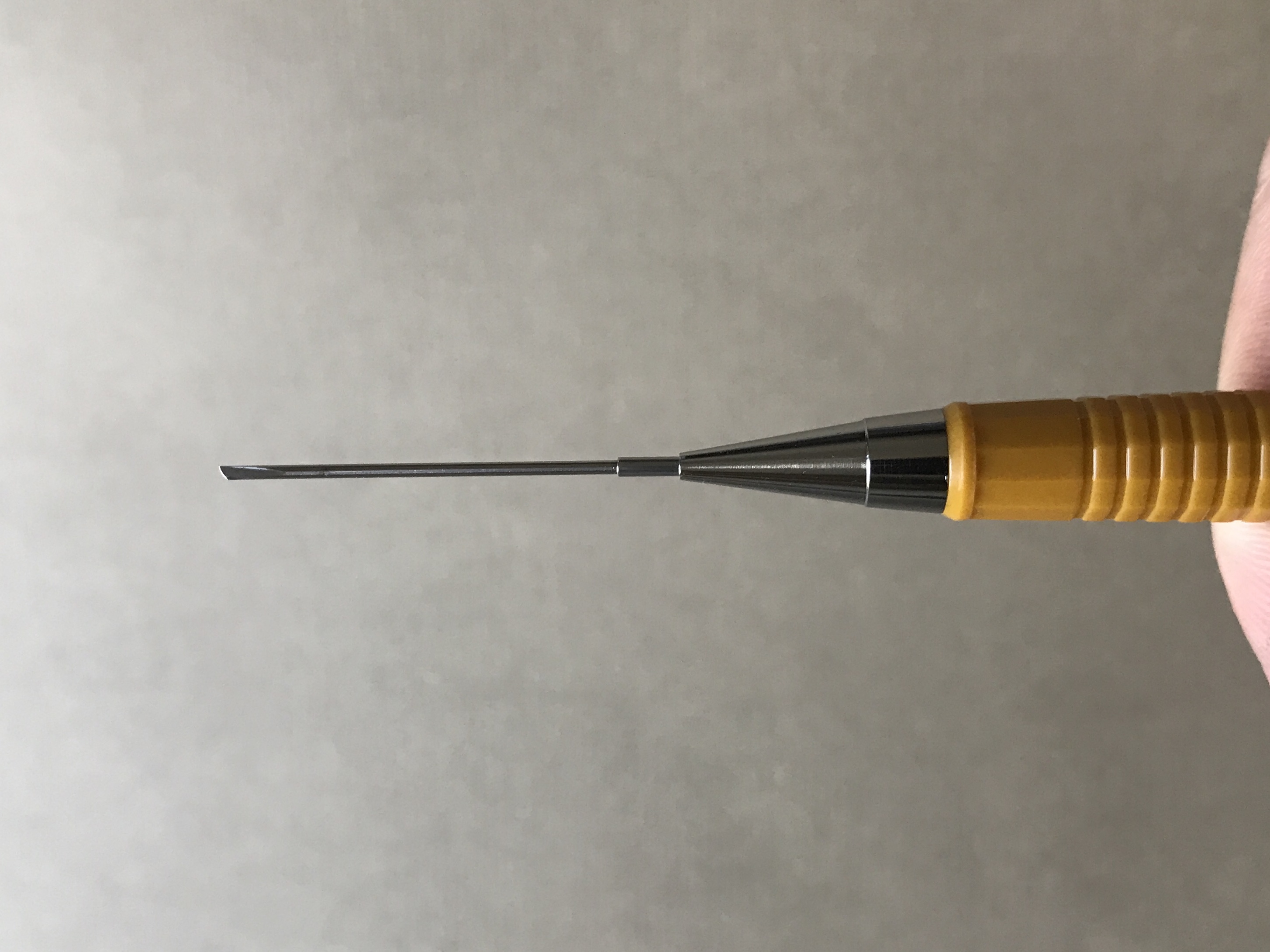
Micro knife slightly extended in its mechanical pencil holder.Micro knife fully extended.
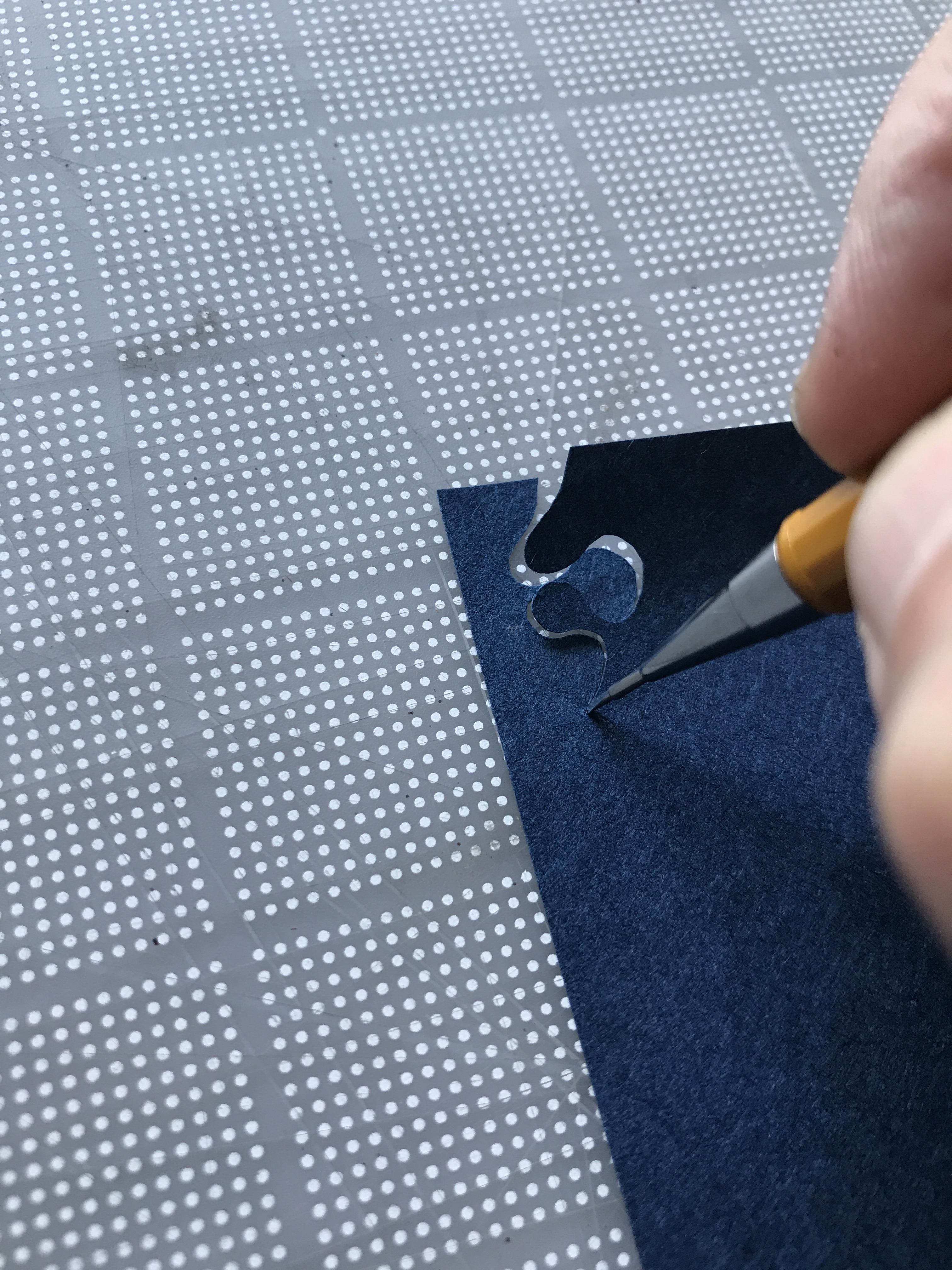
This is the smallest knife available on the conservation market, with a .9mm width. The M2 steel blade retracts into a standard supplied mechanical pencil handle, so it can be retracted when not in use. The blade can be extended to about 20mm to reach into recessed areas. It has a double bevel, and can be used for cutting complex fills, working under magnification, miniature bookbinding, anywhere you need to make precise small cuts. Can be resharpened and stropped. Or the blade could be dulled to use as a micro spatula. The M2 steel blade is hardened to Rc 65. Just don’t mistake it for a pencil!
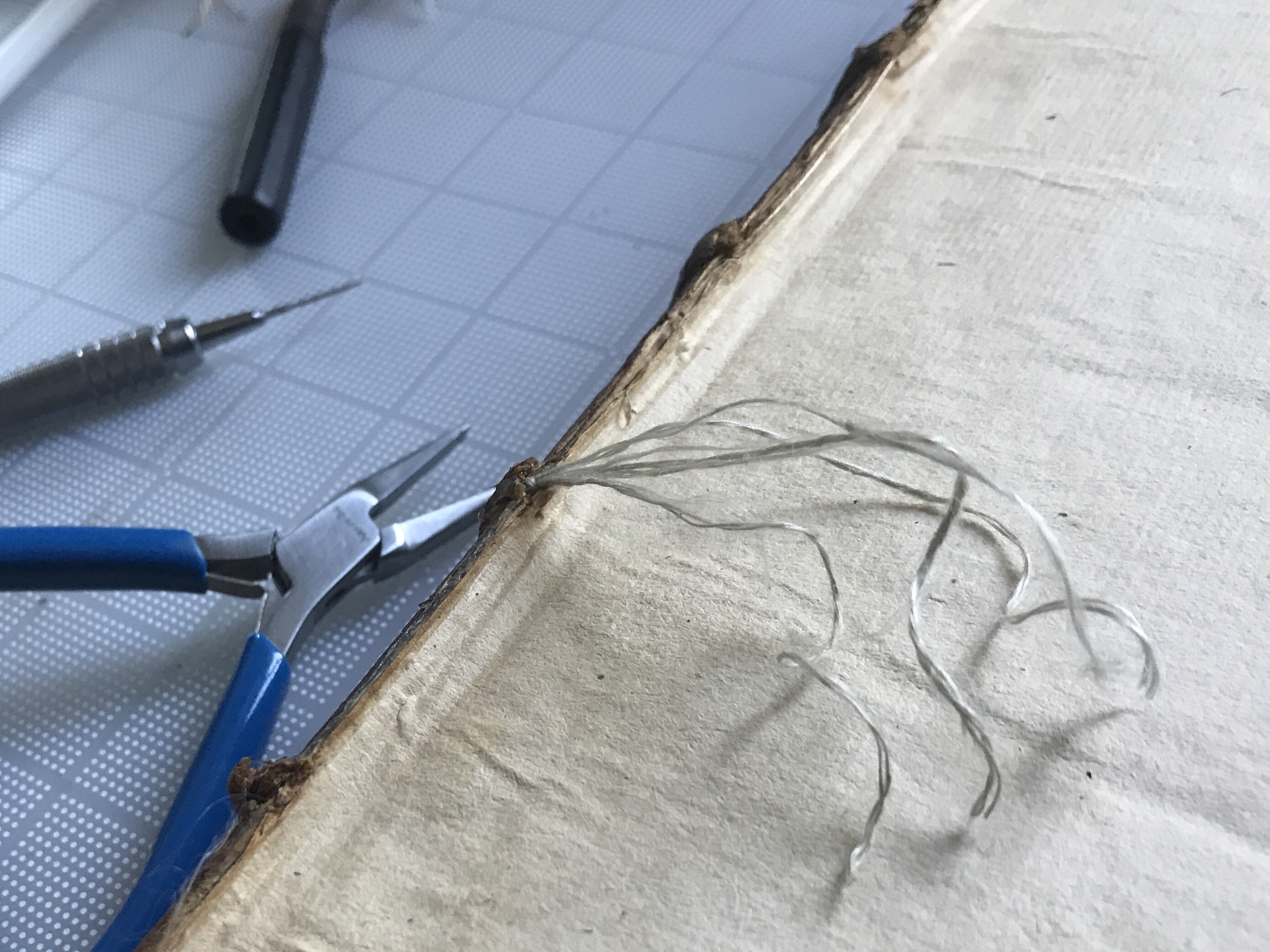
In this variant of sewing support extensions that I came up with, new thread is carefully looped in signatures and under or through existing cords, without having to lift the leather on the spine. Unlike joint tacketing, this method does not restrict the movement of the book spine at the shoulder.
I’ll be teaching this week long workshop for at Notre Dame University, South Bend, Indiana, March 9-13, 2020. The workshop will be devoted to a wide variety of contemporary book conservation techniques to deal detached boards, arguably the most common place books fail. There was much lively and informative discussion when I taught this two years ago at Emory University, and plenty of demonstrations and hands-on work time. The workshop details forty-six methods — although many are combined in practice — organized into five basic groups.
In this week-long intensive workshop, students will be introduced to a wide variety of current techniques used to conserve leather bookbindings. Book conservators, technicians, and bookbinders who wish to learn, expand, refresh their treatment skills are all welcome. Previous bookbinding or conservation experience is required.
Detached boards are the most common place leather bookbindings fail, and all five of the primary methods of treating this will be taught: mechanical sewing extensions and tacketing, inner hinge repairs, outer hinge repairs, interior-board repairs (both splitting and slotting), and several styles of rebacking. Many treatments involve a combination of these techniques. Questions concerning methods of consolidating older leather, the archival qualities of modern leather, and leather dyes will be discussed. A variety of methods to pare, consolidate, and lift leather will be introduced. Since a sharp knife is crucial to success in leather work, sharpening and easy ways to maintain a sharp edge will also be taught.
Participants should bring six to eight non-valuable leather bound books to practice on. It would be best to have a mix of tightback and books with hollows, and avoid case bound books. Skills to be learned include leather paring with a knife and paring machine, how various tools and machines for leather paring including a modified 151 spokeshave, and how to choose an appropriate lifting knife or tool for the task at hand.
There will be individual consultations with students before the workshop to discuss potential treatments for their chosen books, and determine if extra materials or tools might be required. Decision making based on the actual books brought to the class will be foundational.
The primary goal of this workshop is to equip participants with a more nuanced understanding of the pros and cons of currently practiced leather conservation techniques, gain supervised experience while performing them, and feedback when they are completed.


 Peachey Conservation