

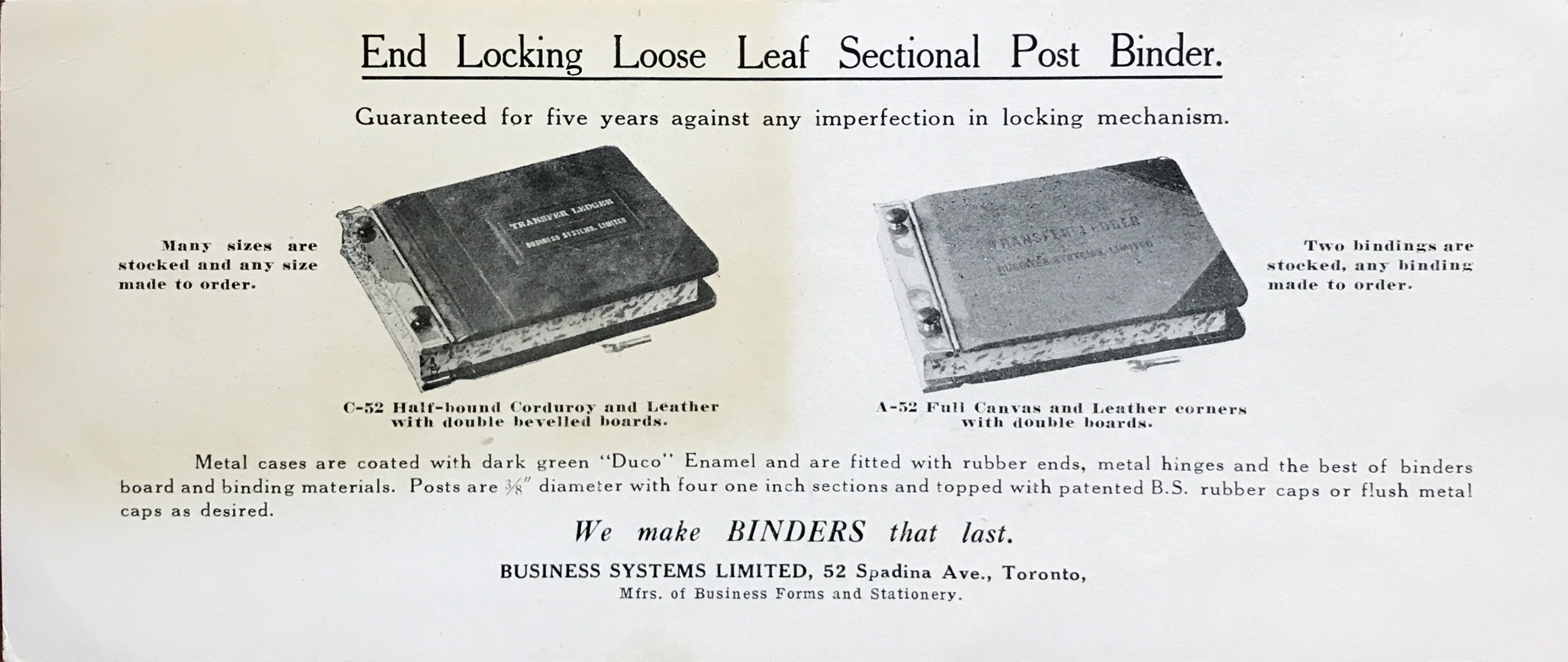
Expandable bookbindings are a fascinating subcategory of Account Book Binding. They are usually designed so that the owner can add or substract individual leaves. Six pieces of ephemera describing a nineteenth century French version of this unusual binding style are for sale from Charles Wood Rare Books, Catalog 179, #13. They were bound (permanently) by Leon Gruel in the 19th century. If you happen to have an extra $4,250.00 lying around, my birthday is coming up. Thanks in advance!
In the meantime, there are bits of internet flotsam and jetsam concerning this structure on the internet. It is difficult to understand from the image above, and almost as impenetrable from the google translated version from Le Normand’s Manual du Relieur below. Moulin du Verger’s complete version of the book is online. It was originally published 1827, but this description of the Relieur Mobile is from the 1900 edition. It may also appear in earlier editions.
I think the book functions by tightening the spine lining material — cloth, or skin — into a recess in the back board. It is tightened by the threaded rods, which are angled and clamp the pages with a bar at the back of the textblock. In order for this to work, the total width of the spine piece of the case has to be fixed. The drawing seems to indicate this. But if anyone has a better understanding….
Here is the relevant passage: “This binding, in which the whole mechanism is on the back, makes it possible to link provisionally all kinds of periodical collections, newspapers, music, etc., and even paperbacks or a collection of engravings, which one would like to read or leaf through before connect permanently. This will avoid the rustling of these collections, whose cover in simple paper never offers to the sheets that compose them a support capable of preventing that they are soon broken or crumpled.
The back is composed of two flat-iron rods: the angles on the inner side are chamfered, and diminish all the more, especially towards the middle, the width of the rod, which then presents an angle; these two sticks thus more easily retain the sheets that they are intended to tighten; the action of these sticks on the edge of these sheets actually raises a little the part, which protrudes and will lodge in the back, so that this part, abutting against the sticks, gives a solidity more to the binding by retaining more the leaflets that make up the collection. The chopsticks are attached to each of the two sheets of cardboard which complete the binding by hinged webs, and glued to the paper which covers the iron rod, which paper is prepared so as to adhere to said rod; these canvases allow chopsticks to have a movement that produces the same effect as a broken back. The canvas can easily be replaced by parchment, skin, etc.
Each rod is rounded at its extremities, one of which carries a milled copper barrel in all its length, and the other is pierced with a half-thickened eye to receive the neck of the screw of pressure; this screw serves to diminish or increase the spacing or the width of the back, according to the necessity imposed by the greater or lesser thickness of the collection which is to be introduced into this binding. However, as the length of the barrel could be an obstacle to the use of this binding for small quantities of leaflets, the addition of one or two wooden sticks, hollowed so as to be able to rely on the iron rods, fill the space not occupied by the sheets.
To guarantee the back of the inserted leaflets, a strip of paper, skin, etc., is glued to one of the iron rods; it comes down on the backs of the sheets, that it guarantees friction, and is thus fixed by the same pressure as that which acts on the sheets to retain them.
The head of the two screws is hollowed out for the introduction of a key for the pressure service; these recesses can be replaced by holes, as is practiced at the heads of the compasses.
The key in question is made like those used for this last object.
The sticks, as well as the cover, the barrels, the screws, etc., can undergo modifications, either in the choice of the material, in their cut or their notches, according to the different applications of this binding which can be applied to all formats of any kind of printed, engraved, lithographed publication and even to manuscripts; but the economy of: the invention will always be the same since it resides in the use of rods, as has just been said, in their meeting by a barrel crossed by a pressure screw, and in the assembling these parts to a blanket.”

 Peachey Conservation