
Bookbinder Colin Urbina recently posted a number of great images of books in art he noticed at the Art Institute of Chicago on his low_mountain instagram feed. In particular, the painting of Madame Francois Buron by Jean Louis-David caught my eye. It may give us some insight into how books were used in the eighteenth century, though there is always the possibility the books depicted were props.
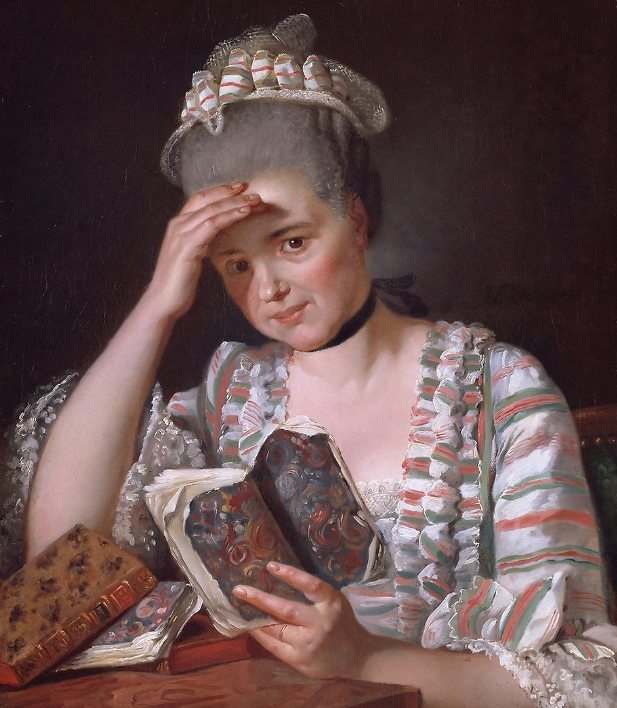
If this is an actual depiction of reading, it adds to the mountain of evidence that full leather trade bindings and “temporary” marbled paper wrapper bindings were consumed simultaneously. This type of pictorial evidence, along with the evidence from bindings that book historians such as David Pearson have gathered, and the usual working method of bookbinders, are all closing the coffin lid on the longstanding idea that paper bindings were intended to be rebound into a proper leather binding before use. The wear on the paper bindings —deftly painted with a white line along the top edge of the book Mme. Buron is reading — suggests these books may have been read before.
But it is a little strange to have four books so close at hand, since she doesn’t appear to be a scholar, and three of the books aren’t open to specific pages: evidence of cross-referencing. It could simply be her reading desk, though.
If the books are intended to be props, what can they tell us about the sitter, and how do they relate to the painting? Why has she interrupted her reading to look at us? And what could she be reading? Louis-David’s painting technique evokes the solidity of the leather bound books in contrast with the loose airiness of paper ones. The way the paper book is cradled in her hand is incredibly realistic. The brush work on the splayed page edges blend with the her blouse, and the triangular composition is anchored by the books. The books are a key aspect of the composition.
The details of the bindings are rendered exquisitely. The cat’s paw decoration on the full leather trade binding is instantly recognizable. The red over black title labels, full guilt spine, and single blind line on the boards is historically accurate. The paper bindings are covered in a common, or french snail marbled pattern. The pattern is rendered loosely, almost abstractly, in some areas. Or could it depict a spoiled sheet, not good enough for endsheets or other purposes?

The book she is holding, with its thick flatish spine apparent at the head, appears to have multiple signatures. Intriguingly, the paper covered book lying flat appears to be a single signature, which would be very unlikely for a letterpress book; could it be a blank book, notebook, or journal? Is it possible she is reading something private, like a diary?
She is shielding her eyes from the light source (truth?), but at the same time the page she is reading is in the shadows. She looks out at us with a concern, and possibly a bit of weary annoyance. The Hasty Book List also noticed she seems a little caught off guard or shy. A full size image is here.

