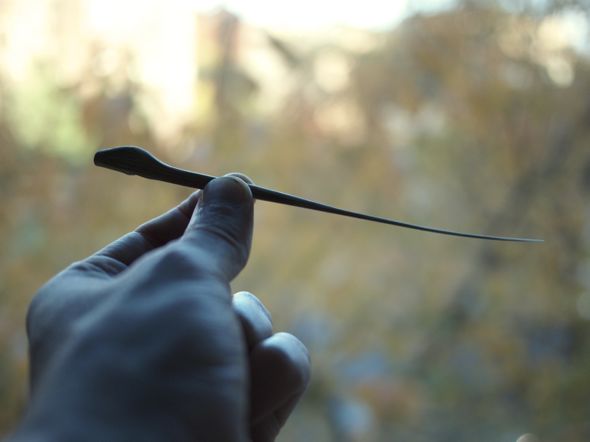
Tonkin Bamboo. Note the large areas of black power fibers. Compare this to the endgrain of a chopstick.
Hera are small Japanese tools useful for a variety of scraping, lifting, and delaminating tasks. They are common in paper conservation. Tonkin is a dense, flexible and strong type of bamboo that handmade fishing rods are made from. More about Tonkin. Heat treating increases the elasticity of the bamboo.
Even so, hera with very thin and flexible tips can wear and can crack, so they need to be maintained by sanding, carving, reducing the width, or even shortening. Once you have the skills to make a hera, they are easy to maintain. If you want to keep things simple, shape it with your Olfa knife, sand it with 220 grit, then finish it with 600 grit. More tips on shaping bamboo.
These blanks are roughly 6 inches long, and 1/4 – 3/8 inch wide. If you want to make two narrow hera, you could split a wider blank. Just ask me for the widest one I have. Making your own tools to the exact size and shape you need is rewarding and satisfying.
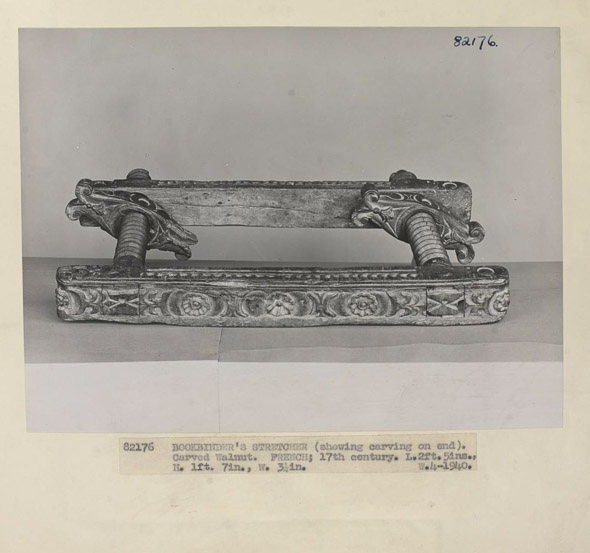
It would be nice to have a book stretcher on occasion, though. Need to turn an octavo into a quarto? No problem! But was this really a book press, or a press intended for some other purpose? The 29 inch long cheeks are very, very thin in profile, and I imagine would deflect quite a bit even with just hand tightening.
Hats off to the V&A has a very progressive large image use policy. You can download them instantly, share them widely, and even use them for publication. There are almost 750,000 searchable images on the V&A site. Let’s hope all institutions free their images.
One of the most common mistakes in sharpening is to allow your stone or film to glaze over. This significantly increases sharpening time, since the knife is not abraded by the grit, but is burnished against embedded steel. Not using enough lubricant is a common reason for this, as is not regularly cleaning your substrate. Depending on the size of the grit, either a microfiber rag or a white vinyl eraser works best.
My sharpening setup, above, consists of a bright swing arm lamp mounted directly above a cork faced workbench (PSA cork shelf liner), a microfiber rag, a large squeeze bottle of water, and the Peachey Sharpening System. I find it more comfortable to sharpen at a lower height, around 34 inches, than my regular bookbinding workbench. Many hundreds of knives have been sharpened here!
The microfiber rag is perfect for cleaning larger grit 3M micro-finishing film, from 80 to around 15 microns. This rag was white when I purchased it, a testament to how well it picks up and retains small metal particles. I also use it to clean off the knife between grits in order to examine the scratch patterns.
For 5 micron and smaller grits, a white vinyl eraser works wonders. Pictured above is the neon lime green 1 micron film, which glazes quite easily. Using the eraser on coarser grits eats it up too quickly.
Of course, over time, the abrasive will wear to the point nothing much happens, and you will need to replace it. I can usually sharpen ten knives or so on one piece of 2 x 11 inch film.
By using plenty of water as a lubricant, and cleaning the film after each use, the effective working life of finishing film will be prolonged.