What is a Conservation Binding?

The term “conservation binding” gets thrown around a lot. It certainly sounds different than just rebinding a book. But what does it really mean?

It is unknown who coined the term, and a google ngram search shows its use beginning in the 1960s, and peaking in the 1980s. It wouldn’t surprise me if it actually started in the 1950s in England. The 1980s were the peak of rebinding in book conservation, which resulted in many treatments that we would now consider too invasive. But the ethos then was to treat a book so that it would last 500 years. Of course, the correlation between the use of the term and making a conservation binding is not known.

Source: https://books.google.com/ngrams/graph?content=conservation+binding&case_insensitive=on&year_start=1900&year_end=2000&corpus=15&smoothing=3&share=&direct_url=t1%3B%2Cconservation%20binding%3B%2Cc0

The trouble is, it doesn’t have any agreed upon meaning, similar to the even more ubiquitous term “archival”. All the usual suspects for bookbinding terminology — Language of Bindings, Carter, Etherington, The Multilingual Bookbinding and Conservation Dictionary — don’t have an entry for conservation binding. In practice, it can simply mean a binding done by a conservator. And anyone can call themselves a conservator. Or it can often mean a reversible layer of paste and Japanese tissue on the spine of a fine binding. Or it can imply the use of durable and modern conversationally accepted materials (i.e. linen, handmade paper, tawed skin) incorporated into a binding, with minimal attention paid to decoration and finishing.

So here is my first stab at a definition:

A conservation binding is a rebinding that is structurally similar and aesthetically sympathetic to the time the text was printed. It is durable, easily reversible, non-damaging and alters the original binding materials as little as possible. It does not fool someone into thinking it is an original binding, though it is harmonious with actual historic bindings.
A Copy Press With Two Threads

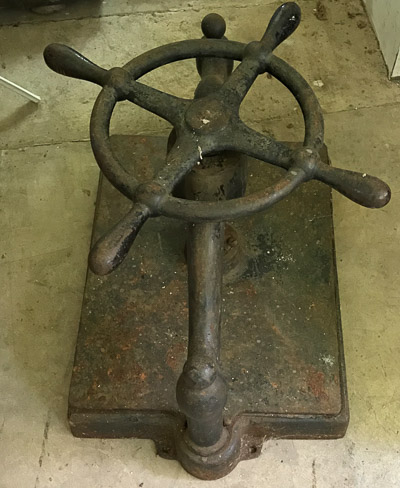
Mark Anderson, Furniture Conservator at the WInterthur/ University of Delaware Program in Art Conservation, is fixing up a copy press for their Book Conservation Lab.  At first glance, it is a large but typical press, though with a nice hand-wheel with spokes extending beyond the rim, useful for extra leverage or pretending to be a captain steering a ship.

Copy press usually have a steep thread pitch, which is great to move up and down rapidly, but they generate a lot of friction when tightening, therefore can’t generate as much pressure as a real book press. This is compounded by a common tendency of not attaching them to the bench. There is a reason almost all presses — like the one below — have four holes cast into the base, in order to screw into the bench! I guess that by having to hold a press with one hand, and tighten it with the other, the total compressional force is reduced by 25% or more.

Large copy press. Photo: Mark Anderson

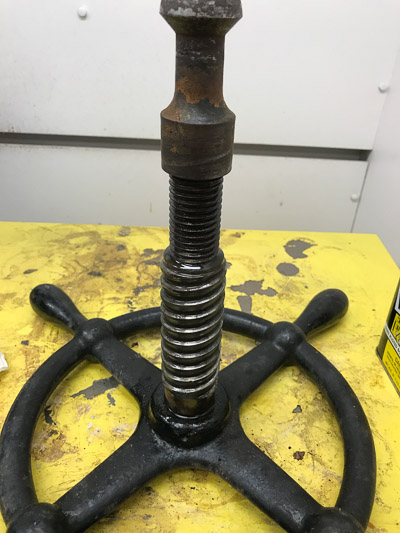
Once Mark took apart the press to clean it, he noticed an unusual aspect: the central screw had two different screw pitches and diameters on it. Apparently the finer thread is internally threaded into the larger one, though it is currently frozen.

Two different thread pitches and diameters. Photo: Mark Anderson.

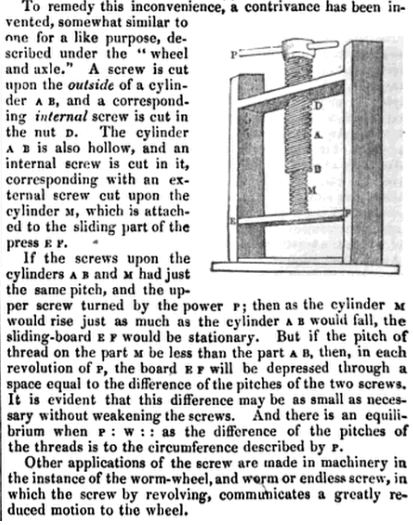
A similar style of screw is mentioned in the 1843 Practical Mechanic and Engineer’s Magazine. There  may be earlier examples. Even today, external threads are sometimes referred to as male, and internal threads as female. In a surprisingly contemporary note, the writer in 1843 recommends that this coarse language should be abolished.

Source: The Practical Mechanic and Engineer’s Magazine, Volume 2, p. 204.

Although Mark’s example is inoperable at the moment, presumably the larger external coarse thread raises and lowers the platen quickly, and at the same time the internal thread moves more slowly, due to the finer pitch. But when the press firmly tightened, the smaller internal thread kicks in to apply more pressure. Fast operation and lots of pressure would be ideal for a copy or book press.

Source: The Practical Mechanic and Engineer’s Magazine, Volume 2, p. 204.

For this to work, the finer thread needs to be affixed to the platen, as in the image from The Practical Mechanic and Engineer’s Magazine. In the press Mark is working on, it looks like it spins in the top of the platen, like most copy presses. An alternative explanation might be that the finer threads were left over from a different project, or cut wrong? But if this mechanism works as advertised, why wasn’t this a more popular mechanism for copy and book presses? Hopefully he can get the screw unfrozen and we can find out.


Long Live the Superstrop

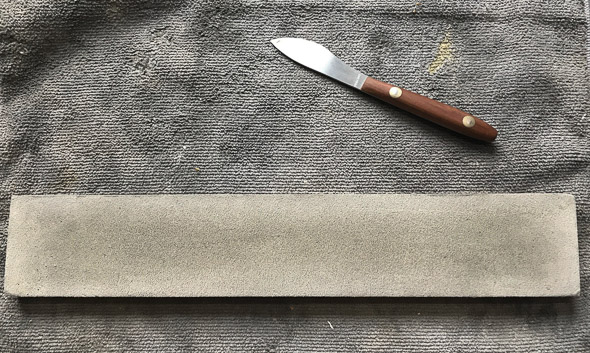
I introduced the Superstrop about eight months ago, and have been using this one for over a year without having to recharge the substrate, which is a .1 micron Poly Crystalline Diamond spray.  And last month, seven students used it to make a total of 24 leather bindings. So I’m guessing one application of the diamond compound, which comes with a new strop, will last at least a number of years under normal use. The substrate itself is more durable than leather. It holds the small diamond particles in place, allows them to move around a little to expose sharp edges, and doesn’t glaze over.The small knife at the top right is a prototype paper conservation scraping knife. Get the Superstrop here