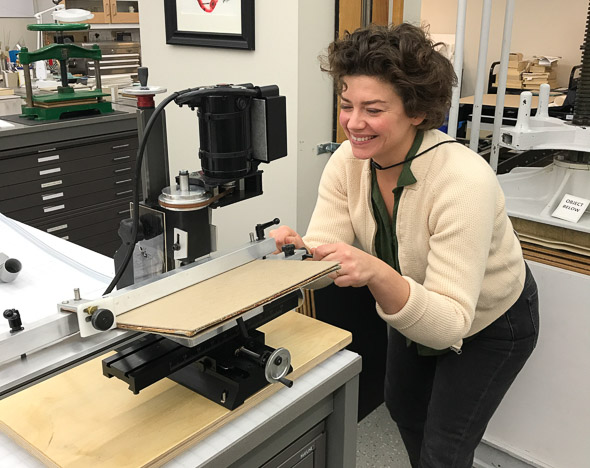
Jennifer Jarvis, Conservator in the John Hopkins Department of Conservation and Preservation, demonstrates how fun book conservation is using the Peachey Board Slotting Machine.
John Hopkins Department of Conservation and Preservation recently acquired a Peachey Board Slotting Machine as another technique in their book conservation arsenal to reattach detached boards. Detached boards are likely the most common place books fail. This machine accurately cuts a very small slot, as thin as .015″, to allow a hinge to be inserted without disturbing the covering material or obscuring evidence of lacing, board attachment, etc…. The machine is manually operated, and can accommodate boards up to a 18″ high. The start and stop of the slot is controlled by setting adjustable stops.
No matter which side of the fence you are on regarding the use of leather in book conservation, board slotting with a cotton or linen hinge is a strong and durable base. The fabric can be left alone or colored with acrylics for fast repairs. Or board slotting can be combined with other treatments — such as tissue repairs, cast acrylic repairs, and leather onlays — to achieve a high degree of aesthetic integration. Board slotting is especially suited to nineteenth century leather bindings with a made hollow. More information on different structures for board slotting.
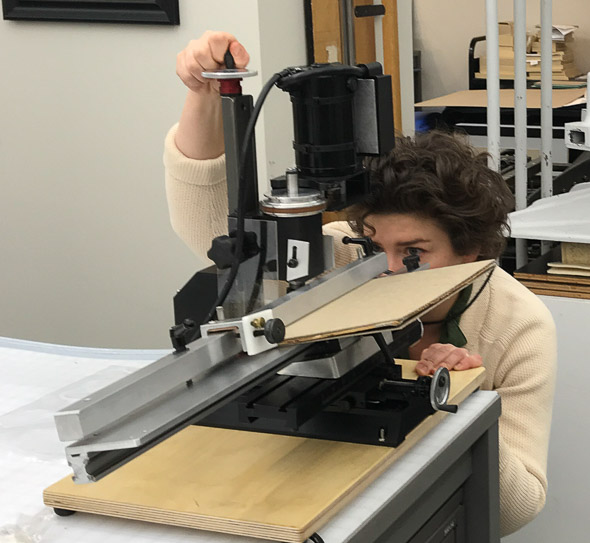
Jennifer Jarvis aligning the height of the blade where it will begin making the slot. This is much easier on the new machine, since you can sight the length of the board from the end of the machine.
Traditionally, leather paring knives either have round or straight cutting edges. I discuss the advantages and disadvantages of each in this post. I usually use an English style straight blade, but became tired of the fact it could only be used for edge paring. Partially inspired by the rounded corners of a spokeshave blade, I made a couple of other modifications to a standard M2 English style knife so that it can be used for more than edge paring.
A slightly curved cutting edge on essentially an English style knife allows it to scoop out leather, necessary for the spine area, headcaps, and decorative work. The blade is oriented at a 45 degree angle, like an English knife, so right and left handers need to purchase different knives. The corners of the knife are rounded so that the tip or heal will not cut through the skin while performing this scooping action. The tiny secondary bevel allows quick resharpening.
This knife can be used for all types of paring necessary in bookbinding: edge paring, reducing spine and caps, paring deep into a skin (similar to a spokeshave’s action) and even for overall scraping, if you are into that.
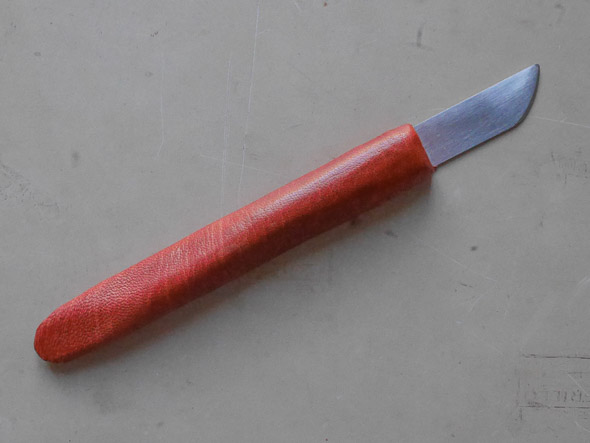
M2 Hybrid Knife. Around 8 – 9 inches long, and 1 inch wide. Since the grind marks on the primary bevel go along the length of the blade, the primary bevel is not apparent when looking at the top of the knife. The exact curve of the cutting edge varies a bit from knife to knife.
A lower angle primary bevel cuts down on the amount of time it takes to resharpen the blade, since there is less metal to remove. The 13 degree cutting edge is only a millimeter or two. The disadvantage is that there is not a large enough bevel that you can feel when you put your knife on the sharpening substrate; you have to trust your hands and the angle you are holding it at. This is quite similar to sharpening a kitchen knife by hand. Another advantage of the small secondary bevel is that it can be stropped back into shape very quickly, again because not much metal has to be removed. This is a perfect blade for sub-micron stropping. M2 steel seems easier to strop than A2, for some reason.
Cross section of primary and secondary bevels.
The slightly curved blade creates more opportunity to find a sharp area as the knife dulls, so it can be used longer. Straight blades, as they become dull, don’t seem to bite the leather enough to get started with a cut. The disadvantage is you can’t just rub it back and forth like a standard straight edged knife when resharpening. Stropping takes a slight twist of the wrist, to keep parts of the cutting edge in contact with the strop throughout the stroke.
The rounded areas allow you to work into a skin, for headcaps and the spine. But the shape also allows you to use it like a standard English style knife for edge paring.
The third change is that the tip and heel of the cutting edge are rounded. This prevents the knife from cutting through the skin when you are working away from the edge, similar to how a spokeshave blade works. In practice, I don’t miss having a pointed, sharp tip. A rounded tip also makes it less likely to dig into your paring surface.
The M2 Hybrid used like a standard English knife for edge paring.
All of these aspects combine to make a sensitive and versatile knife intended for professionals. An analogy for cyclists might be this is more like a track bike than a road bike. This knife, in addition to edge paring, can do most of what a spokeshave can do, albeit with more “workmanship of risk”. If you want the most versatile knife on the market, look no further.
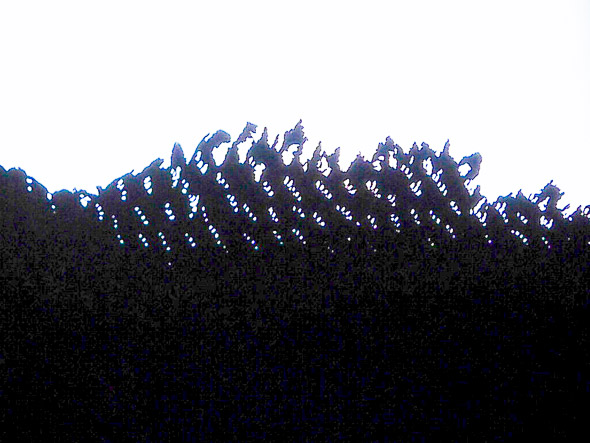
Close up of a piece of goatskin feather pared,, so that the valleys of the grain are cut through. The middle of the blade was used for this, almost parallel to the edge of the leather..Progressively paring towards the center. The rounded edges keep the blade from cutting through the leather as it stretches.
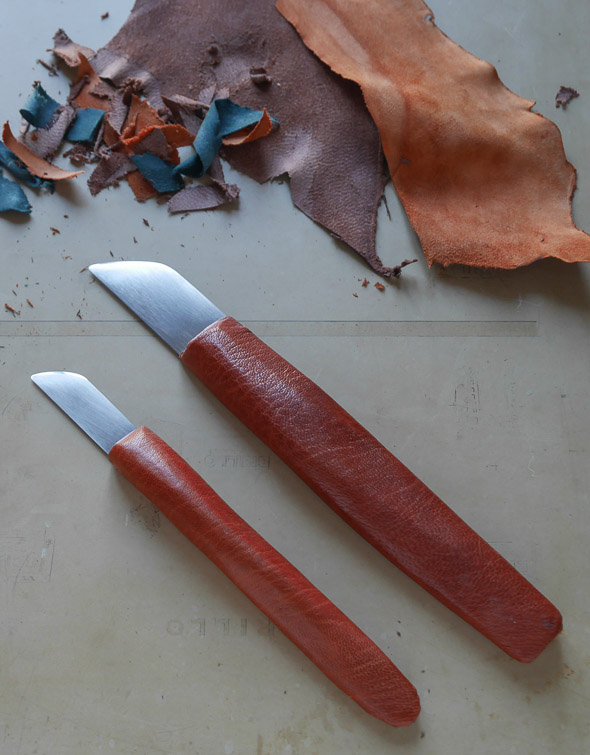
M2 Hybrid Paring knife. M2 Steel. The handle is hand carved wood, covered with vegetable tanned goatskin, and ergonomically shaped. The metal is .040″ thick, the handle around 5/8″ at the thickest point. It is about 1 inch wide and around 8-9″ in overall length. The secondary bevel is 13 degrees. Hand sharpened to .1 micron.
Small M2 Hybrid knife. The best knife for onlays and intricate leather decorations. Also great for paring paper. M2 Steel. The metal is .025″ thick, about 5/8″ wide and 6-7″ long. Leather covered wood handle. The secondary bevel is 13 degrees. Hand sharpened to .1 micron.
The Small M2 Hybrid Paring Knife. $150.00. Order here.
Small M2 Hybrid knife bottom left, regular size next to it.
The idiosyncratic spelling of “Craft” is intended to reference the earlier Anglo-Saxon conception of craft. The 2018 American edition is titled “Craeft: An Inquiry into the Origins and True Meaning of Traditional Crafts” The 2017 English edition is titled “Craeft: How Traditional Crafts Are About More Than Just Making” Does the publisher think Americans like the “true meaning” of crafts? And the English assume craft is just about making stuff?
Book Review. Alexander Langlands, Craeft: An Inquiry into the Origins and True Meaning of Traditional Crafts. New York: W.W. Norton, 2018.
People working in craft often have philosophic inclinations. We work outside of mainstream society. We make objects that are not strictly necessary anymore. Combine this with long hours working alone, extremely repetitive hand work which affects the rhythm of our thoughts, getting lost in archaic techniques, and it only seems natural existential questions arise. What am I doing? Why am I doing this? (and the annoying corollary, why am I doing this for so little money) Does it matter? Is craft in the 21st century anything more than a marketing term for a new cider? As partial compensation, I habitually buy most new books on the philosophy of craft, which means I must be looking for some new insight or different perspective.
With a few significant exceptions, the history of craft is recorded by writers and artists who described the actions of a craftsmen, but were not experts in the fields they described. Alexander Langland continues in this tradition. “I’m no craftsman” he announces near the end of his book. (297) He does consider himself a “jack-of-all trades, master of none”, though. There is an almost universal prohibition against attempting to learn too many trades in most languages and cultures on earth. But why? Most people I know who are good with their hands are adept at a number of crafts. Is mastering a craft a different category altogether?
Langlands writes with a poetic sensitivity detailing the activity of handwork which renders the fact he is not a professional craftsman irrelevant. I became completely absorbed in his descriptions of hand work. David Esterly’s Lost Carvings (my review here) may have been the model for this style of craft writing: you feel you are inside a craftsman’s head, thinking what he is thinking while he moves his hands and tools. Esterly is a master craftsman writing about his own long years of carving. Langlands admits he is good at talking about it. (297)
Over a dozen crafts are described in Langlands book. Descriptions of performing a craft can sometimes go on for pages, and could have easily become inconsequential and dull. With Langlands firm narrative, however, they are engaging and even exciting. For example, the chapter on making a thatch roof is almost pornographic in detail; from sharpening the scythe, selecting the stubble thatch, twisting the thatch, augering the rafter peg holes, pegging it with a square greenwood trenail, driving the spars, and more. After reading, I felt exhausted and relieved to get off the roof and have the day’s work finished.
Each chapter has a similar recipe. He starts by placing a particular craft in a historical context, mixes in a bit of etymology, describes the importance of the materials, then narrates his own experimental recreation. His background as an archaeologist and British television personality (The Victorian Farm, The Edwardian Farm, Wartime Farm) serve him well in presenting the information in an engaging and readable manor. The chapter on weaving and hurtle fence making, for example, is exemplary: he unites these two disparate appearing crafts through a fundamental commonality of warp and weft. All the while he emphasizes the respect he has for the abilities of earlier craftsmen.
Though the book is filled with interesting factoids — who knew that the tines of traditional wooden French pitchforks are made out of trained branches! — the real value is in Langlands’ underlying conception of craft, “… a vehicle through which we can think, through when we can contemplate, and through which we can be.” (343) He continues a philosophy of craft born in the arts and crafts movement, then overlaid with a bit of Richard Sennett (The Craftsman, my review here), David Pye (Nature and Art of Workmanship), and Howard Risatti (Theory of Craft). Another great strength of this book is the explication what he feels is the “craeft” way of knowing: evaluating and sourcing raw materials, working within constraints of cost and time, using your hands, and working towards a specific means. Craft, to Langlands, is not just a final product, but the sum total of the involvement in the process by the craftsman with the environment. Is this just a slight variation of farm-to-table cooking applied to objects?
For all of practical and engaging description, and his extensive experimentation, he has a romanticized view of craft, likely because he is an amateur. “Perhaps harshly, I would not consider a topiarist who uses electric hedge trimmers a true craftsman on the simple grounds that the tool mutes their level of engagement with the material properties of the entity they are working.” (36) Attitudes toward work — even for a real craftsman — change quite a bit when doing something day after day, month after month, year after year, decade after decade. Pecuniary pressures can also negatively impact a craftsman’s enjoyment of work. David Pye would also take issue with this statement, though on the grounds that an electric hedge trimmer takes a great deal of hand skill to operate, and the source of the power is irrelevant.
Langlands pays little attention paid to how craft skills are passed on or inherited. For all of his emphasis on craft as a integrated system and way of thinking, this is a significant omission. When discussing a Viking longship, he theorizes “It’s a craft that relies on building something relative to the materials employed… allowing the materials to speak for themselves, to answer back, to tell you what the natural shape must be…” (333) This sounds more something you would hear from an exercise guru or in a Monty Python skit, not the way a craftsman would think about constructing a ship in the ninth century. “Thor, let the keel timber be what it wants to be!”
There are several chapters where he describes the actions of a skilled craftsman, but he does not investigate the transmission of knowledge. Re-enactment, etymological history, and the study of extant artifacts are his primary methods of inquiry. But this was is not how craft was taught and transmitted for most of human history.
At the risk of coming across as a mystic, but I do believe Craft (with a capital “C”) resides outside of objects. Craft objects are the result of Craft. Learning or experiencing this way of thinking is traditionally taught through close contact with skilled practitioners. But I also think you can get there on your own, it just takes a lot more time. Before the nineteenth century this took place in apprenticeships; now it is more commonly acquired during internships. The transmission of craft knowledge is an important part of the entire craft ecosystem.






 Peachey Conservation