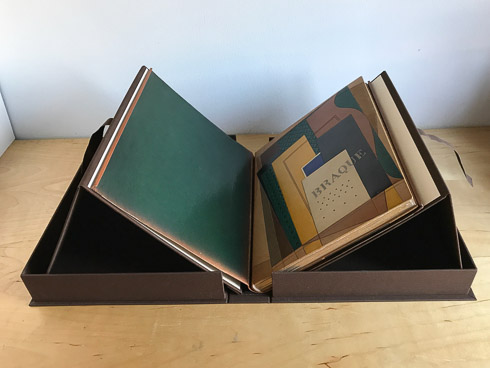
Nine years ago I designed a new style of cradle box, and it is rewarding to see the idea picked up by others. Below is recent one I made is for this stunning early 20th century French fine binding. The cradle also supports the slip-case chemise which is quite fragile. The slipcase itself is missing, or maybe it never had one.
French fine binding in a cradle box. Private Collection.
A collection of boards bindings from a circulating library is being sold by Antiquates. Considered together, it forms pretty strong evidence against the traditional view boards bindings are entirely temporary structures, since the books contain circulation records.
Bookbinders might be interest in several other items in this catalog, particularly a run of The Bookbinding Trades Journal, or a fascinating book (I have a reprint) that details the murder of a bookbinder’s finishing tool maker by a bookbinder: Cook, the murderer, or the Leicester tragedy: Being a Full and Faithful Account of the horrible assassination of Mr. John Paas, of London, On the 30th of May, 1832, perpetrated by James Cook, of Leicester; with an authentic detail of the cruel means adopted by the murderer to accomplish the bloody deed…. A short summary of the incident is on the British Library Blog.
And if a reader of this blog is feeling the holiday spirit particularly strong this year, I confidently recommend that any of these items would make a wonderful Christmas gift for me. Thanks in advance!
A collection of publishers’ boards bindings for sale. Source: https://www.antiquates.co.uk/images/ListBbPrintFinalCompressed.pdf
Boards bindings are traditionally regarded by bibliophiles as rude, drab, ugly, and temporary. This disparagement alone perks my interest.
“Unfit for a gentleman’s library!” I imagine a Victorian barrister exclaiming, hurtling the ugly blue paper volume towards the marble fireplace, in the process tearing the spine and detaching the front board. “See, see,” he triumphantly states, pointing with his fat forefinger at the vile, dirty, weak and damaged paper covered binding.
Although there are a number of differing definitions of what temporary means, a common one regards them as a weak and non-permanent. This was a book meant to be rebound once a purchased — preferably into a “real” leather binding — so the traditional bibliophiles say.
What makes this collection fantastic is that it documents the use of each book, though likely this is somewhat less than the actual use. Twenty times, at least for this volume, as well as an unknown history since the documentation. These books are not in great shape, as the first image illustrates. But they are still functional.
The Puck building once housed the largest lithographic printing press operation under one roof in the world. This gorgeous 1887 Romanesque revival building is located in Nolita, New York City, and was home to Puck magazine between 1871 and 1918. Puck was the first political satire magazine in the United States, and the first weekly to use color lithography.
The building primarily housed printing related industries throughout most of the twentieth century, though in the 1980’s, another satirical magazine, Spy, had its headquarters there. Kurt Anderson, the co-founder of Spy, also has the distinction of being the first person to call attention to Donald Trump’s bizarrely small hands. Anderson also named him one of the 10 most embarrassing New Yorkers in 1986. Ironically, Ivanka Trump and Jared Kushner have a condo in this very building, ostensibly to store their contemporary art collection, and Kushner Enterprises now owns the building.
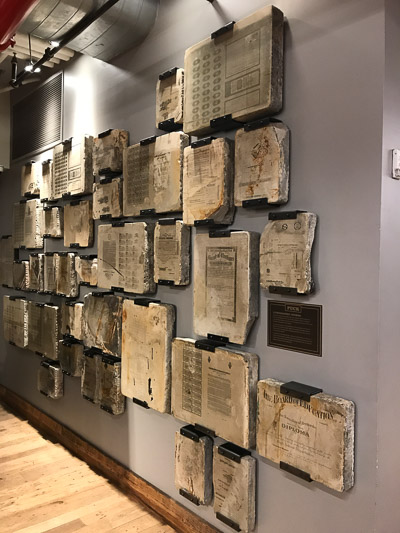
Anyway, the first couple of floors are occupied by REI’s flagship store for outdoor performance sportswear. Even if you aren’t in the mood to shop for 300 different types of wool hiking socks, there is a fairly large collection of lithographic stones on display. These were discovered when the building was renovated in 2011.
Lithographic stones on display. I bet some of you would love to dig your knife into these babies!
Some are very damaged, but I’m glad to see them preserved and displayed. Some appear to have been in wet soil for quite some time. A small plaque mentions they presumably came from the J. Ottmann Lithographing Company, which began in the 1880’s.
About 20% of the stones in this display are right-reading, like this one.
The display includes a number of right-reading stones. Terry Bellinger calls these “mother stones” and describes a stone to stone transfer. The often used mother stone was printed onto a daughter stone (creating a reversed image), then the daughter stone was used for the printing onto paper, generating a right-reading image once again. The mother stones could also be ganged together onto a larger daughter stone. For example, four of these Board of Education certificates in the image above could be printed onto a large daughter stone, then all four images printed at the same time onto a sheet of paper. In addition to speed, he mentions this technique protected the mother stone from damage.
A recent thread on the Book-Arts_L Listserv, “Question about stone lithography and printing” raised some questions about stone to stone transfer, since it would be quite difficult to register the stone upside down, it would be prone to cracking, and difficult to lift off. Ludwig Mohr describes a method of first transferring the image from a right reading stone onto an Albumen saturated piece of paper, then is then used to print from, presumably pasted to a stone? If a wrong-reading image was printed onto a carrier, then it would transfer back to a right-reading final print.
Of course, different printers may have used different techniques to print from a right-reading stone, but given the prevalence of these stones it bears more investigation. I didn’t notice anything written about it in the 1904 Handbook of Lithography. Further info is appreciated.
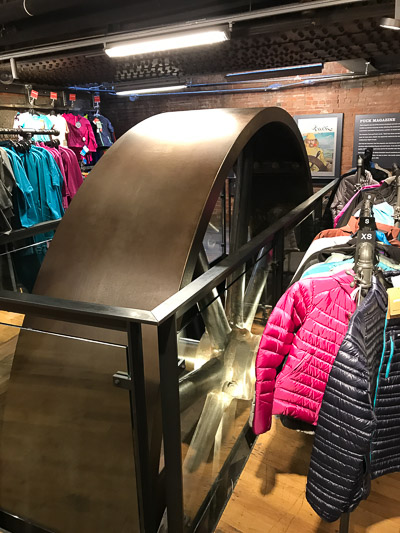
Gigantic flywheel.
Also in the store there are also two massive cast iron flywheels from the original power plant. They form an odd contrast to the featherweight plastic performance hiking gear. But who doesn’t like monster cast iron flywheels? Or featherweight plastic performance hiking gear?
An undated photo of the original configuration of the flywheels.
Lithographed cartoons and illustrations formed a large part of Puck magazine’s content. So much so, that the letterpress department felt it humorous to issue the following notice in 1881, in an attempt to elevate their emoticons to the level of visual art that existed elsewhere in the magazine.






 Peachey Conservation
#/media/File:Emoticons_Puck_1881_with_Text.png)