I purchased the Czeck Edge ruler stop about two months ago and keep finding more and more uses for it. It costs around $35 and clamps onto almost any ruler easily and securely.
In addition to a ruler stop, it is accurate enough to convert a ruler into a double square. Although marketed to woodworkers, bookbinders will also find it quite useful. The non-rusting anodized aluminum is slightly more compatible with binders boards, leather, paper and cloth than a hardened steel Starrett double square.
This tool is useful in circumstances where your dividers are not large enough, for example when centering a label in the middle of a bookboard. It can be used for measuring a book without relying on quantification for boxmaking: simply set the stop for the measurement of the book, then transfer the distance with a knife to your board. It could be used for laying out tooling. I’m sure there are many more uses.
The small (3.75 x 1 x .5 inch with the knob) size is appropriate for books. This is a handy little tool at a reasonable price. Czeck it out! Sorry!
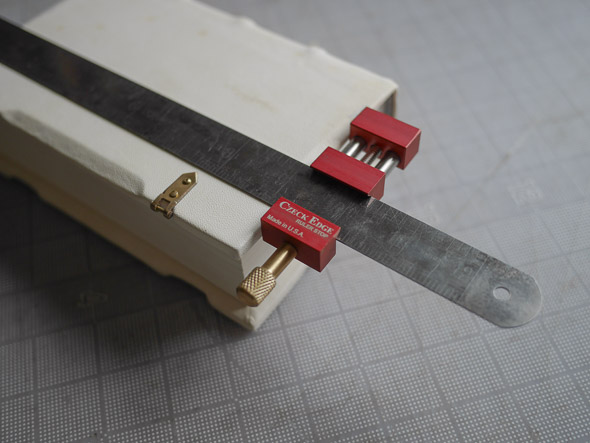
Here I am using it to position the catch plates when mounting clasps.
As readers of this blog may have surmised, I spend a lot of time looking through flea markets, junk shops and antique malls. Often it is just for the fun of looking at lots of random material culture, sometimes it is a search for inspiration from an obsolete tool or machine, and sometimes it is the thrill of finding a rare bird in the wild.
My Collection. Daily’s “Perfect Stroke” Brushes and Supplies, Catalog # 15. Front cover.
A couple weeks ago I scored big on a $3 investment. This seems to be the only known copy of this particular catalog. Worldcat only lists #3, #11, and #17. No copies of catalog #15 are available on ABE or other online sites. I’m guessing my #15 copy is from 1929.
Trade catalogs are very useful. They provide information and context about specific tools or techniques. They often have detailed illustrations and textual descriptions of unusual tools. For example, there is an incredibly cool folding palette knife with an ebony handle on page 51. And only $1.35! If I could only go back in time . Technical information often abounds. For example showcard brushes were pure red sable, while lettering brushes were grey camel hair.
My Collection. Daily’s “Perfect Stroke” Brushes and Supplies, Catalog # 15. Page 24.
One tool in particular caught my eye: the Artascope.
The Artascope is described as an “idea-machine”.
The kaleidoscope on-line book mentions it is constructed with a 4 Point Mandala or 45 degree 2-mirror system which generates the internal image. I can’t quite wrap my head around this. The inclusion of it in a professional sign painters catalog is at odds with the general current classification of this early kaleidoscope as a toy. Contextual evidence from the literature adds to our understanding of this odd little machine, which was at least co-marketed to professional artists.
“Sometimes you may feel stale, but your Artascope never does. It never fails to produce.”
Eighteenth century French binding models made in Historic Book Structures for Conservators 2017 workshop.
Late 18th Century French Binding Structure
Date: November 6-10, 2017
Location: The Georgia Archives in Morrow, Georgia
This workshop will focus on reconstructing a typical 18th century full leather French binding by comparing and contrasting three 18th century technical descriptions, examining extant bindings and using historic tools.
In some respects, this structure is the end of 1,200 years of utilitarian leather binding; fifty years later, the cloth case becomes the dominant inexpensive rigid board structure. The making of the book is very organic and does not rely on numeric measuring. This class is a hands-on explication of historic written texts. We will try to understand how and why these books were made the way they were made — then model as many aspects as possible — all the while acknowledging our inaccuracies and incomplete understanding.
Techniques to be learned:
-Using a beating hammer to beat the textblock before sewing
-Sewing on thin raised single cords
-Lacing in slips into handmade pasteboards in a typical three hole pattern
-Beating the boards
-Trimming all three edges with a plough in-boards while using trindles for the foreedge
-Coloring the edges with vermillion
-Applying vellum transverse spine liners
-Sewing endbands on rolled paper cores
-Paring and covering in full calfskin
-Marbling, pastewashing, and burnishing the leather
-Applying simple blind tooled decoration
Reproductions of 18th century French tools, constructed from plates in Diderot’s Encylopedie (1751-1780) will be available for use. Participants will learn to use and maintain a plough and investigate the problems in translating written descriptions of bookbinding into the construction of a model. Extensive notations (in English) on Gauffecourt’s Traite de la Relieure des Livres (1763) and Dudin’s L’Art du Relieur-doreur de Livres (1772) will be provided.
Basic bookbinding skills are a prerequisite, but this class can serve as an introduction to leather paring. Discussions will include treatment decision making for this particular structure in relation to institutions and private clients. This class is open to all levels of experience: pre-program students, technicians, and mid-career conservators who desire a full week at the bench. Ideally, a variety of participant experience levels will result in an invigorating exchange of information on binding techniques, institutional protocols, and treatment approaches. Students should bring basic bookbinding tools.
To apply, applicants must submit a resume and brief, one-paragraph statement of intent. Prospective students should outline educational hopes for this class, and review their background in book conservation, bookbinding, or other crafts.
Fee: $700 and a $100 materials fee
Application deadline: September 15, 2017
Send applications to: Kim Norman: Kim <dot> Norman <at> usg <dot> edu
Include any questions about the facilities, hotels, or transportation (Morrow is close to Atlanta). For questions about the class: Jeff Peachey: jeffrey <dot> peachey <at> gmail <dot> com



 Peachey Conservation