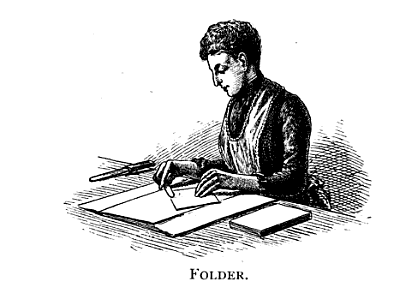
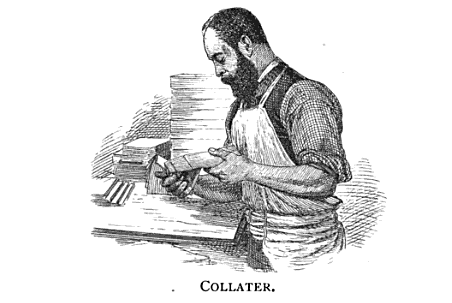
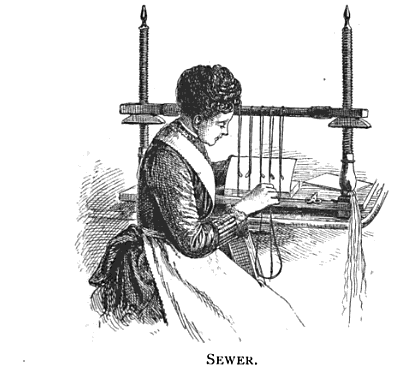
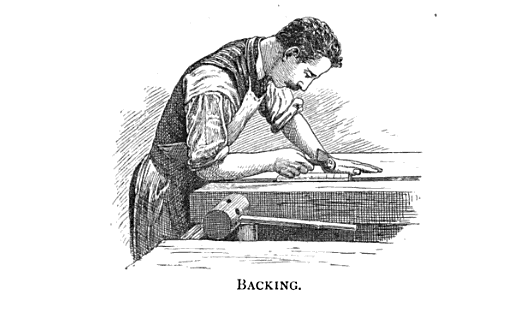
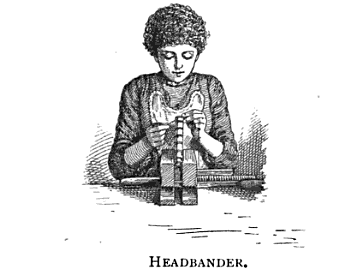
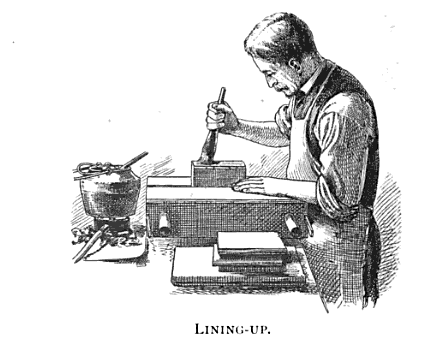
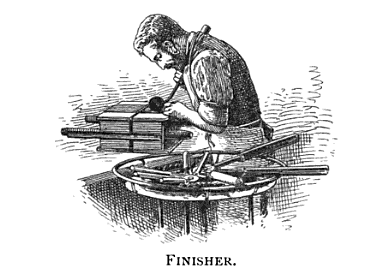
Zaehnsdorf’s A Short History of Bookbinding, originally produced as promotional material, contains some nice images of his premises and details of several steps in binding. Even in these low-res google scans, interesting details can be observed: the headbander using an upside-down plough, the massive finishing press with wood top (replaceable, to protect the press from glue?) used for spine lining and finishing, the sewer working inside the frame, etc….
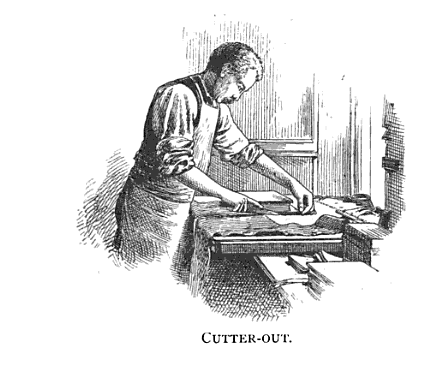
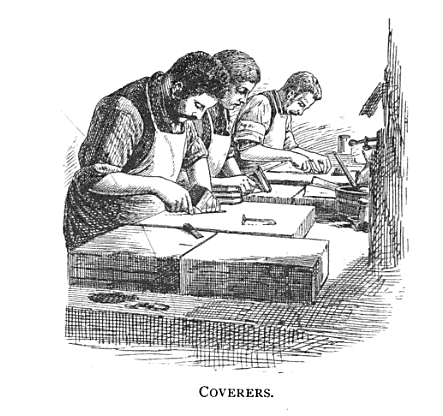
Notably, some of the steps are described as a generic action — “backing” — while some have the specific names for positions — “collater, cutter-out and coverer”. Small clues like this can help to understand the divisions of labor in Zaehnsdorf’s large nineteenth century bindery.
The folder also has a slitting knife to her right.Interesting a man is doing this, usually I see women doing it. Maybe his great beard got him the job!Look how long the lay cords are, both to save money on the sewing supports and an indication that only one book at a time was sewn.Press pin still stuck in the press, indication of the speed of work? It also looks like it either does not go through a hole, or new holes had to be drilled? Usually the holes are drilled completely through at 90 degrees to each other.Upside down plough. Likely worn out, since the brass holder on many English ploughs would get in the way even if the blade was removed. The women seem to be wearing different aprons, while the mens all look the same.The rectangular guide rails are on the end of the cheeks of this finishing press, much like Tim Moore does for his modern lying presses. Love the massive cheeks. I want this press! And we know he is using hot animal protein glue, note the pot with a gas line hooked up.I wonder if he is cutting on a tin, or cutting board. The knife has a handle. In shoemaking, the cutter-out (called the “clicker”) is one of the most skilled and highly paid positions, since they have to decide how to make best use of flaws in the skin. He does have primo bench position, right in front of a window.I would guess they are covering on litho stones. The man in the foreground is using a sharply angled bone folder to turn in the leather in the cap area, and I suspect supporting the opposite end of the book with his stomach. Are there band nippers also on the stone?A better view of the same press used earlier. It looks like three sides are covered with extra pieces of wood. I really, really need this press.
***
I also noticed that Zaehnsdorf’s The Art of Bookbinding is available as a 6 hour audio book. It would be an interesting experiment to listen to his instruction, while following along. I doubt I will do this, but if you do, let me know how it works!
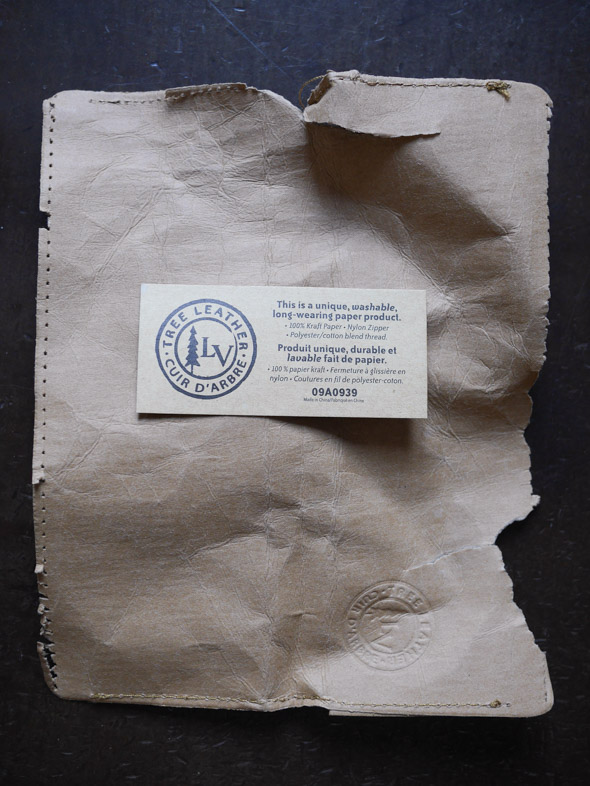
Lee Valley’s Tree Leather after some rough handling.
Lee Valley, one of my favorite innovative woodworking tool makers and retailers, is now selling a variety of items — wallets, totebags, pouches — made from what they call Tree Leather (TM).
Tree leather is what the rest of us call paper.
I purchased a small bag, and played with it a bit. Like a paper bag it is highly puncture resistant, and for a fairly thick .023″ does not seem to delaminate internally when repeatedly folded. Tear strength is good, but not exceptional, roughly on par with vegetable tanned leather this thick. The surface pH is quite low, 4.5.
Lee Valley describes the tree leather as being made from long fibered kraft paper, and I bet there is some polyethylene added as a protective coating, giving it the washability they tout.
It is not a huge surprise to anyone involved with books or conservation that paper is quite durable and strong. In fact, many book conservators tend to view leather as a cosmetic, not structural aspect when repairing a binding.
I had a sudden and strong compulsion to make wooden spoons around nine months ago.
Part of it was a way to avoid some extremely tedious conservation work. Part of it was a desire to emulate the beauty, at least in spirit, of traditional Swedish wooden spoons. Part of it was an excuse to buy some new tools.
I also wanted to test out some longstanding questions; primarily, as where does technique reside? Traditionally Western craft technique is taught by close contact and imitation of a skilled practitioner. Now it is common to learn by reading a how-to-manual, watching a video, or maybe taking some classes. Technique is often regarded as solely residing in the practicioner.
Many aspects of technique may also reside in the tools themselves. Since I didn’t know anything about spoon carving, this might be a good test: How much could I learn by letting the tools teach me how to make a wood spoon?
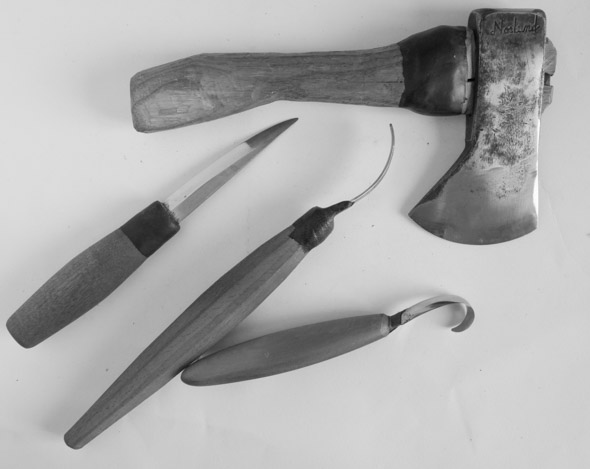
It only takes a few simple tools to start making wooden spoons. On the top, a small vintage (ca. 1970’s) Norlund hatchet with my handle, which split when mounting the head. Grrrr. Still, it works fine. Under it, on the left, a Mora knife, next to it a sweep knife made by Robin Wood, and a hook knife made by Pinewood Forge.
Of course, I had to start with the best quality tools I could find. The odd thing was, after I made a dozen or so spoons, the compulsion disappeared almost as quickly as it came on. This may be explained by the thrill of accomplishment when beginning to learn a new craft: mastering the final 20% can take a 1000% more time than the original 80%. One reason many people jump around to different crafts; jonesing for a new quick rush, weary of the long path towards mastery.
This was not a true test of technique completely residing in a tool. I have been whittling since I was a kid (ball in cage!), professionally make and sharpen knives, and use axes quite a bit. Nevertheless, it does speak to the relatively easy transference of tool based knowledge, rather than traditional object based craft education. Does the saying “Jack of all trades, master of none” serve to warn against tool based knowledge? Could it be dangerous?
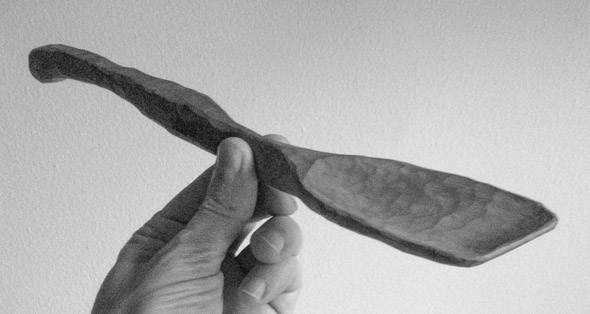
A wooden spoon I made out of Swiss pear wood.
I still use the spoons I made and didn’t give away, they are serviceable and some ended up quite elegant, in my opinion. The one above sees the most use in my kitchen. The handle is comfortable in a variety of grips, and I intended the shallow bowl to be good for tasting while cooking. Wood feels weirdly sticky in my mouth though, like a tongue depressor, so I don’t do this.
There are many aspects of his post that anyone involved with crafts will find of interest. One of his questions revolves around the almost impossible desire to make quality handmade objects at an affordable price. When craft objects get too expensive, people put them on a shelf and are afraid to use them. This might also be part of the reason many craftspeople sell their wares absurdly cheap, and are regarded as failures at business. I doubt that large companies like Walmart care if what they sell is used. People who make functional items want them to be used.
But how many handmade books — including etsy style blank books, seeming sold for less than the cost of materials — actually end up getting used? many books get read? When I worked in an academic research library, I bet almost 10% of the books I recased had never been read.
Much modern craft philosophy emphasizes the making of something as the primary fulfillment. Being in the moment when making, zen like, and so on. This romantic attitude might have inadvertently contributed to public reluctance to pay for the time and skill of craft. “Hey, aren’t you supposed to be doing it for the love? You want to get paid too!?”

 Peachey Conservation