The covering leather has been reused from the board of another book. I don’t think this is the first binding for this book for a number of reasons that aren’t visible: the lack of headbands, the dislocation of signatures which seems to indicate an aggressive spine cleaning, and the fact that the leather is too thick and not properly adhered to the spine and the paper label. I think is was done by an amateur or novice. But the selection of the repurposed leather is extraordinary.
Observe that the lines of the board panel neatly mimic four evenly spaces panel divisions. The numbers on the paper label above the title label make me think this was done in a bookshop or for a bookseller. Primarily judging from the lettering on the paper label, I’d guess this rebinding is likely from the nineteenth century.
In the past decade or so, books that were likely not made (or repaired) by professional bookbinders have become a hot topic. The scholarly trend of considering the book as a democratic multiple started with Artist Books in the 1970’s, and now encompasses vernacular examples?
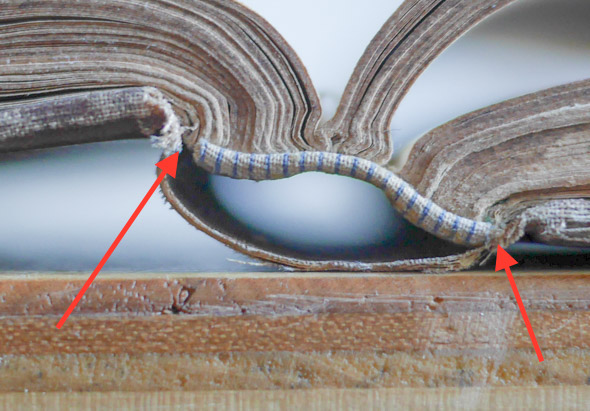
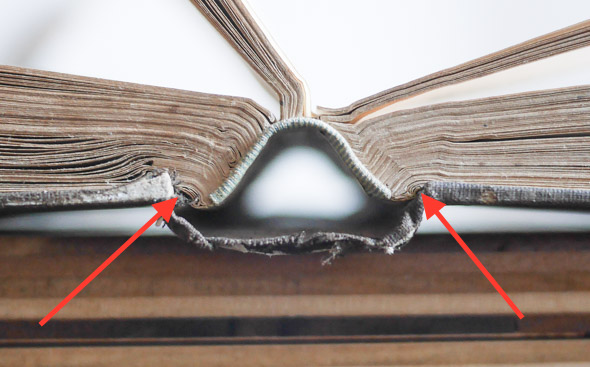
Adding a hollow (aka. Oxford hollow, tube) is often used to repair books that originally had a hollow, which makes sense. What makes less sense is using it on books that originally had a natural hollow, like case bindings. It adds at least three layers of paper, and only adds the strength of one thickness of paper. Admittedly, a strong sheet of handmade paper can be incredibly strong. Adding a hollow can dramatically change the opening, sometimes in unexpected ways. Often other hinging options with airplane cotton, linen or stout tissue are preferable. Adding a hollow is best suited to a quick and fast repair of circulating collections, or on relatively recent bindings with strong covering cloth. There are times when it should not be used.
The movement of the spine would not be significantly changed by the addition of a hollow, since the textblock hinges from the tip of the shoulder. Remember that he significant stiffing caused by the adhesive and paper of the hollow is not addressed here, it also changes the movement, and can be damaging to a fragile covering material or spine linings..
The movement of the spine would be significantly changed by the addition of a hollow, since the textblock hinges from the base of the shoulder. The changes in movement can cause severe stresses to the covering material and spine lining, possibly resulting in creasing, tearing or even failure. Remember that the stiffing resulting from the hollow can also cause damage by significantly changing the movement. Because of the interaction of the case, spine linings and hinging points, cloth case bindings are sometimes more complex to successfully conserve than leather bindings.
***
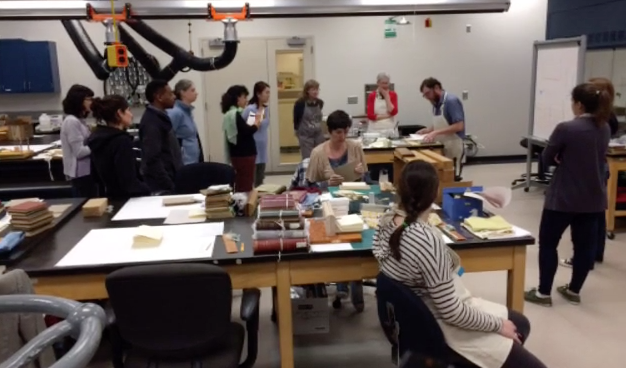
This was one of the complexities we investigated in the recent workshop I taught at the Georgia Archives in Atlanta October 24-28, “Cloth Case Bindings: Their History and Repair.”
Georgia Archives Conservation Lab. Photo Kim Norman.
Click on the links to see a slide show of images from each day. Images courtesy Kim Norman, Preservation Manager and Conservator, Georgia Archives. Thanks for hosting, Kim!
There is talk of scheduling a complementary workshop in October 2017 at the same venue, dealing with rebacking, board attachment and repair of 19th century leather bindings. This would include leather paring with English and French knives, spokeshaves and the Scharffix paring machine, as well as methods of consolidating and dying leather. Check this blog for more info as it becomes available.
“Artisanal ways of knowing, in contrast, are revealed in objects, not books, and so have largely escaped the historian’s scrutiny. This kind of knowledge was transmitted through practice, a combination of talking about and showing techniques that were learned by observation and imitation.”
James Richard Farr, “The Disappearance of the Traditional Artisan”, in A Companion to Nineteenth Century Europe, 1789-1914. ed. Sefan Berger (Malden, Mass: Blackwell Pub., 2006), 100.