Book Review: A Bookbinder’s Miscellany by Bernard C. Middleton

Bernard C. Middleton.  A Bookbinder’s Miscellany. Oxford, England: Alan Isaac Rare Books, 2015. xv, 114 p. ill. 25 pounds sterling, plus 9 pounds shipping to USA. 500 copies.  http://aibooks.co.uk

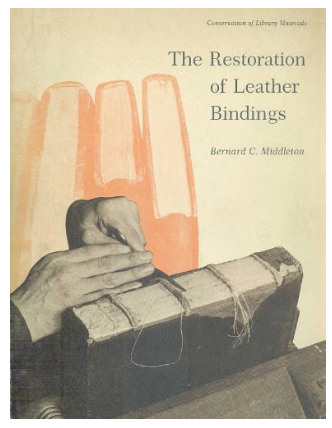
When I attended the Bookbinding 2000 Conference, I thought it might be Bernard C. Middleton’s last hurrah. After all, he had brokered the transfer of his extraordinary collection of books about bookbinding to Rochester Institute of Technology’s Wallace Library Cary Collection. He was 75 years old. He had written two of the most influential books on the craft of bookbinding in the 20th century. The elegant hands (his?) on the cover of the Restoration of Leather Bindings possibly inspired more of us to enter the is field than any of his writing. The bindings I’ve handled of his have been exemplary. What was left to do?
Screen Shot 2015-09-10 at 7.16.31 AM
Source: http://www.amazon.com/RESTORATION-OF-LEATHER-BINDINGS-THE/dp/B001OL8XQW

Fifteen years later, we have another book, consisting of three new essays and nineteen previously published ones. Most appeared originally in Paper & Print, The British & Colonial Printer, Printing World, and The Book Collector in the 1950’s, but all were new to me. This is another essential book, written in Middleton’s straightforward style and packed with observations on forwarding, finishing, and the state of the craft in general.

This book pairs nicely with his indispensable History of English Craft Bookbinding Technique, because it does deal with technique, while despite the title, his History primarily concerns structure.  Technique is an elusive beast. Only traces of it remain in artifacts, and it is often difficult to understand how a particular action was accomplished, even if one can arrive at a similar looking result using current tools and techniques. But understanding and interpreting historic subtitles are essential for understanding the evolution of any craft.

This is precisely why A Bookbinders Miscellany is so important: it is a first hand account (and quite often critique) of fine, trade, extra, craft, restoration, and art binding techniques in the mid-20th century. It is invaluable to gain insight into what binders were doing and discussing, especially if it is now considered dated from our current, conservation oriented approach.

The book also records the tension between art school training, with its emphasis on design, and a decline in craft trade binding skills in the post WW2 era. Bookbinder Sam Ellenport’s introduction situates the book within this milieu.

For readers not so interested in binding history or design philosophy, this book also contains many practical tips for full leather binding.  “Notes on The Art of Covering with Leather”, and “Notes on the Hand Sewing of Books” both contain extremely useful how-to information. “The Supported French Groove” details this often forgotten binding which combines advantages of the case and in-boards binding.

In possibly his most personal essay, published for the first time, “Old vs. New: A Division of Interest”, Middleton reflects on the nature of design, restoration, disorganization, and the value of dirt in his bindery. He considers his professional life “… a muddle — a muddle which, though it constantly exasperates me, certainly provides a wealth of interest.” (p. 106) Frankly, it is hard to consider this scholar and craftsman’s career anything close to a muddle, and I hope this is just an example of English self-deprication.

So why is this excellent and informative limited edition book priced so low? Come on, for all Middleton has given during his life, can’t we give a little more back to him? If bookbinders do not value the physical book, can we expect anyone else to?

“Bookbinding is a challenge — a challenge to our skill and our intellect. To master this craft is to master many things. True mastery has yet to be achieved, but we must all press forward in the endeavor to create the nearest approach to the Book Perfect.” (p. 44) Middleton is realistic when describing the present state of binding, but retains hope for the future. I’m inspired to do the same.

Available from Alan Isaac Rare Books.


Mosda Clipless Paper Fastener

mosda1
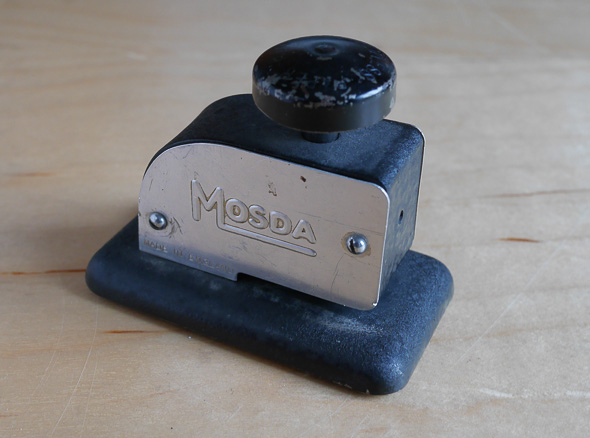
Fig 1. Mosda stapleless stapler. Approx. 9 x 5 x 7 cm. My Colllection.

This Mosda clipless paper fastener is one of a large number of machines designed to attach sheets of paper together without the use of external materials. They date from the early years of the twentieth century and are often referred to as stapleless staplers. These are admirably simple and efficient machines.

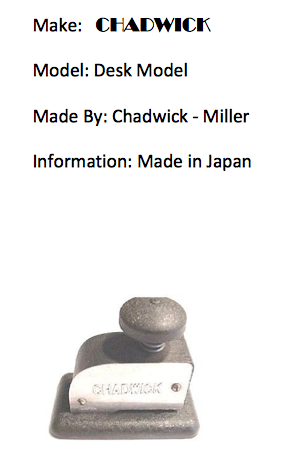
My machine was made in England, and  looks like it is from around 1930. The Early Office Museum has some great information on the history clipless paper fasteners, unfortunately it does not record the cutting patterns of the machines, which is necessary to determine what particular machine was used. The wonderfully detailed blog, The American Stationer, examines a number of paper fasteners, but not the Mosda. Except for a couple of ebay and etsy sales, I’ve not found much info about it, other than an almost exact copy ( maybe the original?) machine called the Chadwick. (Fig 2.)


Screen Shot 2015-08-31 at 8.09.34 AM
Fig 2. http://mystaplers.com/Books/GuideToAntiqueAndVintageFasteners.pdf

According to the Early Office Museum Website, machines for stapleless paper fastening started in 1909 by two competing firms, the Bump Manufacturing Company and The Clipless Paper Fastener Company.  There is some confusion as to which company came up with the first machine. Yet even today, you can buy a new Japanese machine,  which uses almost the exact same punching configuration, though in tandem.

The mechanism is quite ingenious, and even though this machine is very well used and the blades slightly dull, it still creates a surprisingly secure paper attachment with a single push on the top knob. My machine is missing a spring under this knob, so I need to manually lift the knob back to the start position before making a new attachment.


mosda2
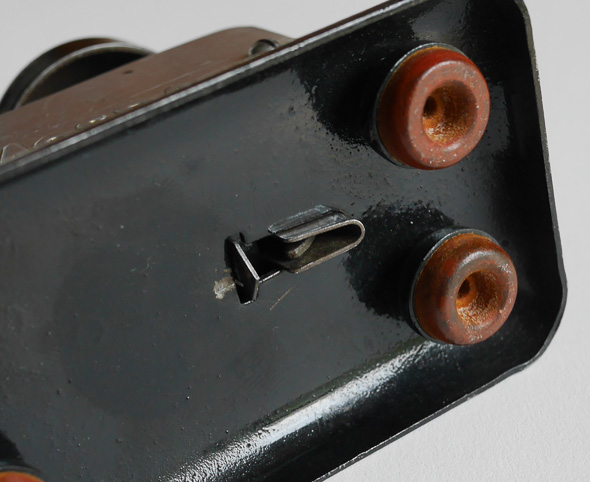
Fig 3. The “U” shaped punch and the slitter punch on the left side.

First the stapler punches a “U” shape and a small straight line behind it. For clarity, I am showing the mechanism on the bottom of the machine. In use, the paper is inserted in the slight gap between the bed and the half arch head as seen in Figure 1.

mosda3
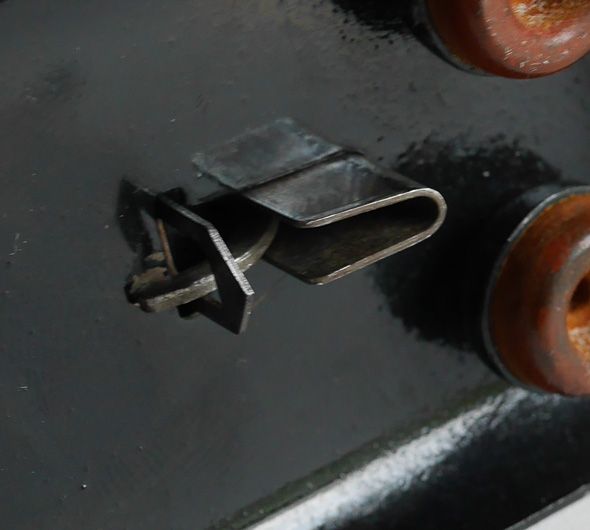
Fig 4. This shows the tongue which pushes the punched paper tab (from the “U” anvil) into and through the stack of paper. It locks the paper into place by pulling it through the slit when the mechanism is raised.

Next, a tongue pushes the attached tab of paper from the  “U”  punch through the slit. This is then raised to the top of the papers, securing them. Other manufactures report that six to twelve sheets are the maximum number that could be punched through, though of course this depends on the thickness of the paper. I’m pleasently surprised this machine works so well, as can be seen below, considering that the punches are unhardened pressed steel.

mosda4
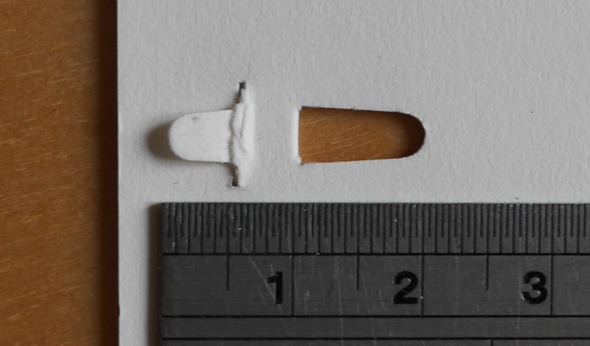
Fig 5. Paper attachment as viewed from the top. Ruler in cm.
mosda5
Fig 6. Paper attachment viewed from the bottom. Ruler in cm. There are small tears on either side of the slit, which happens when the tongue pushes the paper through the slit.

Examining these stapleless fastenings could even generate useful information, such as establishing the  terminus post quem a stack of sheets were assembled. With such obvious tool marks, I imagine it wouldn’t be too difficult to get a sense of a range of shapes and match them to extant machines. Or maybe these antique machines still have uses for the inventive book artist, like non-adhesive corner locking for limp structures?


Book Slate

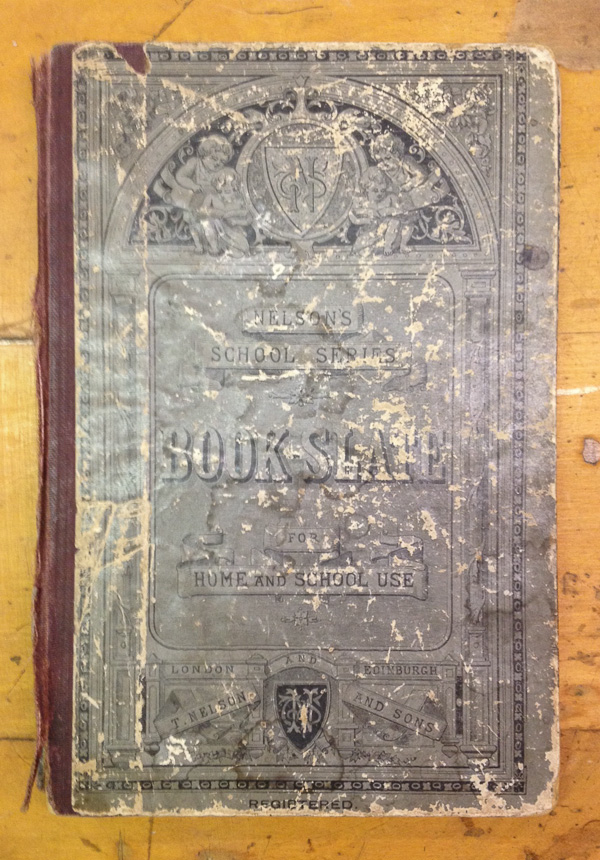
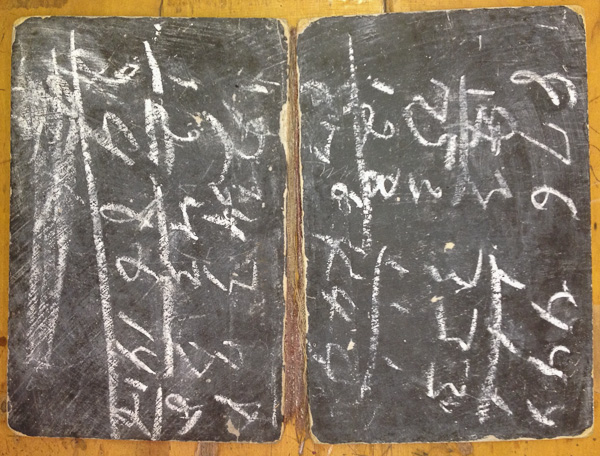
Nelson’s School Series Book Slate for Home and Student Use (London & Edinburgh: T. Nelson and Sons, [1900?]) is an odd structure, a diptych in a case binding. The exterior looks like a standard quarter cloth case binding with printed paper sides. The interior, however, is made from a painted slate-like material. It can be written on and erased. The earliest known diptych is from 14th-century BCE, making the codex seem like a newbie.  Is the laptop a 20th century iteration? Long live the diptych!

book slate
Nelson’s Book Slate. Exterior front board. This is a well used, but largely intact book. My Collection.
book slate 2
Nelson’s Book Slate. Open. Chalk marks of addition and subtraction. My Collection.