Peter Verheyen is doing some fascinating research, beginning to delve into the history of bookbinding as rehabilitation. His post contains some shocking, truly bizarre, graphic images of German WWI era bookbinders equipped with prosthetic bookbinding tools. Imagine bone folders, polishing irons, hammers all screwed—”plug and play” as Peter puts it—into holsters strapped over their stumps. Yet, judging from the images of the bindings, their skill level would put many modern fine binders to shame.
His investigation provides a counter narrative to the all too common notion that bookbinders are just “good with their hands”. I still encounter this, most often in academic contexts, from someone who is “good with their head”. Sometimes it is said out of ignorance, but sometimes it is an attempt to belittle the multiple intelligences, hard work, experience and knowledge it takes to work with your hands. Peters research illustrates you can be good with your hands, even if you have no hands. But you do need a head.
The ability to dexterously manipulate one’s hands creates doubt in the minds of others about brain power, for some reason. Even in 2015, this is still a problem in the field of book conservation, where many of us work all day with our hands. The ranking of the hand below the head is linked closely to ideas of class, and is possibly more prevalent in England than here in America. I’d be curious to hear about other countries. This may also be part of the reason for the relatively low salaries in the field of conservation, when compared to other professions with similar training and professional development expectations.
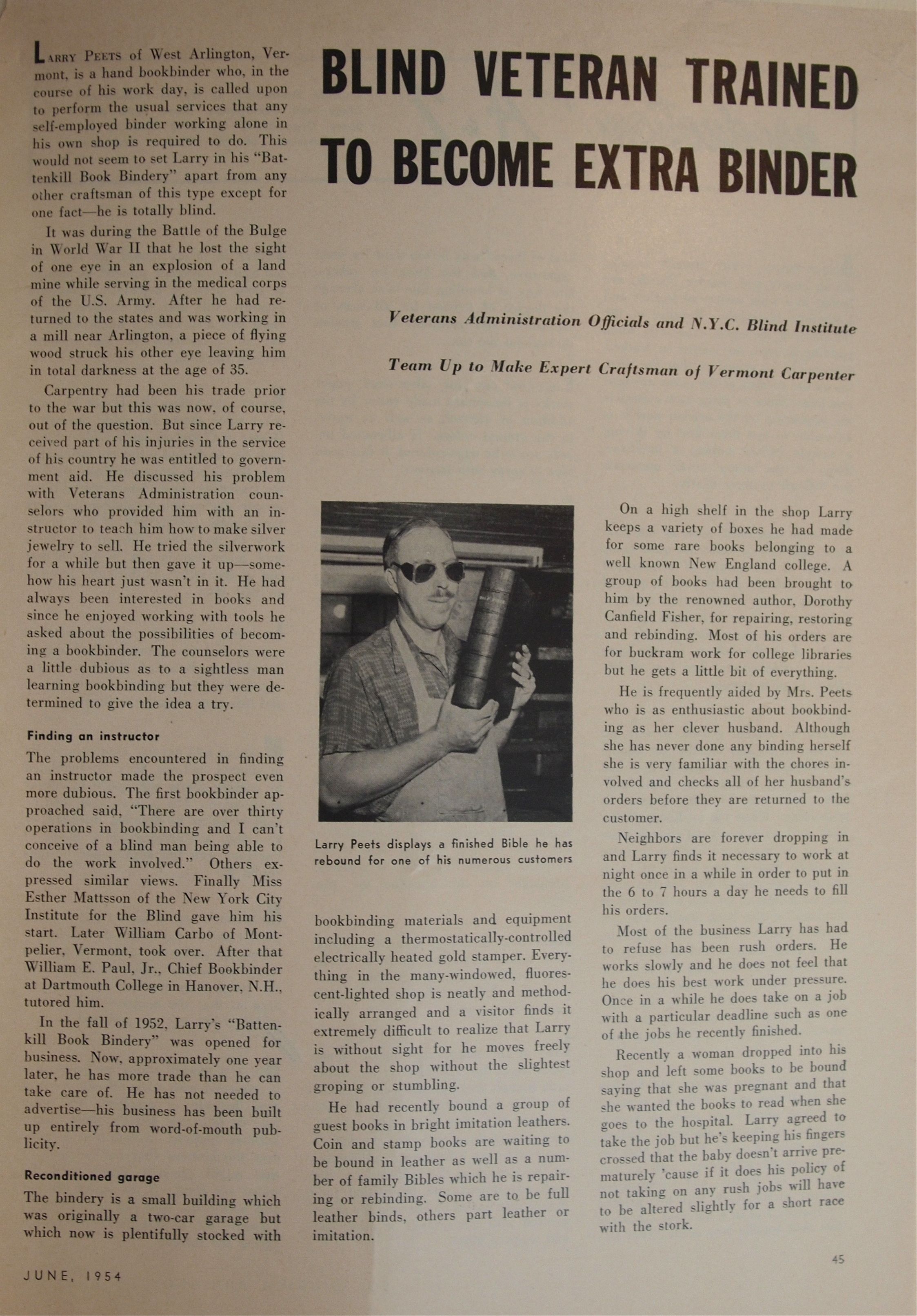
I was also reminded me of an article concerning a blind bookbinder from the 1950’s, which I reproduced below. In some senses this blind bookbinder is working with his hands twice as hard as the rest of us: simultaneously binding the book while judging the tactile feedback on what he is doing, rather than having the additional advantage of visual feedback. Obviously, his head is still involved.
I tried this once, and recased a book while blindfolded. WARNING: it isn’t pretty. Images here.
Click on the image to enlarge to a legible size. From: Bookbinding and Book Production, June 1954, p. 45. Private Collection
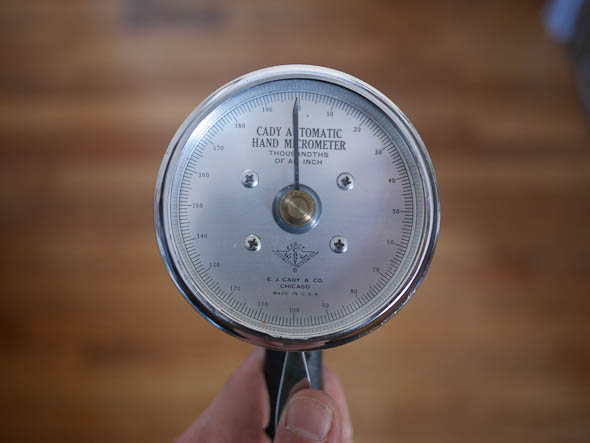
I would have to rank the Cady Automatic Hand Micrometer as one of the most beautiful and well made tools I own. The E.J. Cady company is still in business, making this exact model which looks like it has not changed in design or construction since the 1950’s. It would not be out of place on the dashboard of a Bentley.
Like most people, I have a number of dial micrometers, or dial thickness gauges as they are sometimes called. A deep throat Calati is perfect for measuring in the center of large sheets of paper. A super accurate Ames #2 (.0001″) with a 6oz. weight on top is great for obtaining standardized results with slightly compressible material, like leather. A portable, hand held Mitutoyo is small and lightweight, perfect for taking on the road.
Since I only use micrometers these a couple of times a year, the batteries in the digital ones always seemed to be dead. The digital versions are handy, though, if you use them a lot, or need to easily convert between English and Metric systems. The mechanically geared hand on the dial face has a definite nostalgic attraction for me, like the VU meters on a stereo amplifier.
Meet the Family. Left: Calati, Middle: Ames, Right: Mitutoyo
The Cloisters is a branch of the Metropolitan Museum of Art, located in upper Manhattan, quite near my studio. In fact, I think I might be able to see it, if I climbed up on my bench and peeked out the upper left corner of my window. Northern Manhattan is quite different from the rest of the city. It is where the Dutch purchased the island from the Native Americans and there is still even a farmhouse located on Broadway dating to 1784, which is now a museum.
The Cloisters was built (assembled?) in 1938, and consists of four medieval buildings imported from Europe. It is located inside the 66 acres of Fort Tryon park. There are also beautiful gardens, including a nice garden featuring plants used for making dyes and paints. Looking across the Hudson River, there is a stunning view of the Palisades of New Jersey which John D. Rockefeller so admired he purchased 12 miles of shoreline to preserve the naturalistic view from the park.
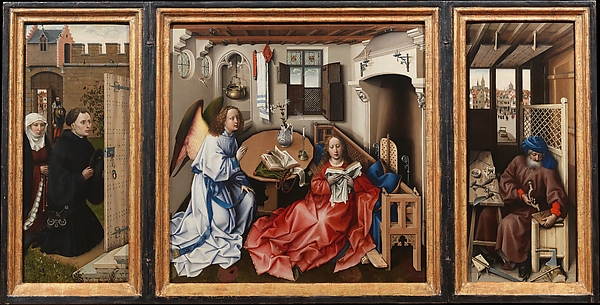
The Cloisters is not only my favorite museum, but it has my favorite painting, The Merode Alterpiece. Note to the impecunious: although the Met recommends a $25 entrance fee, you can pay whatever you wish.
In April of 2015, I decided to photograph 34 actual books and works of art which contain representations of books which were on display. This was also a great chance to try a lot of handheld, low light photography with my new Panasonic Lumix DMC-GX7, which is proving to be the second best camera I’ve ever owned. There are higher resolution images for most of these on the Met site, searchable by accession number.
If anyone would like to visit my studio, we could take a short detour to the Cloisters and look at the works, discussing what we can — and can’t — learn from looking at representations of books in art. Or you can can use this as a virtual or self guided tour.
BOOKS AND REPRESENTATIONS OF BOOKS ON DISPLAY IN APRIL, 2015,
AT THE CLOISTERS MUSEUM, NYC
This virtual tour starts on the main level in the Late Gothic Hall, and follows a counterclockwise path around the Cuxa Cloister, then jumps to the Gothic chapel, Glass Gallery and the Treasury on the lower level.
LATE GOTHIC HALL
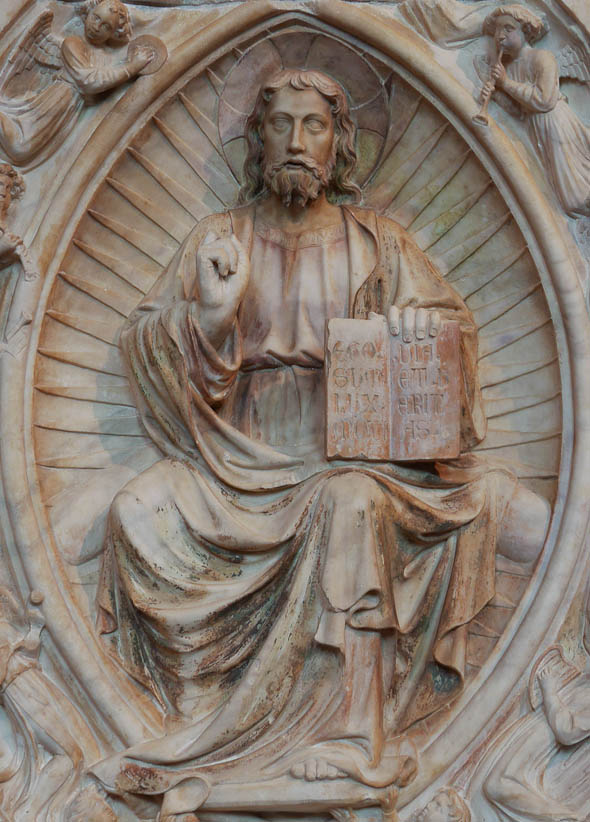
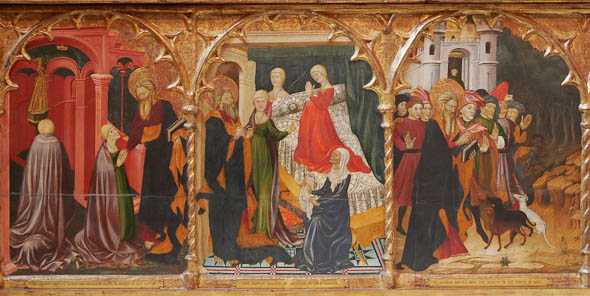
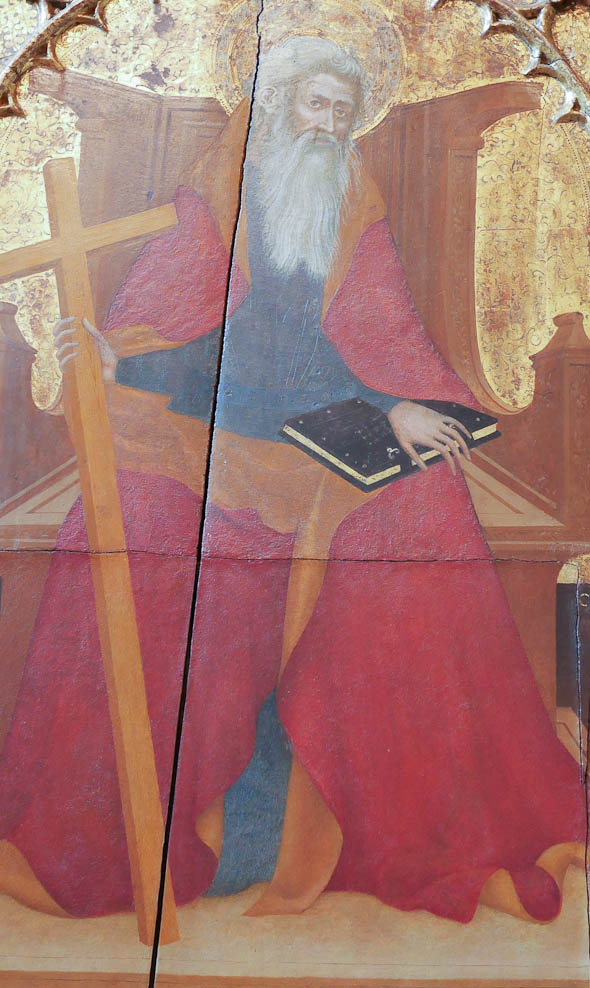
Antiphonal, Tempera, gold and ink on parchment, Italian, 1467-70 (60.165)Detail, Altarpiece with Christ…, Carrara marble, Andrea de Giona, Italian, 1434 (62.128a-i)Detail, Alterpiece with Scenes of the Life of Saint Andrew, Attributed to the Master of Roussillon, Tempera and gold on wood, Catalan, ca. 1420-30 (06.1211.1-.9)Detail, Alterpiece with Scenes of the Life of Saint Andrew, Attributed to the Master of Roussillon, Tempera and gold on wood, Catalan, ca. 1420-30 (06.1211.1-.9)Detail, Alterpiece with Scenes of the Life of Saint Andrew, Attributed to the Master of Roussillon, Tempera and gold on wood, Catalan, ca. 1420-30 (06.1211.1-.9)
MERODE ROOM
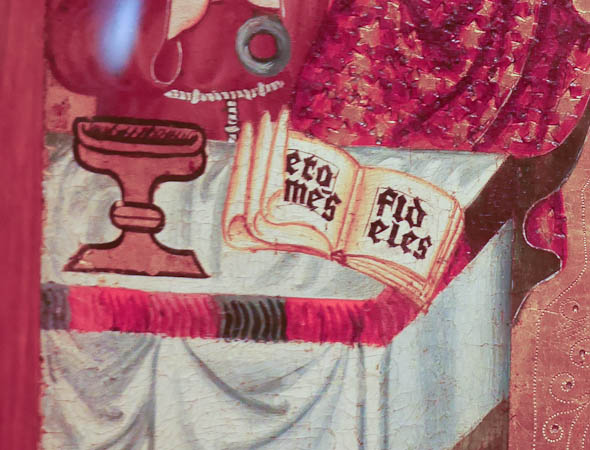
Annunciation Triptych (Merode Alterpiece), Workshop of Robert Campin, Oil on oak, South Netherlandish, ca. 1377-1444 (56.70a-c) http://images.metmuseum.org/CRDImages/cl/web-large/DP273206.jpg. This painting is a hyper real jewel.Detail, Annunciation Triptych (Merode Alterpiece), Workshop of Robert Campin, Oil on oak, South Netherlandish, ca. 1377-1444 (56.70a-c)Detail, Annunciation Triptych (Merode Alterpiece), Workshop of Robert Campin, Oil on oak, South Netherlandish, ca. 1377-1444 (56.70a-c) Ok, these are not books, but the next best thing: TOOLS! He is building two mousetraps.
BOPPARD ROOM
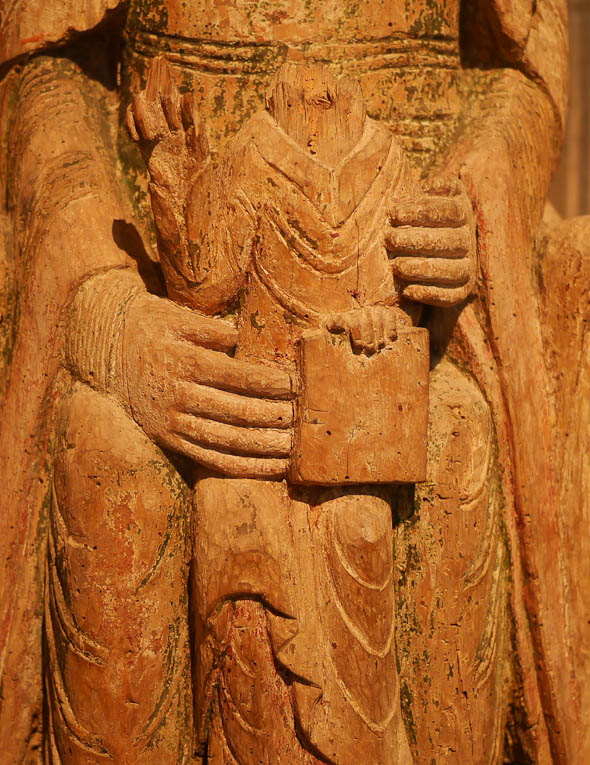
Detail, Paschal Candlestick, Paint on wood, Spanish, Castile-Leon, ca. 1450-1500 (44.63.1a,b)The Dormition of the Virgin, Oak, German, Cologne, late 15th C., (1973.348)Detail, The Dormition of the Virgin, Oak, German, Cologne, late 15th C., (1973.348) Quite likely the most accurately depicted book in the entire collection. It is hard to believe this was once painted, and even harder to believe how someone could scrape the paint off! The detail in the position of the hand, the throw-up and drape of the book, and the anguish in the face is unforgettable.
UNICORN TAPESTRIES ROOM
Book of Hours, Published by Thielman Kerver, Paris,1504 (20.53.3)
EARLY GOTHIC HALL
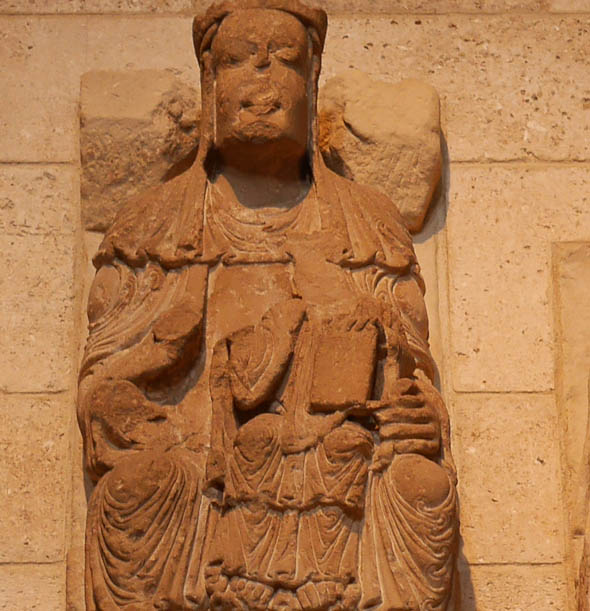
Detail, Enthroned Virgin and Child, Paint on maple, Spanish, ca. 1280-1300 (53.67)Saint Martin with the Virgin, Pot metal and colorless glass with vitreous paint, French, 1245-48 (37.173.2,.5)Detail, Legend of Saint Germain of Paris, Pot metal and colorless glass with vitreous paint, Franch, ca. 1245-47 (1973.262.1)Detail, Enthroned Virgin and Child, Paint on birch with glass, French, ca. 1130-40 (47.101.15)
SAINT GUILHEM CLOISTER
Detail, The Annunciation, Carrara marble, Italian, ca. 1180-1200 (60.140)
FUENTIDUENA CHAPEL
Detail, The Adoration of the Magi, Limestone, Spanish, ca. 1175-1200 (3077.8)
LOWER LEVEL, GOTHIC CHAPEL
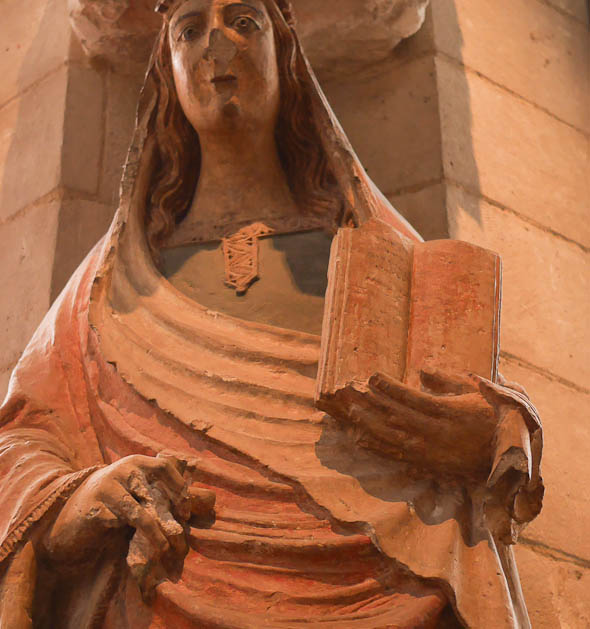
Detail, Saint Margaret of Antioch, Limestone with paint, Catalan, ca. 1330-40 (47.101.13a)
GLASS GALLERY
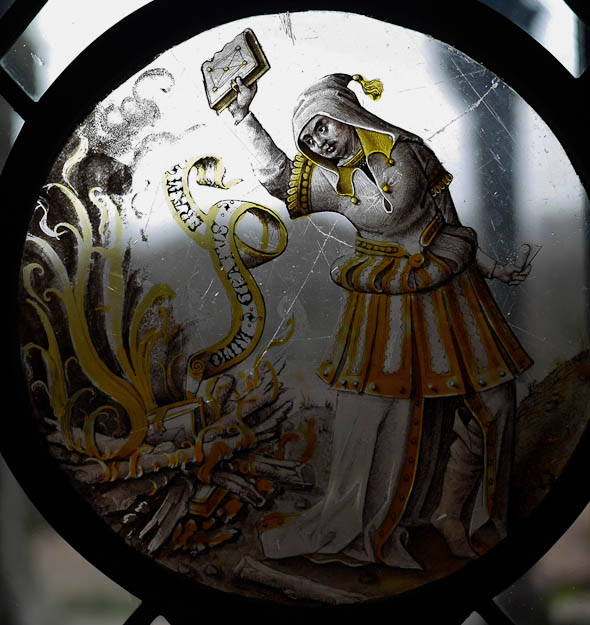
Detail, Three Scenes from the Infancy of Christ, Pot metal and colorless glass with vitreous paint, Austrian, ca. 1390 (36.39.1a)Detail, Tomb of Ermengol VII, Count of Urgell, Limestone with traces of paint, Catalan, ca. 1300-1350 (28.95.a-i)Annunciation, Colorless glass with vitreous glass and silver stain, South German, ca. 1480-1500 (1985.244)Detail, St. Lambrecht of Maastricht, Colorless glass with vitreous glass and silver stain, South Netherlandish, ca. 1510-20 (32.24.48)Souls Tormented in Hell, Adapted from Dieric Bouts, Colorless glass with vitreous glass and silver stain, South Netherlandish, ca. 1500-1510 (1990.119.2) BOOK BURNING!
Saint Peter with a Heraldic Shield, Colorless glass with vitreous glass and silver stain, South Netherlandish, ca. 1520 (12.137.6)Annunciation, Colorless glass with vitreous glass and silver stain, South Netherlandish, ca. 1500-1510 (1972.245.1)Detail, Saint John on Patmos with Apocalyptic Visions, Manner of Dierick Vellert, Colorless glass with vitreous glass and silver stain, Antwerp? ca. 1520-30 (32.24.65)
Saint Jerome in his Study, Style of the Pseudo-Ortkens, Colorless glass with vitreous glass and silver stain, Brussels, ca. 1520 (1998.304.3)
TREASURY
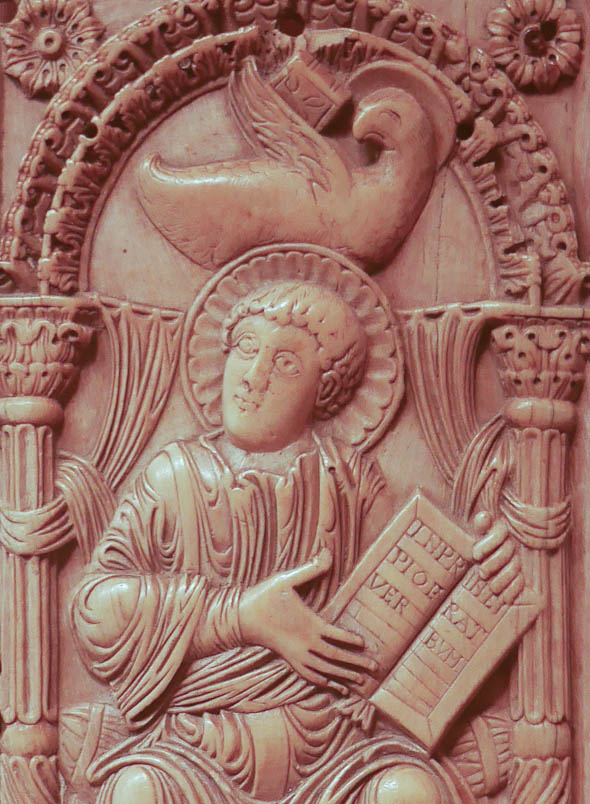
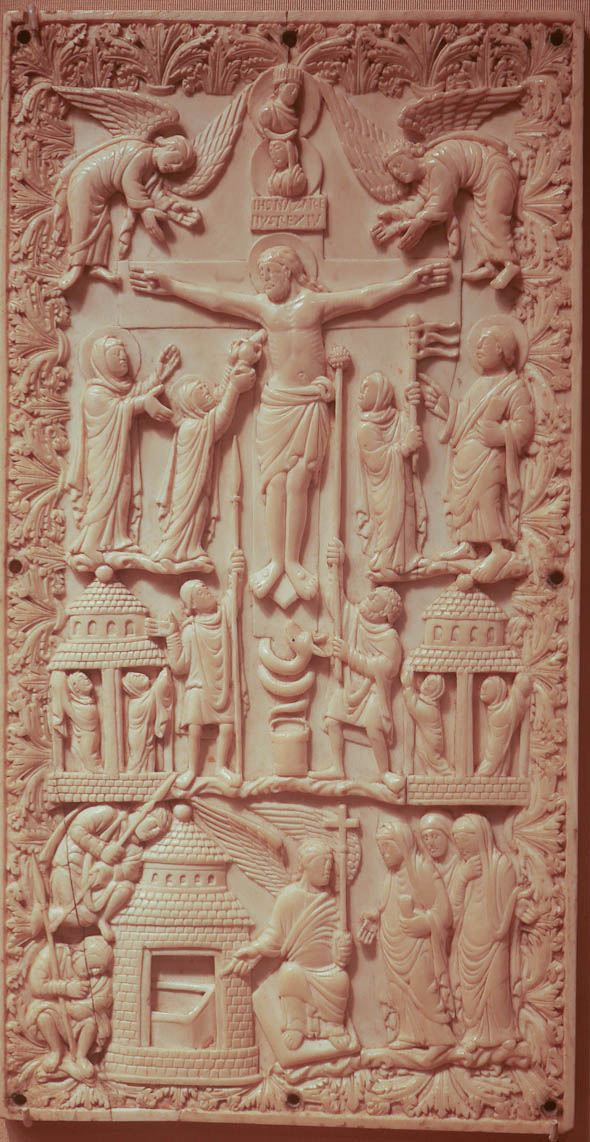
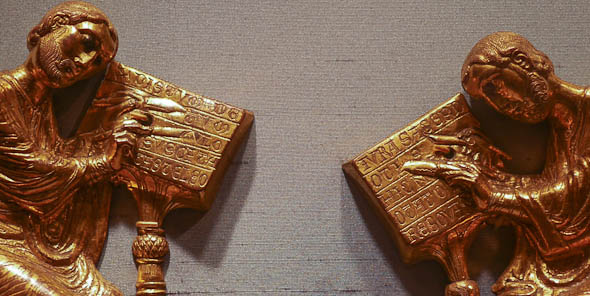
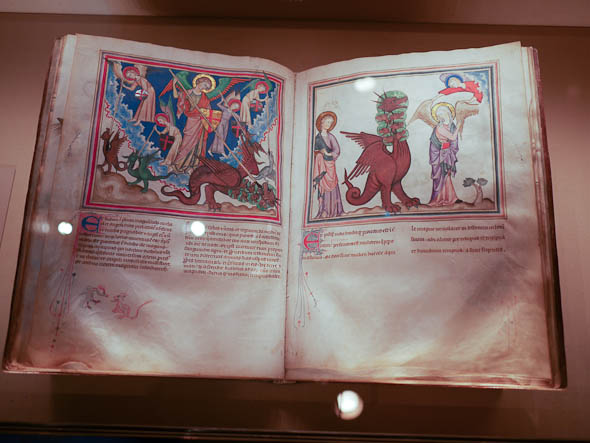
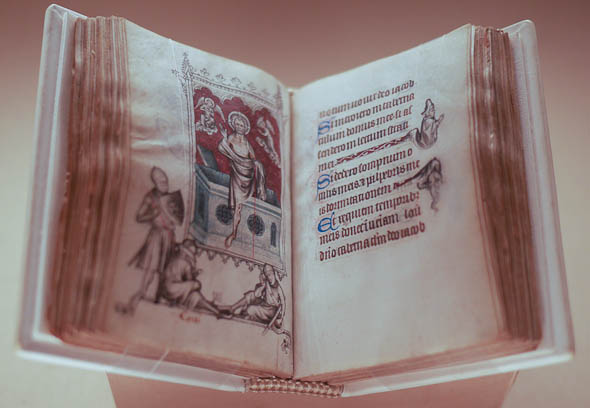
Detail, Bishiop of Assisi Giving a Palm to Saint Clare, Oil, gold and silver on wood, German, ca. 1360 (1984.343) It appears to be a sewn, but unbound book? A wrapper?Detail, Reliquary Plaque with Christ Blessing, Walrus ivory, German, ca. 1200 (65.65.174)Detail, Diptych with the Coronation of the Virgin and the Last Judgment, Elephand Ivory, French, ca. 1260-70 (1970.324.7a)Detail, Plaque with Saint John the Evangelist, Elephant ivory, Carolingian, early 9th C. (1977.421) The inscription reads “The word of John soars to heaven like an eagle.” It looks like the eagle is carrying a small book. The plaque may have once been from a book cover.Plaque with the Crucifixion and the Holy Women at the Sepulchre, Elephant ivory, Carolingian, ca. 870 (1974.266) Likely a central decoration for the front board of a Gospel book.Detail, Evangelists Mark and Luke, Gilded copper and glass, French, ca. 1220-30 (2012.70.1,2)The Cloisters Apocalypse, Tempera and ink on parchment, French, ca. 1330 (68.174) It is telling that the binding materials are not listed at all. For the Met, a book is the text and images..The Hours of Jeanne d’Evreus, Tempera and ink on parchment, French, ca. 1324-28 (54.1.2) This book was recently beautifully rebound by Maria Fredericks in shaped mat board and alum tawed skin. Note the similarities in the opening and the end band between the book in the Merode Alterpiece and Three Scenes from the Infancy of Christ stained glass (36.39.1a)The Psalter and Hours of Bonne of Luxembourg, Tempera, gold and ink on parchment, French, before 1349 (69.86)The Belles Heures of Jean de France, duc de Berry, Tempera, gold and ink on parchment, French, 1405-1408/9 (54.1.1a or b) Again, recently rebound by Maria Fredericks into two volumes.Detail, Thirty Five Panels with Scenes from the life of Christ, Oak, French, early 16th C. (50.147.1) It appears the book is partially damaged.Detail, Thirty Five Panels with Scenes from the life of Christ, Oak, French, early 16th C. (50.147.7)















 Peachey Conservation