Suave Mechanicals Volume 2 – Just Published

Cathleen A. Baker, founder of The Legacy Press, has just published Volume 2 of Suave Mechanicals, Edited by Julia Miller.  I had a chance to read an early version of Jim Croft’s contribution, and it is packed full of information derived from a lifetime of working with wood and books, all presented in the unique Croftian style.  I’m looking forward to reading the entire book, and just purchased it through the Chicago Distribution Center. And if you don’t have Volume 1, you are missing my own contribution, “Beating, Rolling and Pressing: The Compression of Signatures in Bookbinding Prior to Sewing”  Buy them both and save on shipping!

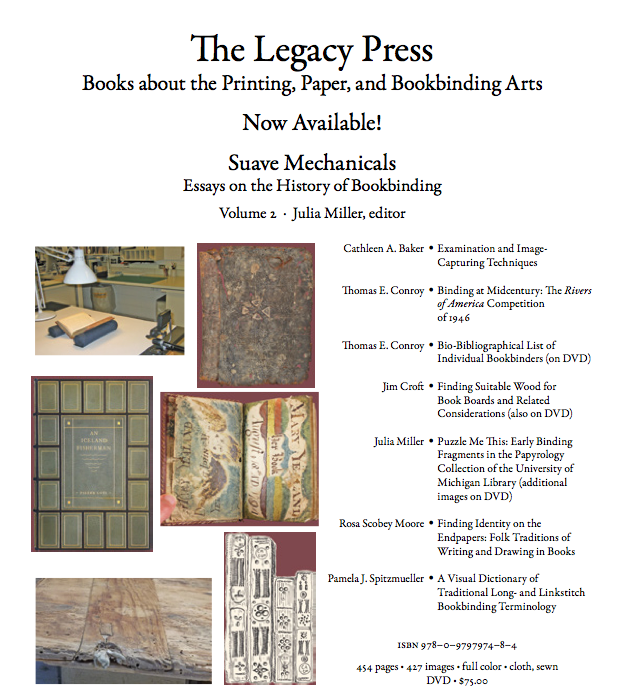
VOLUME 2 INCLUDES:

Cathleen A. Baker   •  Examination and Image-Capturing Techniques

Thomas E. Conroy   •  Binding at Midcentury: The Rivers of America Competition of 1946

Thomas E. Conroy   •  Bio-Bibliographical List of Individual Bookbinders (on DVD)

Jim Croft    •  Finding Suitable Wood for Book Boards and Related Considerations (also on DVD)

Julia Miller   •  Puzzle Me This: Early Binding Fragments in the Papyrology Collection of the University of Michigan Library (additional images on DVD)

Rosa Scobey Moore   •  Finding Identity on the Endpapers: Folk Traditions of Writing and Drawing in Books

Pamela J. Spitzmueller   •  A Visual Dictionary of Traditional Long- and Linkstitch Bookbinding Terminology
 

Screen Shot 2015-02-27 at 5.05.00 PM

Larger version of this advertisement: Suave Mechanicals Vol 2.  Please circulate.

Confusing Book Conservators

It is confusing for the public to understand the differences between Bookbinder, Book Restorer and Book Conservator. Book Conservationist is never used, except by the uninitiated.  Below are how some of these terms are commonly used — more precisely, how I wish the terms were commonly used — in the United States.

Bookbinder: Someone who makes books consisting of partially prepared materials from other crafts, rebinds and sometimes repairs older books.

Book Restorer: Someone who makes old books look an imagined “new”.

Book Conservator: Someone who preserves the historic, intrinsic, artistic and artifactual value of books through preventive measures and physical intervention.

The New York Public Library has muddied the waters even further, with a program called New York Public Library Conservators.  In this case, the term “Conservator” means someone who supports or maintains NYPL financially. This adds confusion, and creates the need for more explanation. But if you have an extra $15,000.00 – $24,999.00, you can call yourself a New York Public Library Carnegie Conservator, which sounds like an endowed professional position.

conservators
Application form for New York Public Library Conservators Program, 2015.

Further resources if you want to read more of my rants discussing these terms:

https://jeffpeachey.com/2010/03/30/outside-of-the-text-my-work-in-book-conservation/

https://jeffpeachey.com/2010/03/11/a-future-for-book-conservation-at-the-end-of-the-mechanical-age/

http://www.bookbindersmuseum.org/the-future-of-book-restoration/  The second comment.

https://jeffpeachey.com/2013/05/07/book-conservation-and-book-restoration-and-ngrams/

 https://jeffpeachey.com/2008/11/11/comments-on-clarkson-conservation-and-craft/


Laotian Kitchen Knife and Vietnamese Vegetable Peeler

veg knife

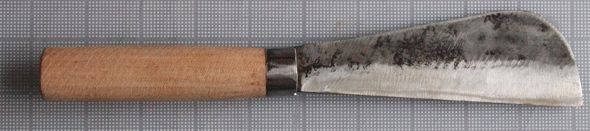
In Laos, at a food market outside Vientiane, I purchased this kitchen knife. I saw many people using knives similar to this. There are many crude forging and grinding marks on it, gradually tapering to a decent cutting edge. Much like the  hacksaw paring knife I wrote about previously, this knife is pure function with little effort expended on decoration or polishing.  The steel itself is a very respectable HRC 55-60. One interesting feature is the complex curve on the back of the blade, possibly to add rigidity to the tip, since the blade is fairly thin, between .048-.051″. Many kitchen knives I saw were shaped like this. Or it might be give the blade additional life as it is reground, since the tip may get reground or used more?  The blade is partially morticed into the steel ferrule, which makes it feel quite solid. The blade angle is slightly offset from the center axis of the handle, an indication it is designed to be used freehand, not on a cutting block.  The handle was turned on a lathe, there are marks from a tailstock center on the bottom, and it was quickly smoothed with a rasp. This gives the unfinished wood handle (some kind of dense hardwood) a very pleasing feel and grip. I really like the feel of unfinished wood for tool handles, though they do get dirty quite quickly.

.

peeler

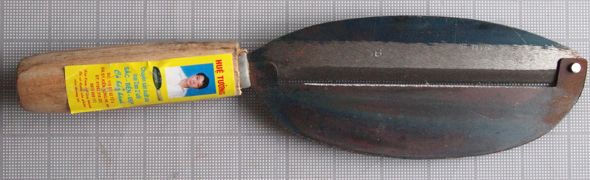
I purchased this vegetable peeler in Vietnam, and believe it or not, this 12″ long version was the smallest of five sizes offered.  The name of the company, or man who made it is named “Hue Tuong”. Vegetable peelers (as well as  mandolins, scabbard planes, spill planes, and a few others) interest me because they reverse the standard way planes or spokeshaves are used— what is usually the waste is actually the useful product. The steel is similar to the knife above, HRC 55-60, but it looks like it is made from rolled stock. This knife is also offset from the central axis, like the Laotian knife above. The knife is made of two pieces, I suspect both to make the manufacture and resharpening easier. A rivet holds the two pieces together at the top, and by simply removing the handle it can be opened 180 degrees and resharpened. Very clever. This knife is sharpened to a finer grit than the one above. I’m still working on my technique when using it.

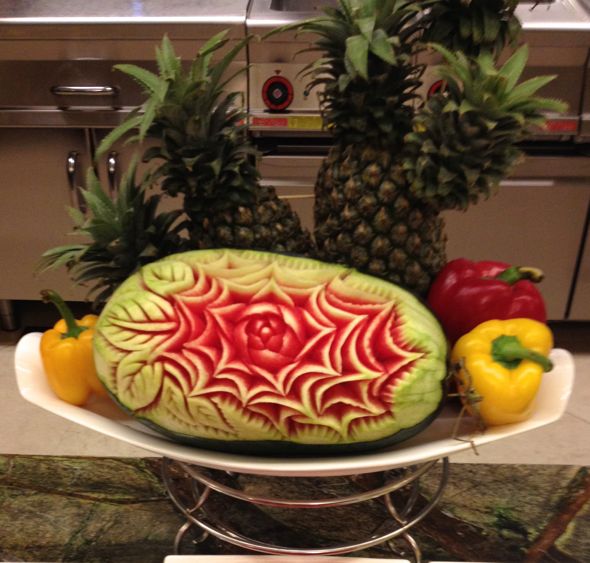
Now that I have these knives, I really should try some of the fancy fruit and vegetable carving, like this beautiful watermelon.

watermellon