Old Books Stink!

Many of my clients talk about the smell of old books as being one of the aspects that attracts them to collecting. 

In the 18th Century, M. Dudin in The Art of the Bookbinder and Gilder ends his treatise by recommending that the completed binding be perfumed.  “Very few people seek this refinement for their books but there is nothing simpler than perfuming a book.” (86) He explains two methods, one by sponging the pages with perfume, the other leaving the book in a cupboard for a long period of time with an open bottle.  Keep those noses going, fellow conservators, I would love to find an example of this.  

Now Christopher Brosius, and his store CB I Hate Perfume, has bottled the smell.  The scent is named “In The Library”, and here is part of his description.

“I love books, particularly old ones. I cannot pass a second hand bookshop and rarely come away without at least one additional volume. I now have quite a collection!  Whenever I read, the start of the journey is always opening the book and breathing deeply. Don’t you find there are few things more wonderful than the smell of a much-loved book? Newly printed books certainly smell very different from older ones. The ink is so crisp. I’ve also noticed that books from different periods & different countries also have very different smells. And then there are the scents of different bindings: leather is marvelous of course but I find a peculiar pleasure in musty worn clothbound books as well. Perhaps just a hint of mildew!  The main note in this scent was copied from one of my favorite books – I happened to find a signed first edition of this novel a few years ago in London. I was more than a little excited because there were only ever a hundred in the first place.” (From the CB I Hate Perfume Website)

I purchased a tiny, 2ml vial of this scent for about $12.  

I’m not much of a perfume guy– it didn’t smell bad, but it didn’t smell like an old book either.
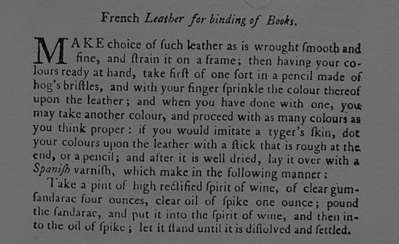
French Leather: 1755 vs. 1810

Godfrey Smith’s The Laboratory or School of Arts is an important, and popular 18th  C.  description of bookbinding.  It was published in at least 7 editions over some 70 years.  Reproduced below are two paragraphs, dealing with “French leather”, which is a method of sprinkling leather. It is extremely prevalent during that time period, and Dudin mentions that “…our eyes are so used to seeing it there that the work would seem unfinished if it was absent.  Moreover, it is, to a certain extent, necessary to hide the minor defects…in calfskin.” (Dudin, 52)  He later notes that it is too expensive to use Natural Calf, since one would have to use leather without holes in it.  Patching holes in a leather binding– almost unthinkable today, given the reversal in the price of labor vs. materials– was considered standard practice. In this time period a pencil means a brush.  Note that hog bristles have yet to be replaced by a synthetic for bookbinding brushes.  This was an English book, commenting on a French tradition, and it appears the author colors the leather (“strain it on a frame;”) before covering, although the French generally applied color after covering.

But what I find most interesting, about the two passages reproduced below, one from the fourth edition, 1755, and one from the seventh, 1810, is how much closer to our own times the 1810 edition is.  Even apart from the long ‘s’, the whole look of it is different in ways that relate to the change in binding structure at this time–from a bound book to a cased one, which I have discussed in another post.  Still, there are some interesting similarities, such as the eccentric italicization in the title.

Although the text is virtually unchanged, the change in typography and the standardization of the printing is dramatic. The letter spacing is more open, even and controlled in the seventh edition contrasted to the fourth.  Visually, all the lines are much more even in the seventh, making the fourth look crude or charming, depending on your viewpoint. Just looking at the differences in these examples highlights the tremendous influence of the beginning of the industrial revolution, and the radical changes that occurred in book structure, machinery, tools, typography and in the world.

Fig. 1The Laboratory or School of Arts. Fourth edition, 1755.

Fig. 2.  The Laboratory or School of Arts. Seventh edition, 1810.

Dudin, M. 1977. The Art of the Bookbinder and Gilder. Trans. R. Atkinson.  Leeds, England:The Elmente Press.