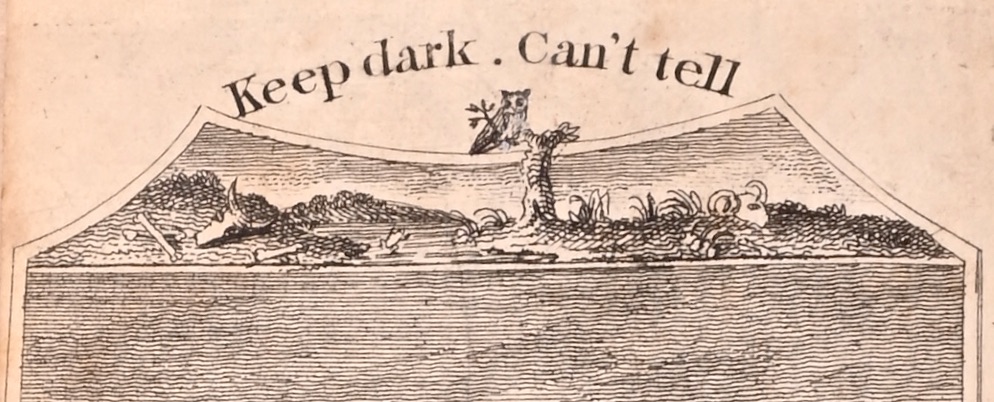
Frontispiece to Bradford’s 1815 “The Poetical Vagaries of a Knight of the Folding-Stick of Paste-Castle.
A Presentation by Jeff Peachey Monday November 25th, 2024
3:30-5:00pm
North Bennet Street School
150 North Street
Boston MA
John J. Bradford: A Knight of the Folding Stick. In this illustrated lecture, book conservator and lapsed poet Jeff Peachey traces the life of John Bradford and interprets his bookbinding-centric poetry. Particular attention will be paid to the 19th century bookbinding tools he describes, and is in fact made of in the frontispiece above. Bradford was a lifelong journeyman bookbinder in early 19th century New York City.
Not only are John Bradford’s poems a lot of fun, but his book is the earliest American description of bookbinding written by an actual bookbinder. Only twelve copies are held in institutions. Bradford was an odd character parts of the book are written in hieroglyphics. This presentation is based on his recent publication, “The Binder’s Curse: John Bradford and Early Nineteenth-Century American Bookbinding” In Suave Mechanicals: Essays in the History of Bookbinding, Volume 8.
At the conclusion, we will read selections from “The Binder’s Curse” aloud. Join us for geeky bookbinder fun! Non-bookbinders are welcome.
Registration is not required. Open to the public.
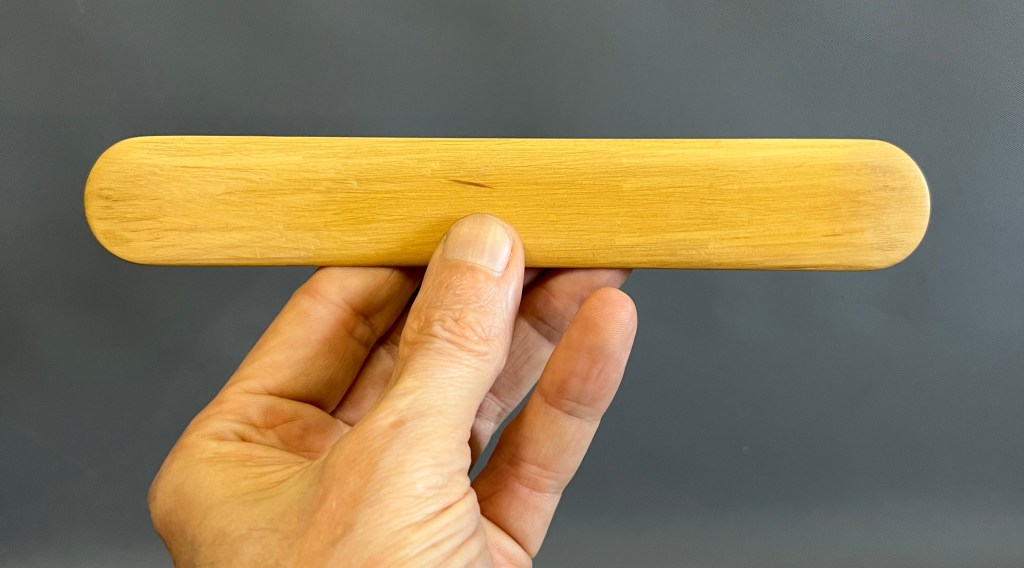
A reproduction 19th century folding stick, made from boxwood.
Detail of the Frontispiece from John J. Bradford’s The Poetical Vagaries of the Knight of the Folding Stick of Paste-Castle and The History of the Garrett, 1815. Photo courtesy The Rosenbach Museum & Library.
Please join us at Emory University on Friday, October 11th, 3:00-4:30pm, for an informative and entertaining presentation in the Jones Room of the Robert W. Woodruff Library. This presentation is in-person, and registration is free. Light refreshments will be served.
In this illustrated lecture, conservator and lapsed poet Jeff Peachey traces the life of John Bradford and interprets his bookbinding-centric poetry. Bradford was a lifelong journeyman bookbinder in early 19th century New York City, remarkable for his idiosyncratic, self-published book of poetry, “The Poetical Vagaries of the Knight of the Folding Stick of Paste-Castle and The History of the Garrett” (1815).
Not only are John Bradford’s poems a lot of fun, but his book is the earliest American description of bookbinding written by an actual bookbinder. Only twelve copies are known of this book, and they are all heavily consulted. Bradford’s bookbinding infuses his mythopoetic cosmology in this seriously weird book; parts are even written in hieroglyphics.
“The Binder’s Curse” is John Bradford’s most well-known poem, and we will read it together at the end of the presentation. This talk is based on Peachey’s recent article, “The Binder’s Curse: John Bradford and Early Nineteenth-Century American Bookbinding” In Suave Mechanicals: Essays in the History of Bookbinding, Volume 8. (Ann Arbor: The Legacy Press, 2023): 386-457
The Binder’s Curse: John Bradford and Early Nineteenth Century American Bookbinding, in Suave Mechanicals 8, The Legacy Press, 2023, 387 – 457.
“Keep Dark. Can’t Tell” With these four words, 19th century NYC bookbinder John Bradford begins an extraordinary book of bookbinding related poetry and imaginative parody. Written records from craftsmen during this time are very uncommon. Writings from bookbinders are very, very uncommon.
Bradford’s well-known poem, The Binder’s Curse, contains an introduction which places it in the context of a trade dispute, which is not so well known. The full title of the book gives a hint at Bradford’s wacky worldview: The Poetical Vagaries of the Knight of the Folding-Stick of Paste-Castle andThe History of the Garrett, &c. &c., Translated from the Hieroglyphics of the Society, by a Member of the Order of the Blue String, Printed for the Author, [New York], 1815. The title is not just poetic exaggeration; part of the text consists of — supposedly — translated and untranslated hieroglyphics.
“This world’s a huge bindery…” Bradford proclaims, decades before Mallarmé’s more famous dictum, that everything in the world exists to end up as a book.1 Bradford constantly reinforces this world-as-bindery cosmology: Did this guy ever think about anything but bookbinding? Yet these poems provides primary documentation of bookbinding techniques and tools: the first mention of a squaring shears, details of which tools the binder owns (Bradford was a journeyman his entire career) and which the master provided, the use of templates, and more. There is a lot of serious bookbinding history buried in his poems.
There are also less serious aspects, like some really cringey love poetry. “Her forehead is like a paste bowl / And smooth as a fine paring stone.” Anyone want to guess what body part is “white as wheat paste”?
Bradford gives us a sense of the working life of an early nineteenth century binder, including day-to-day annoyances, and trade politics, all written with his relentlessly quirky sense of humor. The poem “Receipt for binding a book” consists of the earliest comprehensive listing of the steps in American binding, which is analyzed in depth by comparing it with extant bindings and relevant bookbinding manuals of the day. Bradford’s poems provide a insight into an imaginative bookbinder working on the cusp mechanization, especially dealing with the importance of tool ownership and use.
Thanks to editor Julia Miller and publisher Cathy Baker of the Legacy Press. And congrats to all the other authors below! I can’t wait to read the other essays. Available soon from Oak Knoll Press.
KEEP DARK
Essays in Suave Mechanicals, Vol. 8.
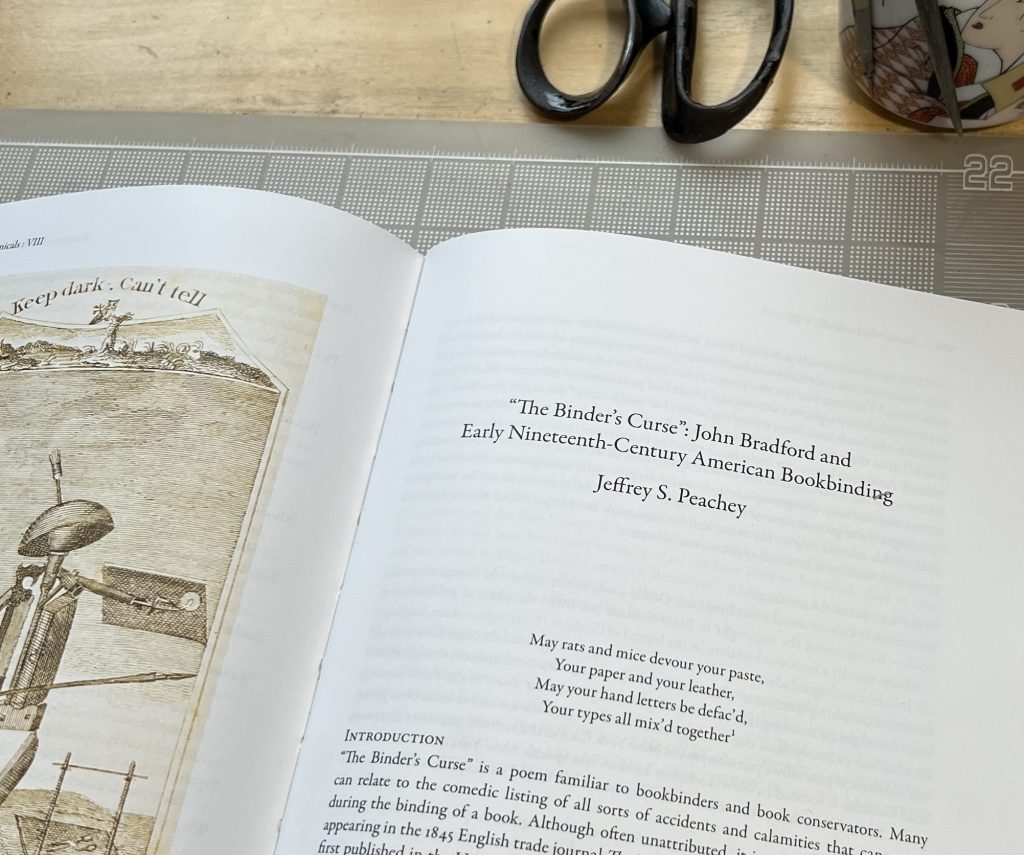
DO NOT attempt this curse at home! Provided for informational purposes only. The beginning of “The Binder’s Curse” from The Poetical Vagaries of the Knight of the Folding-Stick…. 1815.
Malarmé, “Les Livre, Instrument Spirituel,” Quant au livre, 1895. ↩︎




 Peachey Conservation