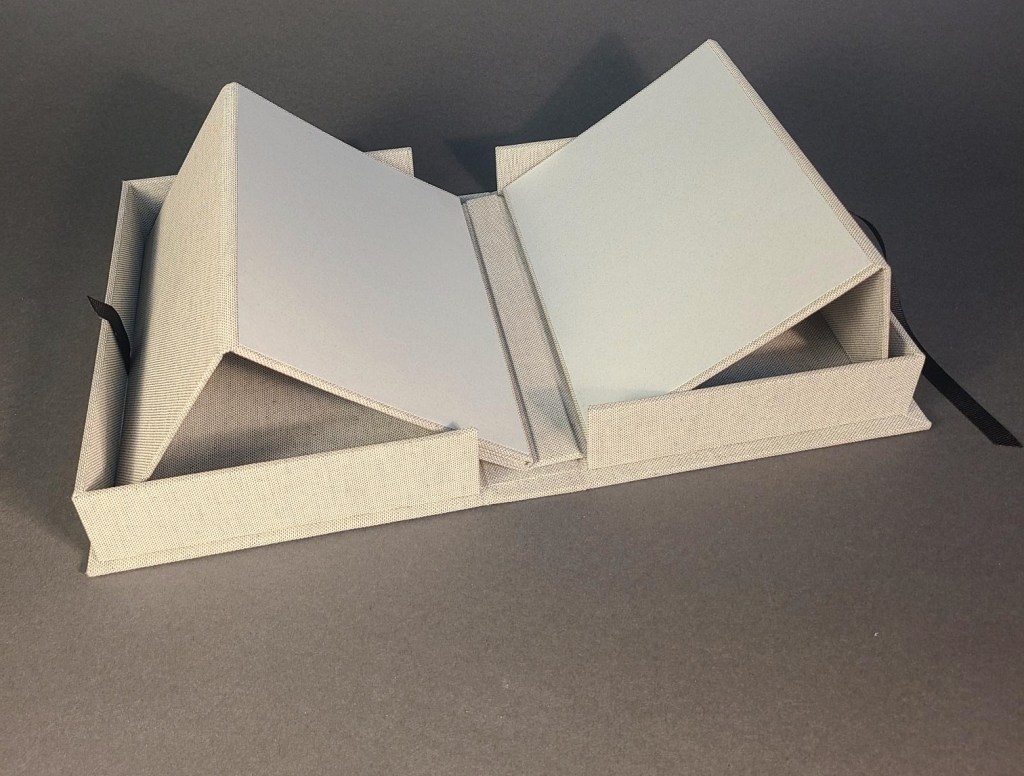
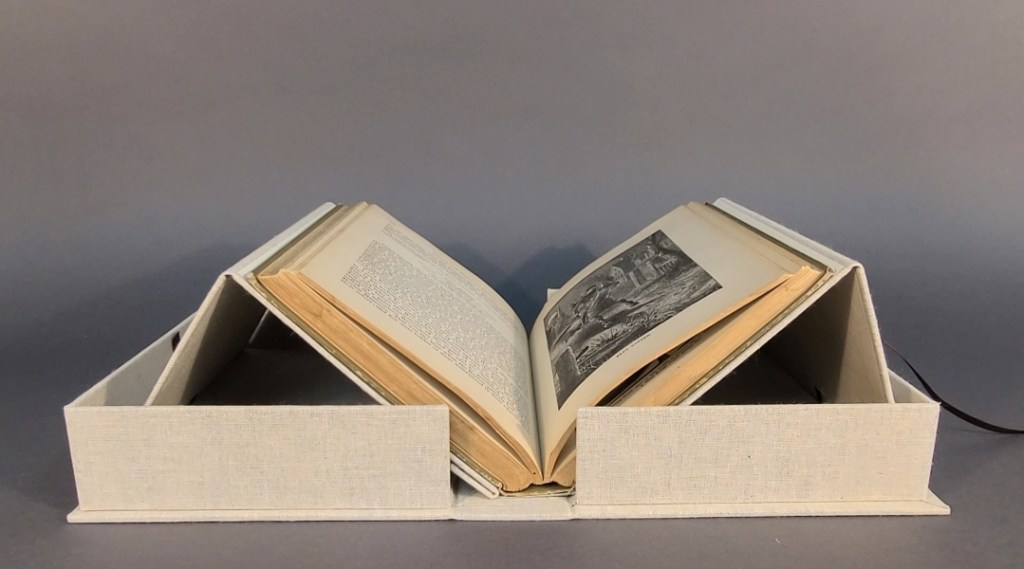
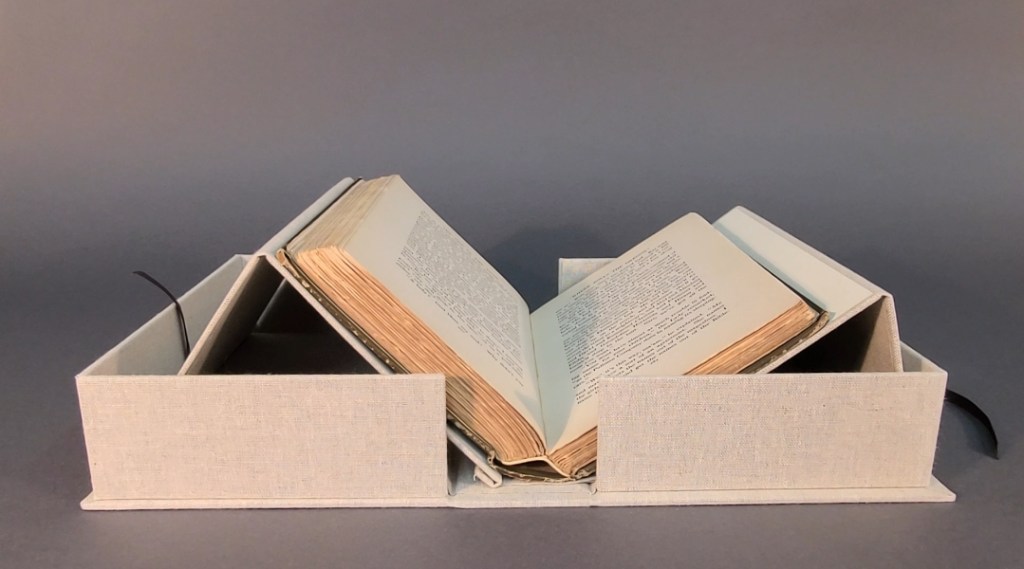
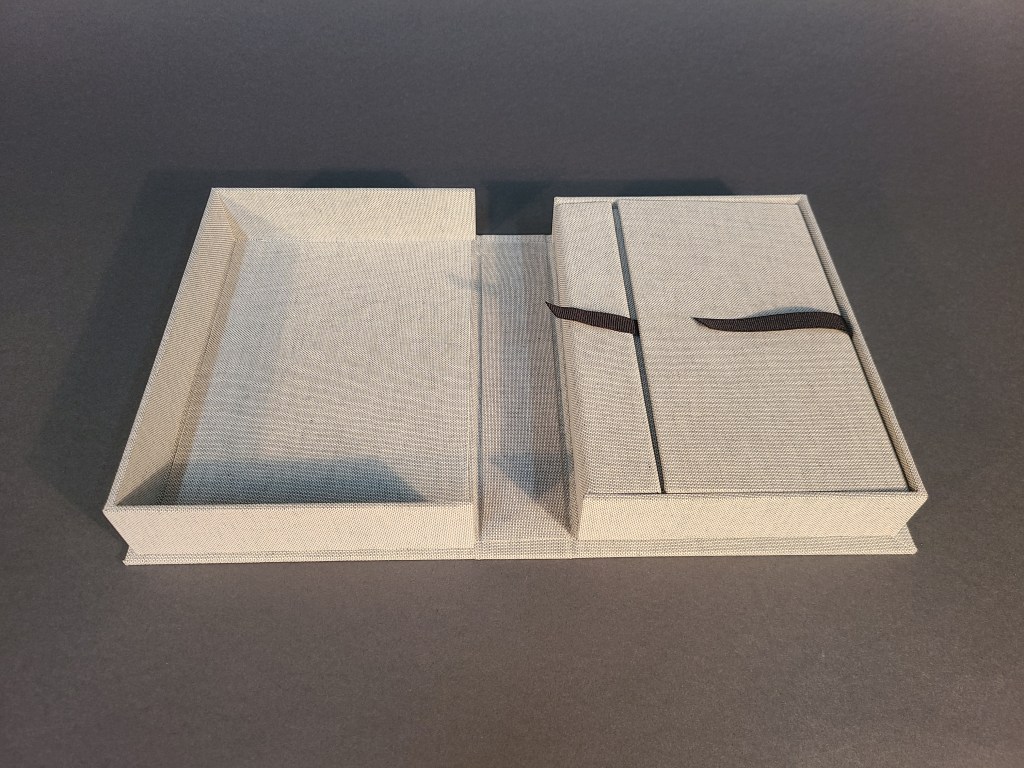
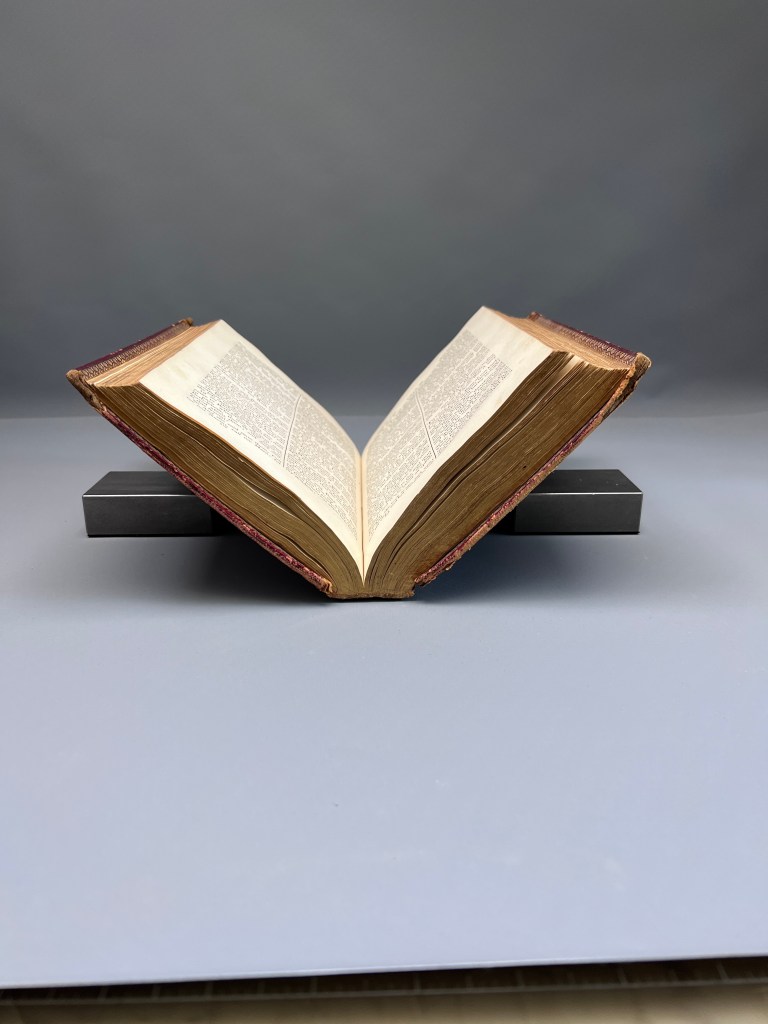
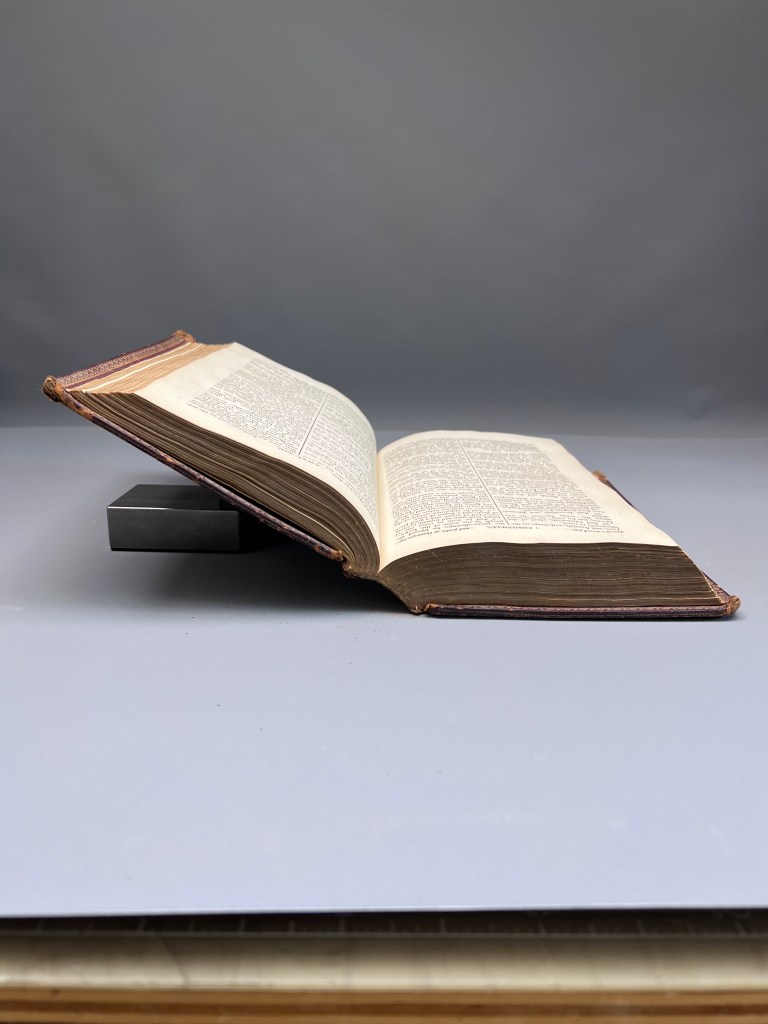
Annie’s completed box open, ready to display and protect a book during handling.
Annie Ujifusa, who developed this variant of a cradle box, guest blogs about her process and details the construction. I came up with the one-piece cradle box in 2009.
During a book conservation internship at the Boston Public Library (BPL) last summer, I was shown a beautiful medieval manuscript from the rare books vault that was housed in a clamshell box with a delightful built-in cradle. This enabled the book to be safely opened and read without even having to take it out of the box. I was charmed by the idea and when I asked how I could make one, I was pointed in the direction of Jeff Peachey’s blog, and then I went down a rabbit hole into making and experimenting with it. I started modifying small elements until I eventually ended up with a structure that I think serves a specific, useful purpose. I recommend reading his blog first to understand his terminology that I have adopted here.
The original construction from Peachey calls for two pieces of bookcloth glued back-to-back serving as the hinge connecting the two wedges of the cradle. I made two boxes this way, and I really loved how, when closed, this limp hinge is able to wrap perfectly around the curve of the spine of the book. But I wanted to keep playing around. For my third attempt I got to thinking about what changes could benefit the structure. I wanted the hinge to have a more finished look; I decided to add a piece of binder’s board to it, making it stiff, so that the cradle looked like a complete, cohesive structure — almost like a book itself — instead of two wedges connected. A structure I was shown by Mary Hamilton French, the Conservation Officer at the BPL, came to mind as the perfect inspiration: the post binding. I took the spine from this binding and adapted it to this purpose.
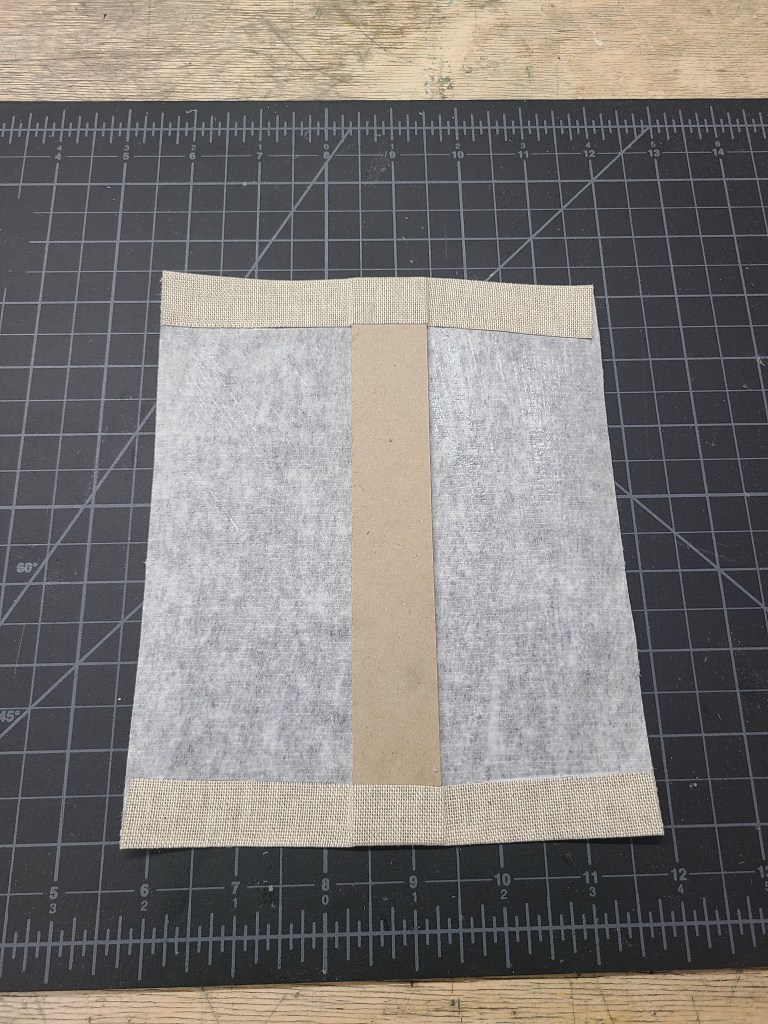
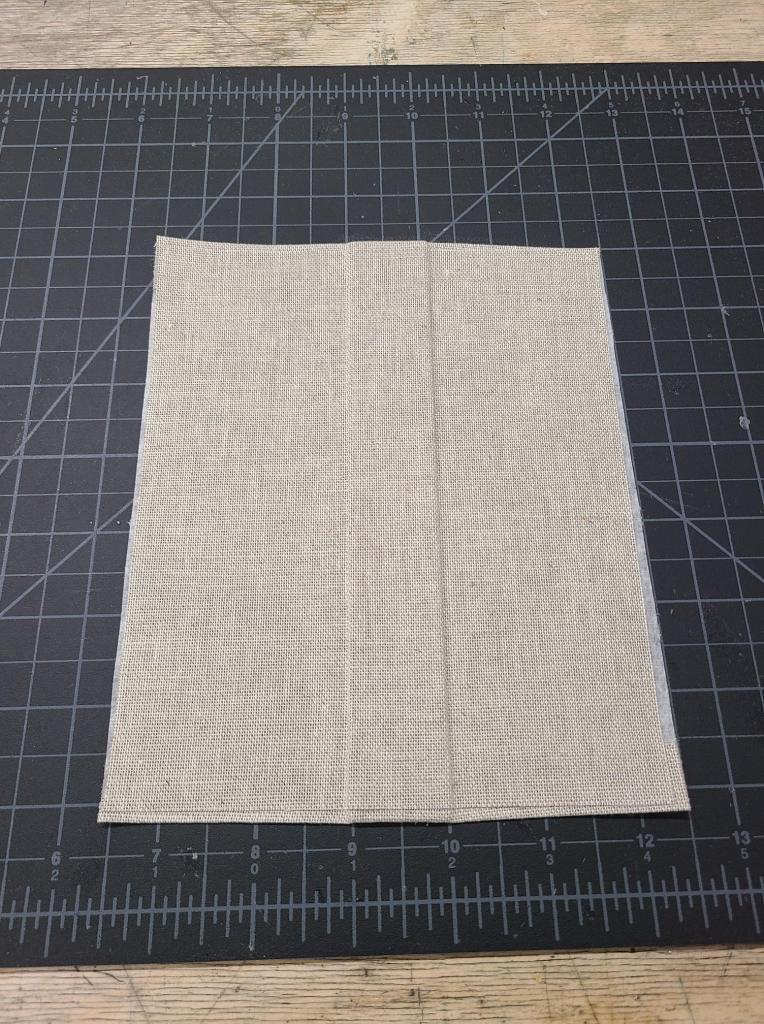
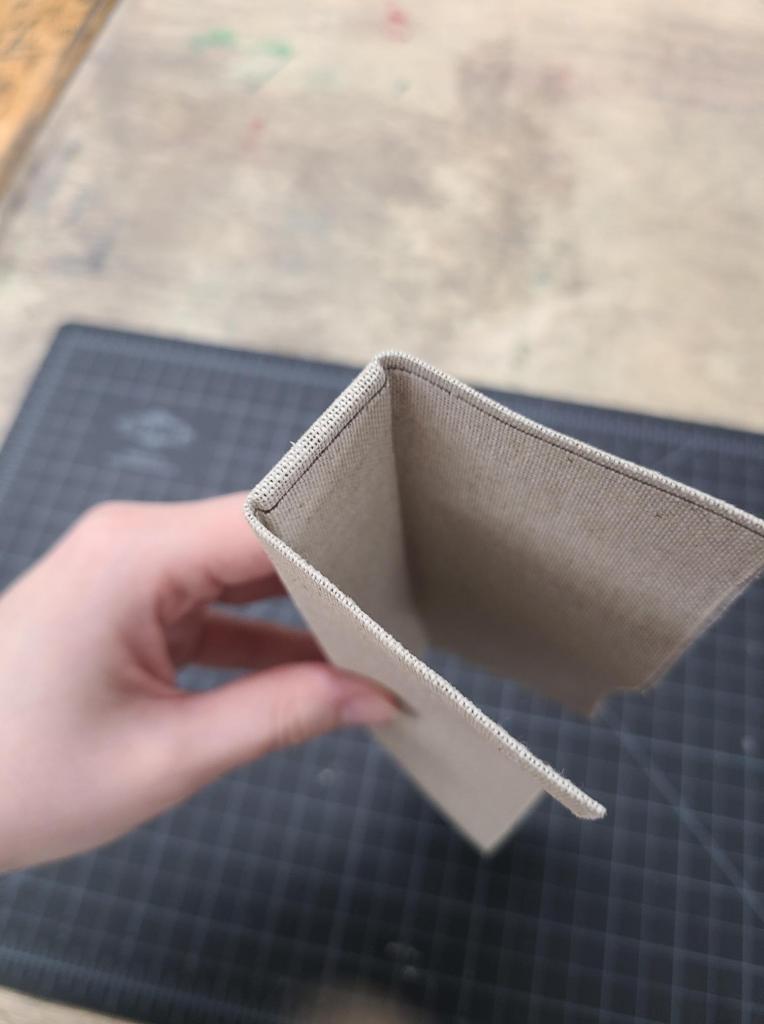
Figs 1. A: The spine piece exterior covered. B: The inside. C: .
Its construction is simple. To make it, cut the binder’s board to match the thickness and height of the book. Cut two pieces of cloth—one should have a height that allows for turn-ins around the head and tail of the board, and the other should have a height that is just a few millimeters shorter than the board. The width should be oversized for now, allowing enough to cover the spacer boards on each wedge, and then some. Glue out the taller of the two pieces of cloth and lay the board down in the center. Turn in the cloth at the head and the tail, and crease it against the sides of the board, keeping the turn-in folds as perpendicular to the board as possible. (Fig. 1A) Then glue out the other piece of cloth, lay it onto the board, then crease it against the sides and then across the expanse of the other piece of cloth (Fig. 1B) Fold both layers of cloth in, against the board edges (Fig. 1C).
Then trim off the excess cloth. With fixtures holding the book and the folded-up wedges in place, glue one side of the hinge to the inner spacer, and then the other side to the outer spacer. If you’re using cloth that cuts nicely, without frayed edges, you can simply cut and glue the cloth down right up to the edge of the outer spacer. (Fig. 2A) Otherwise, before adhering the spacer to the platform, leave enough cloth to wrap around the spacer and glue it to the underside for a nice, seamless look as seen in Fig 2B below..
Left: Fig. 2A. A cut spine wrapper. Right: Fig 2B. At the top, the cloth is wrapped around for a more finished look.
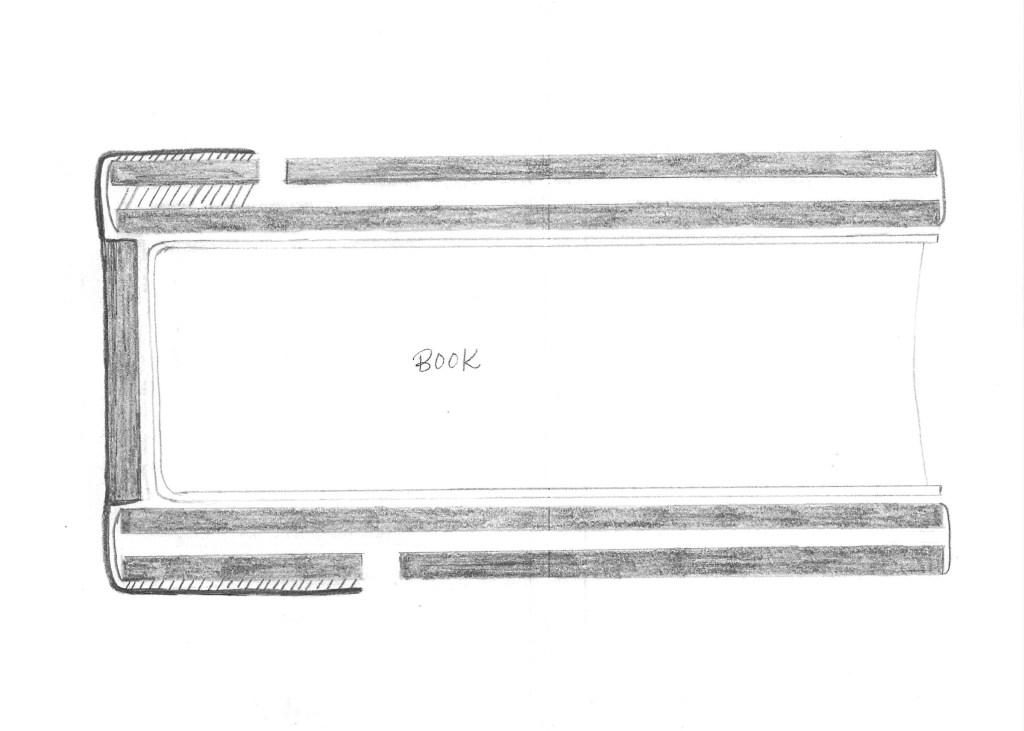
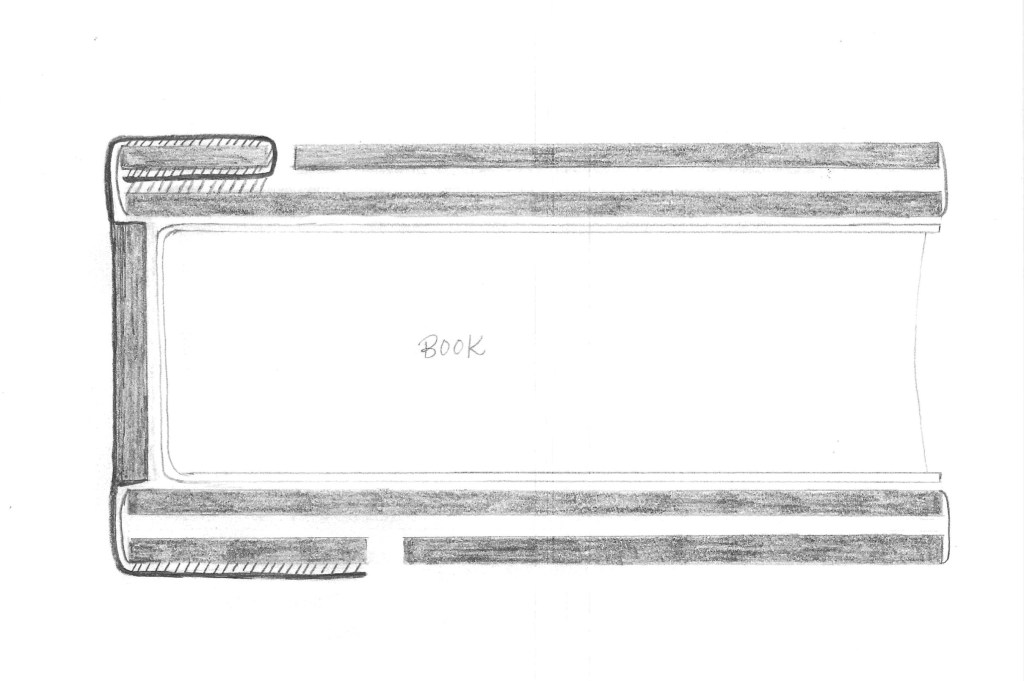
There were a couple of other minor adjustments I made. The gap between the spacer and upright was suggested to be one centimeter. I ended up reducing that to 5mm, for no other reason than I felt it simply looked more elegant. I also found that adding about one spine thickness to the height of the outer upright, as suggested, caused the wedge angle to be too steep. Instead, adding only about one third to one half of the width of the spine created an angle that more closely matched that of the other wedge. (Figs. 3A and 3B)
Figs. 3A and 3B. The left image has about a third the width of the spine added for even wedge height.
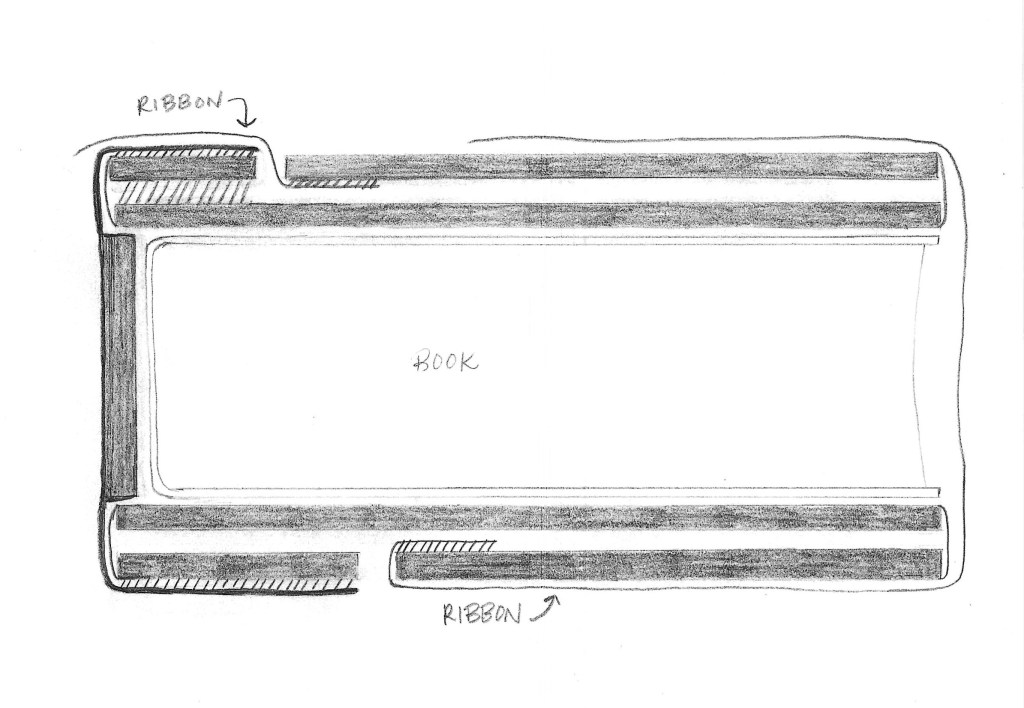
I then added the pull ribbons to a different spot as seen in Fig. 4. I adhered them to the back of the upright pieces before covering the back of the wedges in cloth. The outer wedge ribbon needs to be long enough so that it falls over the wall of the outer tray when opened, and the inner wedge ribbon needs to be long enough to span the width of the upright, the wall height of the inner tray and about two thirds of the width. I felt this saved time, while still allowing the opening to be effortless with a minimal learning curve.
Fig. 4. Ribbon placement for ease of opening the cradle.
Since this was just a model, I made it for a small, skinny book (Fig. 5). At the time, I didn’t realize it’s most valuable use and greatest potential; I think it would really shine in the case of large, flat-backed books that need the added support. It’s an overall neater look in the box, and it feels sturdier when opening. It also avoids potential abrasion from the edge of the inner tray where the spine in the limp hinge would have rested on.
Fig. 5. Completed box closed.
As Peachey laid out in his blog, this type of box requires very specific needs, and has some obvious drawbacks. This one I created calls for even more specific needs, but I think that’s one of the joys of conservation. Each book and each treatment is different and has its own set of obstacles. In addition to providing protection during storage and use, this box is a sure crowd pleaser and fun to open. It was an immensely satisfying structure to make, and I’m looking forward to making more in the future!
Annie UjifusaBio I’m currently a second-year student in North Bennet Street School’s (NBSS) Bookbinding program. Originally from Washington state, I moved to Boston from Alabama. During my first year at NBSS, I quickly became enamored with conservation. It’s truly magical to me. I will be starting as the newest Conservation Technician in the Conservation Lab in Special Collections at the Boston Public Library after I graduate. I believe the book is an object that should be engaged with, and I can’t wait to repair and stabilize books every day so they can be safely handled and studied for generations to come. In my spare time, I hope to continue making new bindings, as well as slowly mastering the art of gold tooling, which I have become obsessed with. I’ll be trying to build my hand tool collection for the rest of my life! Instagram: @annieuji
Thanks for the great idea and post, Annie! Some other cradle boxes from around the web are here. The AIC wiki is also useful for more information.
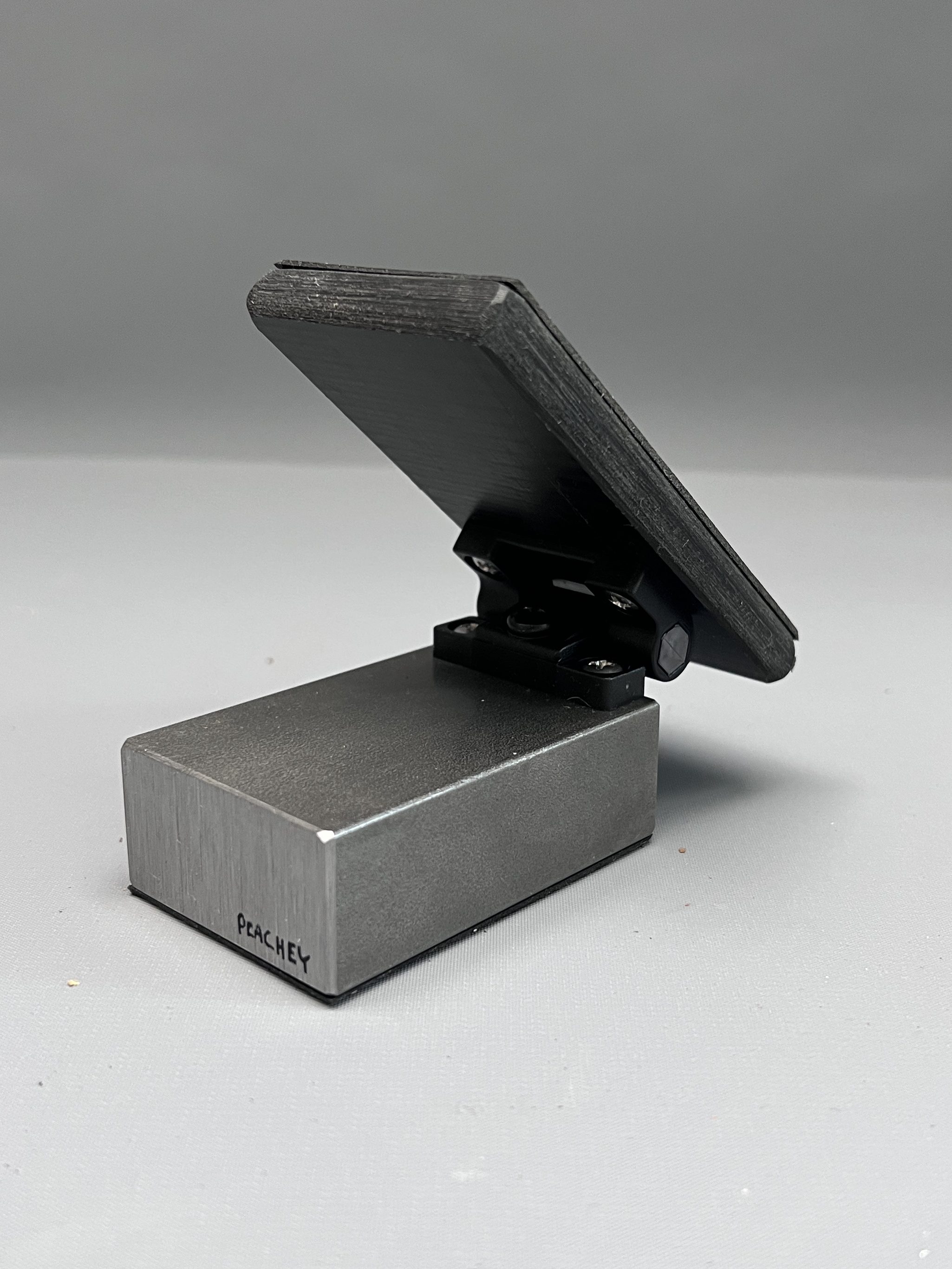
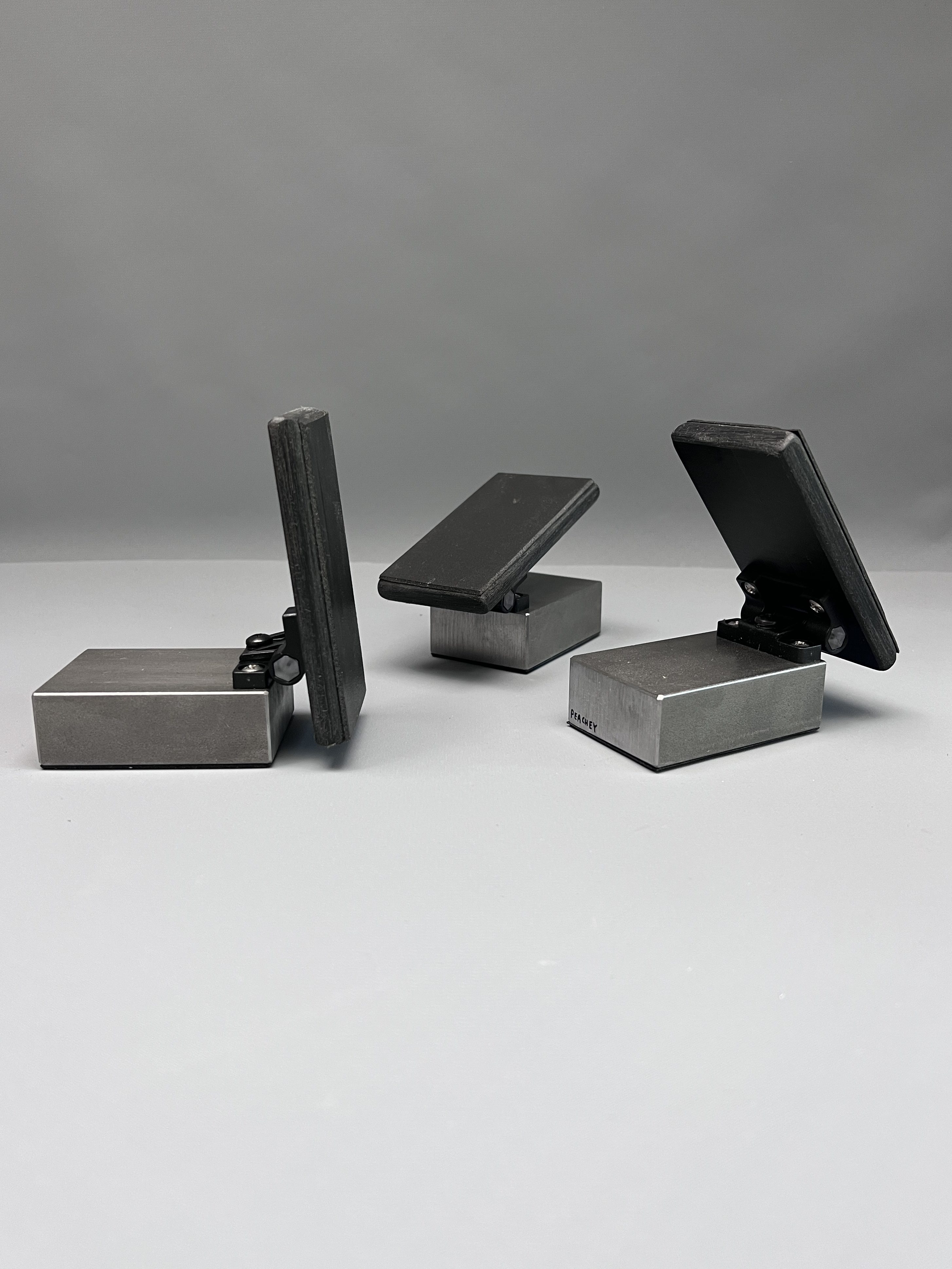
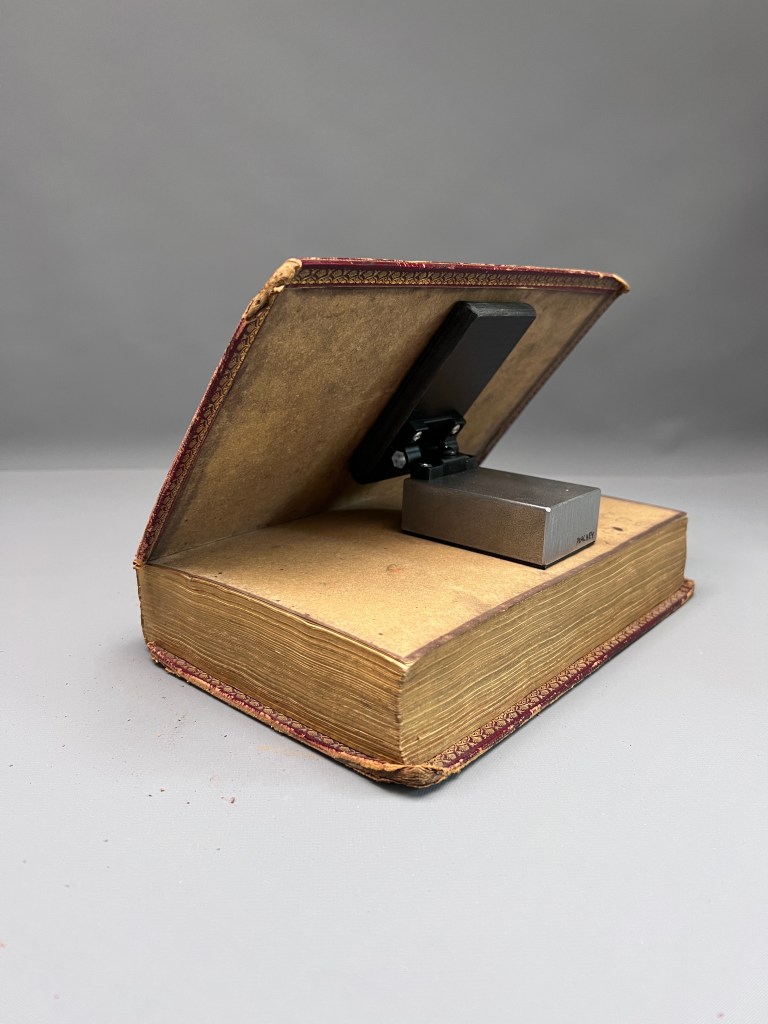
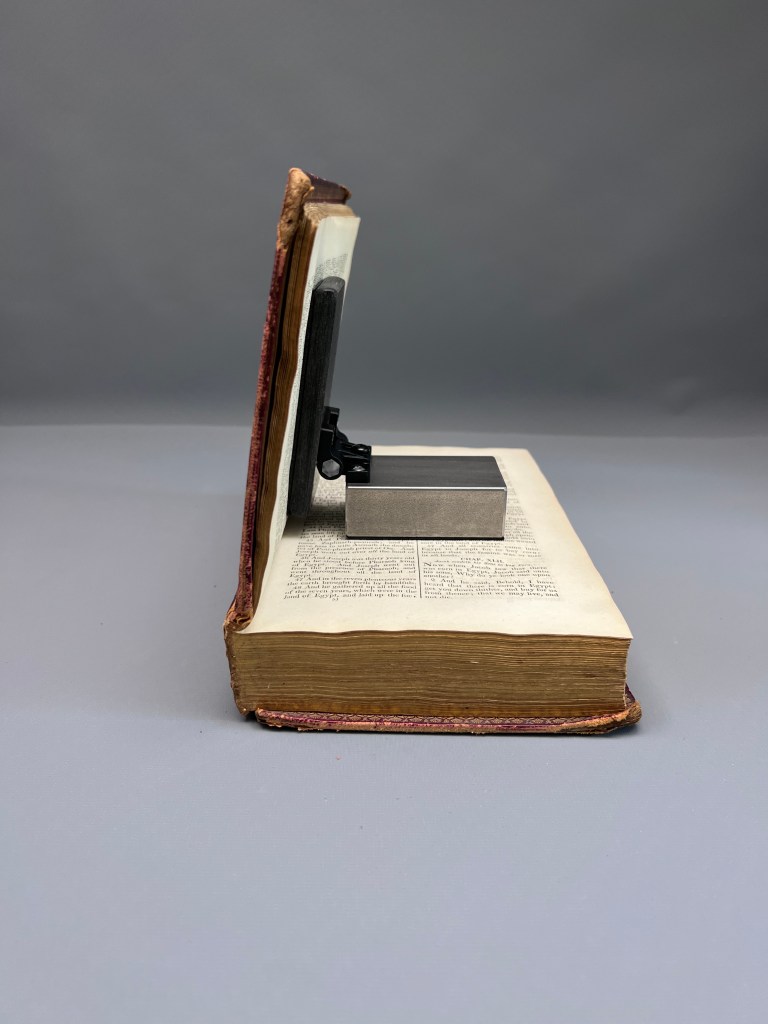
The Weighty WedgeWeighty Wedge is adjustable with a friction hinge
There are dozens of book wedges on the market; the Weighty Wedge is intended for book conservators to use during treatments. It conveniently holds books open in a variety of positions. At 1.9 pounds, or 850 grams, the steel base stays put, and the friction hinge is easily adjustable with one hand from 90 degrees to almost flat. The Volara lined contact surfaces are safe for contact with artifacts and easily replaceable if they become soiled.
These wedges are useful when working on the insides of books for page repair, board edge consolidation and sewing extensions. They can be used to support books open when measuring for display cradles, photography, examination, etc.
Size: Average 4 x 2 x 2 inches. Materials: Steel, Delrin, and Volara. Weight: Average 1.9 pounds or 850 grams. One wedge per order.
I am thrilled to be teaching at Monte again this summer. I’ve only taught once in person for the past two years. I really miss it. Zoom workshops are better than nothing, but still…. If you haven’t been to Monte, I can vouch for what a great experience it is. In addition to the classroom syllabi, a ton of learning happens in more informal surroundings, like cafes and outdoor bars on the main square. Spending time with a passionate and knowledgeable international cohort has resulted in lifelong friends for me. Montefiascone is a special place — too beautiful — a quintessential small Tuscan hilltop town. And Italy as a whole ain’t too shabby either. I suspect many others are hungry to learn in person again, so contact Cheryl (info below) soon to reserve your place! Jeff
Montefiascone is a small medieval walled city about 100 k (80 miles) north of Rome, on Lake Bolsena. Since 1988, conservators, curators, art historians, book artists, and others interested in books and their history have come together to work, to learn and to enjoy this special place. Participants come to enjoy the medieval architecture, friendly people, a clean accessible lake, books, and scholarship. The Montefiascone Project is a non-profit making organisation, set up to fund the restoration of the Library of the Seminario Barbarigo in Montefiascone. Participants may attend one, two, three or all four weeks.
Costs are £550 (or euro equivalent [about $750 USD]) for each week and include all lectures (which are in English). For more information and to enroll, contact Cheryl Porter: chezzaporter (AT) yahoo (DOT) com
For the sake of the local community and everyone associated with the program, we must maintain health and safety standards. We will need to be assured that all course participants comply with Italian regulations concerning vaccinations and other travel requirements.
Recreating the Colours of the Medieval Palette: Western, Hebrew, and Islamic
Course Tutor: Cheryl Porter
This class will study the colours (made from rocks, minerals, metals, insects, and plants) that were processed to produce the colours used by artists throughout the medieval era. The focus will be on manuscript art – Islamic, Hebrew, and European. Participants will re-create the colours using original recipes. Illustrated lectures will address history, geography, chemistry, iconography. And conservation issues. Practical making and painting sessions will follow these lectures. No previous experience is necessary.
Cheryl Porter is the director of the Montefiascone Conservation Project at the Seminario Barbarigo in Montefiascone, Italy, which she founded in 1988. She graduated from Camberwell College of Arts in 1989 and has subsequently worked in many museums and Learned Societies in the UK and many other countries. She teaches workshops on the history of the uses, and methods of application of colour in manuscripts – Islamic, Western and Hebrew. From 2007-2009 she was Head of Conservation and Preservation for the Thesaurus Islamicus and Dar al-Kutub (National Library) of Egypt Manuscript Project and Deputy Head of the Project from 2009-11. She is a consultant to the Library of Alexandria in Egypt and is currently writing a book based on her manuscript colour workshops.
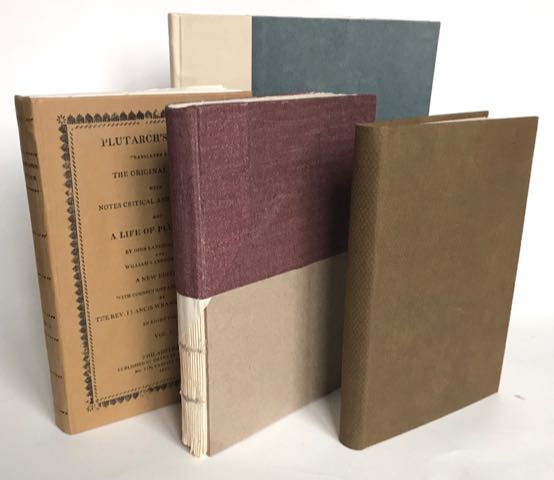
Early nineteenth century structures. Note the XSL dyed reproduction cloth in the middle, and textured cloth on the right.
1st-5th August
Early nineteenth century American and English Bookbinding: Machines, Materials, Structures, and Tools
Course Tutors: Jeff Peachy & Nicole Alvarado
In England and America, common book structures changed significantly during the early nineteenth century. A typical common calf binding was supplanted by even cheaper, new binding styles, such as paper boards bindings and the three-piece adhesive cloth case. We will examine this time period through PowerPoints, readings, discussions, and the hands-on construction of four models: an English common-boards binding, an American extra-boards binding, an American tight-back cloth binding, and an English cloth case. We will explore methods of replicating plain and textured nineteenth century bookcloth, starting with undyed muslin, which will be useful for conserving and sympathetically rebinding books from this time. Close readings from bookbinding manuals, analysis of bindery images, and the use of historic tools will enhance our understanding of this important and under-appreciated time period.
Jeff Peachey is the owner of Peachey Conservation LLC, which specializes in preserving the intrinsic, artifactual, aesthetic and historic values of books. With more than 30 years’ experience. He has taught book conservation workshops internationally and has been awarded numerous fellowships to support his book history research, including at the Rockefeller Foundation Bellagio Center (Italy). He invented the Peachey Board Slotting Machine, which is used in book conservation labs internationally, and designs and manufactures specialized tools for other book conservators. He is a Visiting Instructor for the Library and Archives Conservation Education Consortium graduate consortium. His forthcoming publication in Suave Mechanicals 8 details the bookbinding poetry of John Bradford in the broader context of early 19th century binding practice.
Nicole Alvarado received a B.A. in fine arts with a minor in chemistry from Mount St. Mary’s University in Los Angeles before going on to earn her MA, CAS in Art Conservation at SUNY Buffalo State College. Nicole is currently the Andrew W. Mellon Fellow in Paper Conservation at Los Angeles County Museum of Art. She has previously worked at the Academy of Motion Picture Arts and Sciences’ Margaret Herrick Library, UCLA Library, University of Michigan Library, and Huntington Library.
Chester Beaty Is 1602
8th to 12th August
A Chinese Qur’an
Course Tutors: Kristine Rose-Beers & Cécilia Duminuco, with a lecture from Alison Ohta
During this class, participants will make a model of Chester Beatty Is 1602, a 17th or 18th century Chinese Qur’an with its original binding. This small manuscript is distinctly Chinese. It is covered with fine patterned silk, and the pages are made of soft, fibrous paper. In keeping with many Islamic bindings, it has an envelope flap, but this is squared off, similar to those seen in some south-east Asian Islamic manuscripts. This Qur’an is an example of how aspects of the Islamic book were combined with local decorative traditions influencing ornament, calligraphy and illumination.
Muslim communities have been established in China since the 7th century. According to the historical accounts of Chinese Muslims, Islam was first brought to China by Sa’d ibn abi Waqqas, who came to China for the third time at the head of an embassy sent by Uthman, the third caliph, in 651. Emperor Gaozong, the Tang emperor, then ordered the construction of the Memorial Mosque in Guangzhou/Canton, the first mosque in the country. Although scholars have not found any historical evidence that Sa`d ibn Abi Waqqas visited China, they agree that the first Muslims must have arrived in China in the 7th century, and that the major trading cities, such as Guangzhou, Quanzhou probably already had their first mosques built during the Tang Dynasty although no reliable sources attest to their actual existence.
Muslims in China have continued to practice their faith sometimes under very difficult circumstances since the 7th century. Today, the Muslim population of China is estimated as representing 0.45% to 2.85% of the total population with 39,000 mosques serving this congregation. This Qur’an represents the Islamic legacy in China and is a unique opportunity to examine this combination of traditions which were carried along the Silk Roads over the centuries.
Kristine Rose-Beers is Head of Conservation at the Chester Beatty in Dublin and an accredited member of the Institute of Conservation. Her research interests include the conservation of Islamic manuscript material, early binding structures and the use of pigments and dyes in medieval manuscripts.
Before moving to Ireland, Kristine worked at the Fitzwilliam Museum in Cambridge as Assistant Keeper (Conservator of Manuscripts and Printed Books); at the Chester Beatty Library with a particular focus on the Turkish manuscript collection; and at Cambridge University Library. She graduated from the Conservation programme at Camberwell College of Arts in 2002 and is a member of the Board of Directors of The Islamic Manuscript Association, and the Kairouan Manuscript Project.
Cécilia Duminuco is a book and paper conservator. She graduated from the École Supérieure des Arts Saint-Luc of Liège with a Masters in Painting Conservation in 2013, before completing a Masters in the Conservation of Books and Library Materials at West Dean College in the UK in 2015. Cécilia joined the Chester Beatty in Dublin as Heritage Council Intern in Conservation 2015-16, before moving to Cambridge University Library to work on Charles Darwin’s Library digitisation project. She then worked at the University of Manchester, before returning to Cambridge University Library in 2019 to work on the digitisation of Greek Manuscripts. Cécilia has now relocated to Belgium where she continues to follow her passion for early bookbinding, non-Western book structures, pigments in illuminated manuscripts and painted surfaces.
Alison Ohta is currently Director of the Royal Asiatic Society of Great Britain and Ireland. She completed her doctoral thesis at SOAS (London University) on Mamluk bindings and has published and lectured extensively on the subject.
A late 16th Century Cambridge Binding, and the reproduction tools used for decoration
15th-19th August
Recreating a late sixteenth-century Cambridge bookbinding
Course tutors: Jim Bloxam &Shaun Thompson, with lectures from David Pearson
Cambridge, heavily influenced by its university, has always been a place with books at the heart of its activities; a place where they have for many centuries been printed, sold, bound, owned, stored, read, and used. Our Montefiascone course, a few years ago, was devoted to making a model of a late 15th century Cambridge binding; this year we will analyse a binding style from a century later and construct a model of a typical late 16th century Cambridge binding. At the end of the 15th century, leather-covered bindings usually had wooden boards and clasps and decoration depended on labour-intensive repetitive tooling using small hand-held tools. A century later, wood had given way to pasteboard or pulpboard, clasps had been replaced by cloth ties and decoration looked very different; gilt tooling, unknown in English binding work before about 1520, had become common.
The tutors will enable the course participants to make a model binding. Processes will include sewing the text-block, sewing the endbands, shaping and attaching the boards and covering with calf-skin. The covered books will be tooled and have cloth ties attached. The course will be led by a team bringing together the hands-on binding expertise of Jim Bloxam and Shaun Thompson, from Cambridge University Library, and the historical knowledge of David Pearson. David, a binding historian, is currently working on a project to map the development of Cambridge binding between the 15th and 18th centuries, so that Cambridge work can be better recognised and dated. He teaches the evolution of binding styles at the Rare Book Schools in London and Virginia. During the week David will give presentations on ways in which Cambridge binding changed during the 16th century and how it fits into the wider context of British and European binding of the time. He will also consider the value of studying historic bindings, highlighting the questions we should ask.
David Pearson retired in 2017 as Director of Culture, Heritage and Libraries for the City of London Corporation, after a professional career of 35 years or so working in various major research libraries in London and elsewhere. He is now a Research Fellow at the Institute of English Studies in the University of London, and a member of the teaching staff of the London Rare Books School there. He has published extensively on aspects of book history, with a particular interest in aspects of the book as an owned and designed object; his books include Provenance Research in Book History (1994), Oxford Bookbinding 1500-1640 (2000), English Bookbinding Styles 1450-1800 (2005), and Books as History (2008). He has taught and lectured in these fields for numerous audiences and is a Past President of the Bibliographical Society. He is currently working on a project on early modern Cambridge bookbinding, to become a book published by the Legacy Press, and the basis of the Sandars Lectures in Cambridge in 2023.
Jim Bloxam is Head of Conservation and Collection Care at Cambridge University Library. Jim is an Accredited Conservator of the Institute of Conservation. His particular research interests lie mainly in the history of books, their structural qualities and their cultural context. He has taught historical book structures in the UK, Europe, and the US, focusing mainly on European book structures.
Shaun Thompson is a traditionally trained bookbinder with over thirty years’ experience and a passionate advocate for the importance of hand bookbinding skills in book conservation. He has worked for Cambridge University Library for the past 19 years and presently holds the position of Conservation and Collection Care Manager. Shaun’s research interests are in early northern European book structures and he has made good use of the Library’s collections to examine the physical aspects and historical techniques used in medieval bindings. He is also an experienced and highly skilled practical teacher, having taught hand bookbinding to conservation students in the UK, at both West Dean College and City and Guilds of London Art School. He has taught courses at Montefiascone since 2013 and is looking forward to returning to share his ever-widening knowledge and experience.
For additional information, please see The Montefiascone Conservation Project web page and follow us on Facebook for program updates and more.



 Peachey Conservation