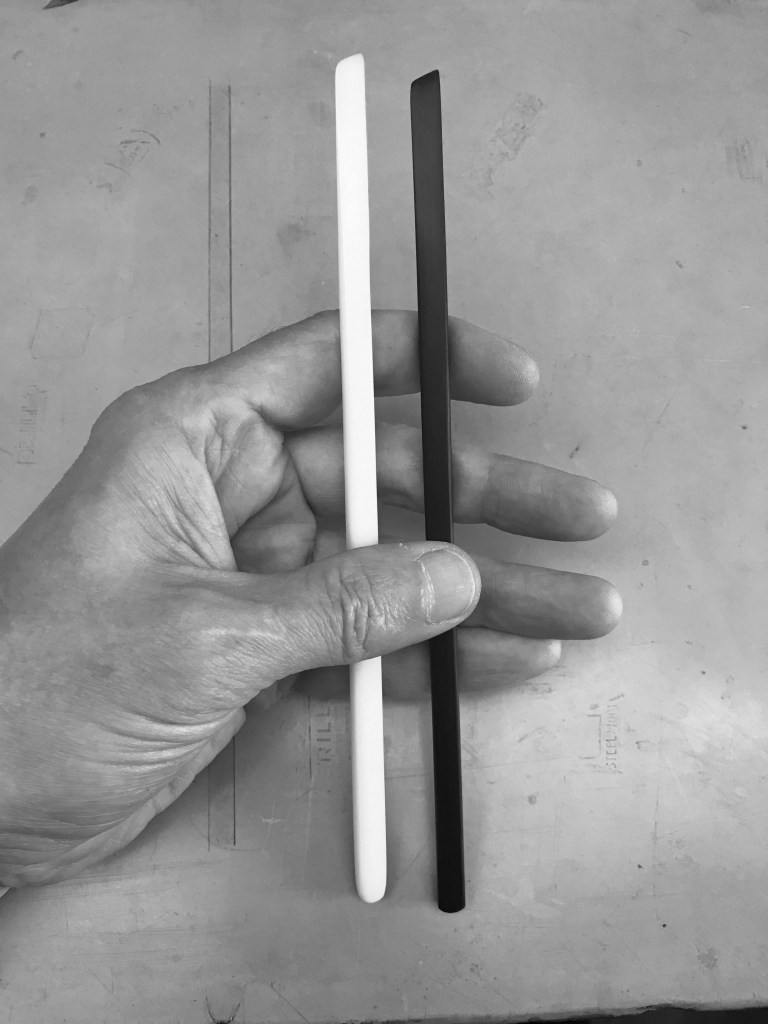
Delrin heras are now available in a black rigid version and a white flexible one.
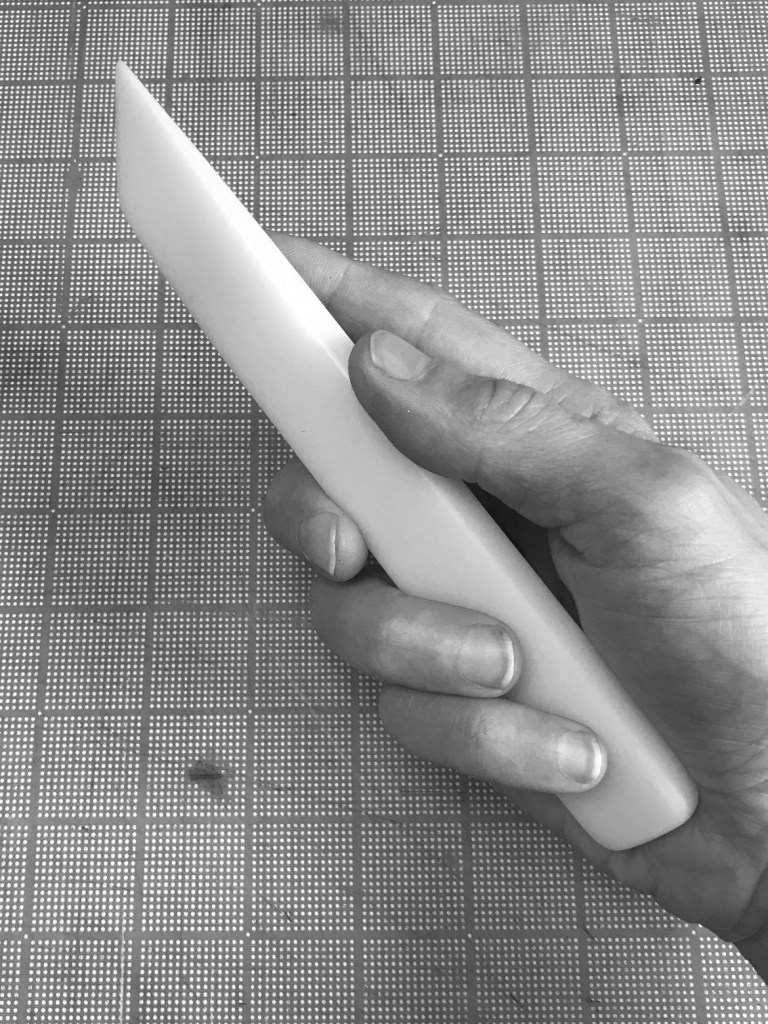
This is one of my most used tools. It almost always seems to be in my hand while working.
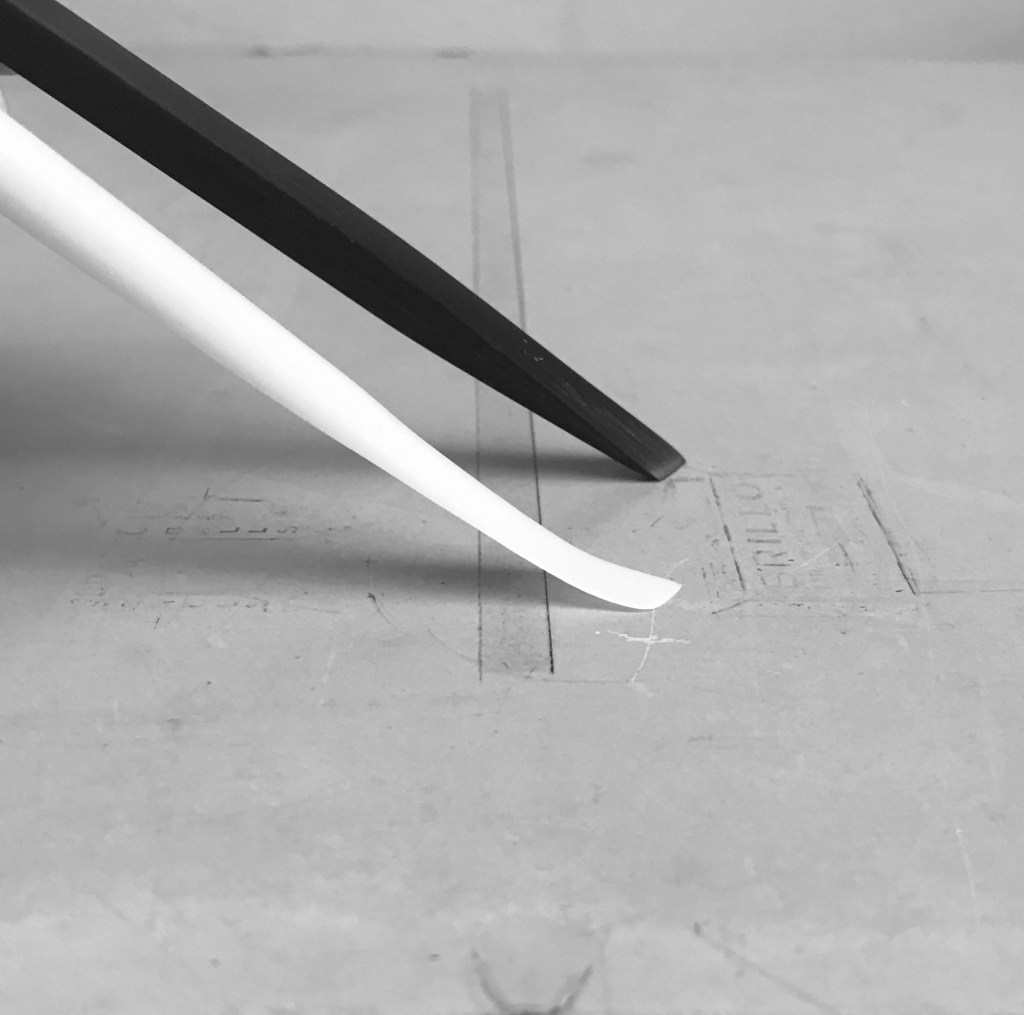
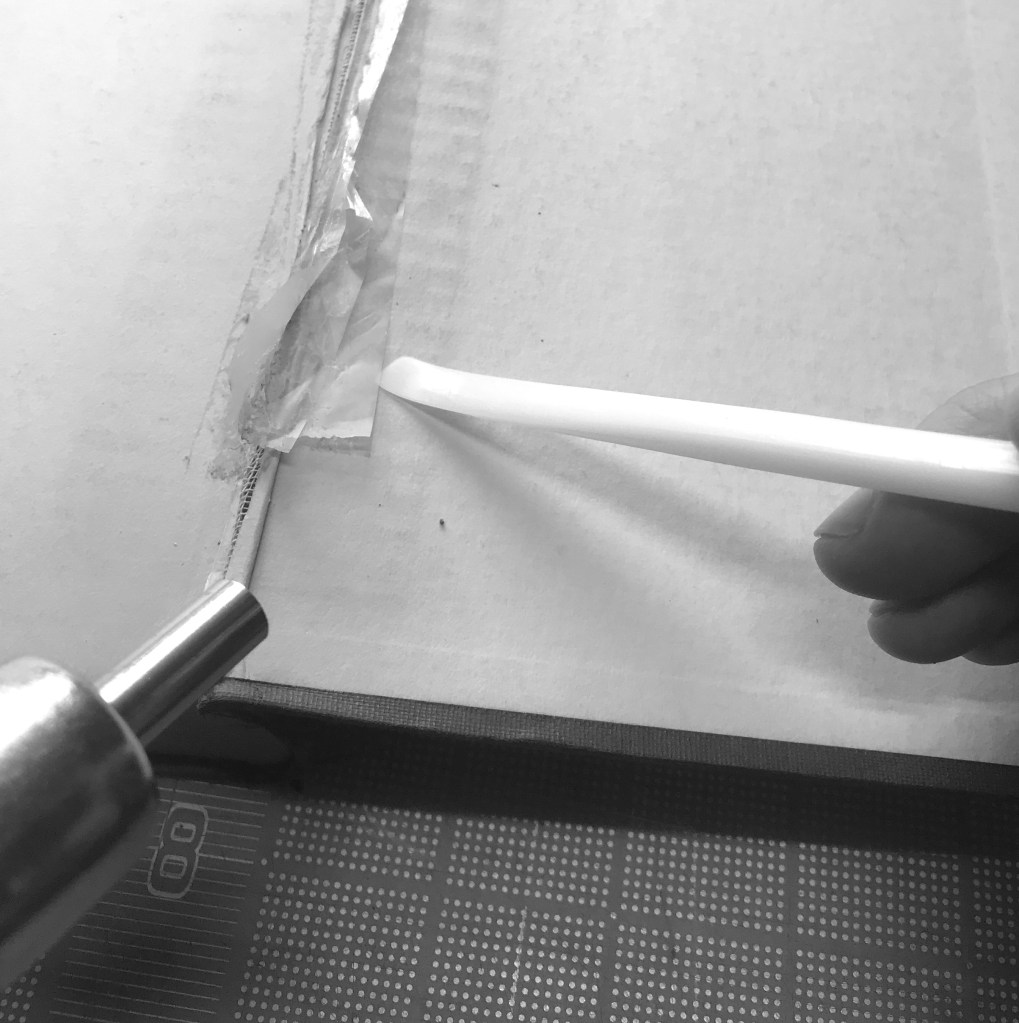
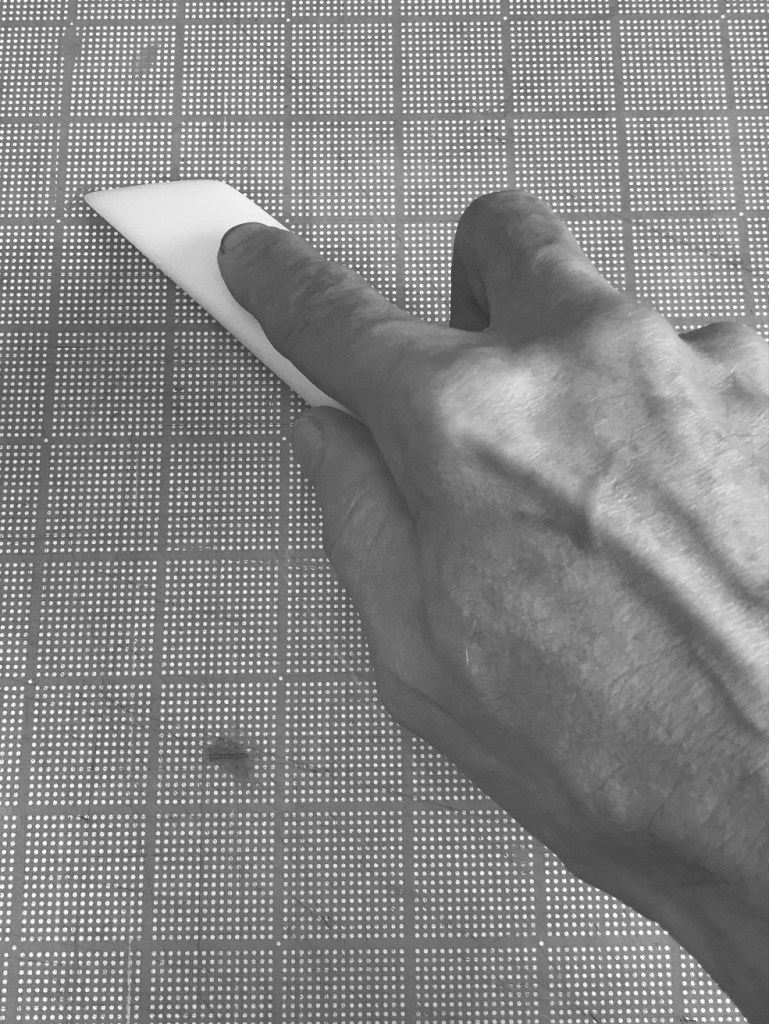
The white version is very flexible at the tip, making it ideal for delicate tasks, lifting fragile materials, pigment consolidation, and pressure sensitive tape removal. The super thin, translucent tip bends to almost 90 degrees, allowing precise control of downward pressure while sliding under the tape carrier. It is also perfect for gently releasing tissue repairs from remay or hollytex.
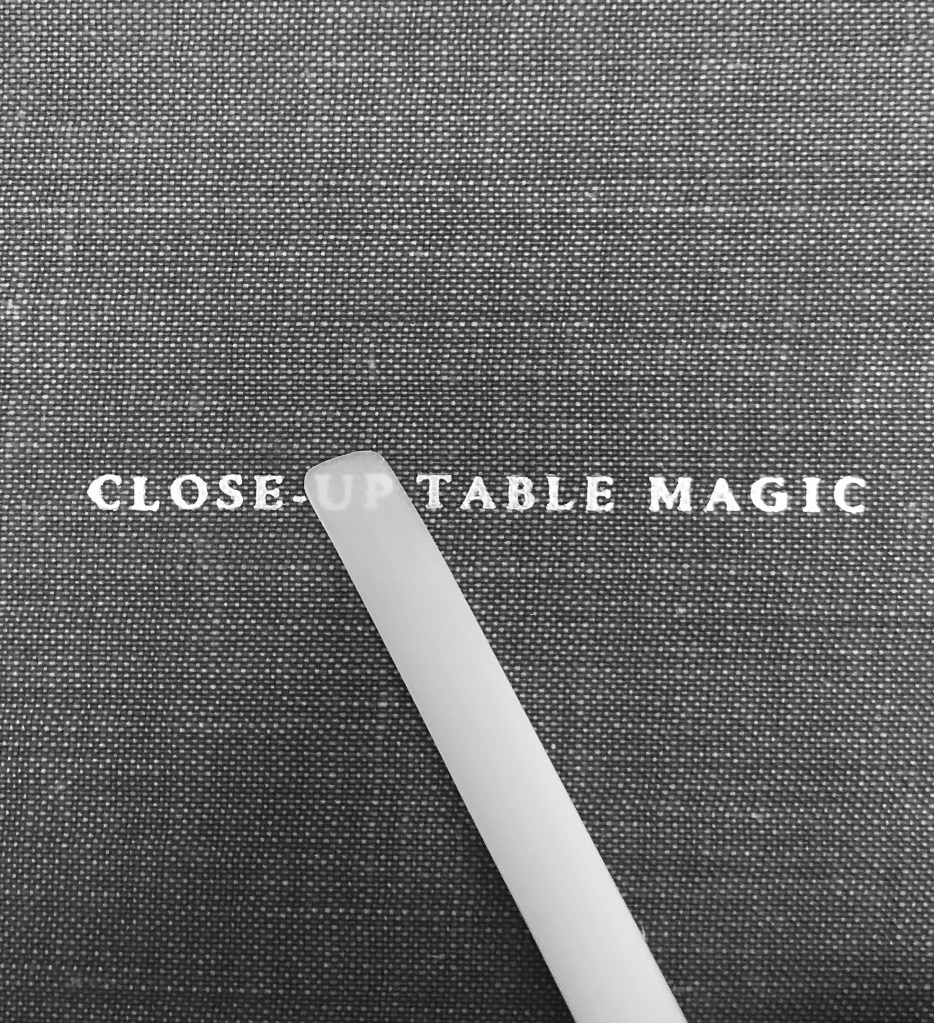
Warm air + delrin = tape removal blissThe white version is thin enough to be translucent
The black version of Delrin is stiffer than the white, and the tip of this tool is thicker and stronger. It is useful for lifting, inserting adhesive, smoothing repairs, general smooshing, scoring, folding, marking, holding repairs in place, rebacking, etc… . Other uses.
If you can’t decide between the two versions, the only reasonable option is to purchase both. The non-reflective surface is easy to photograph. Delrin does not rust and is food safe. But I doubt it tastes very good. Delrin, approximately 7 x .25 x .25″
NB: if you are interested in learning to make your own tools, we will make both of these (and 8 other tools) in upcoming Delrin and Bamboo Toolmaking workshops. More info here!
It is a great feeling to use a tool you have custom designed to fit your hand and working methods.
Making tools is not only engaging and fun, but entirely practical since the result is set of tools you can use daily. Book conservators, other conservators, bookbinders, technicians, artists and others will find this workshop valuable. Filing, scraping and polishing are meditative activities, no previous experience required. Working Delrin and bamboo is a great way to start toolmaking and we will make folders, lifting tools, microspatulas, hera, and creasing tools. Most of the skills and techniques taught are transferable to wood and bone toolmaking too. Fair warning: making your own tools is highly addictive!
Thankfully, the pandemic is subsiding in New York, but I originally created this workshop specifically to teach online with a kit, and it has worked well for the past four sessions, so I will keep it up for a while. So far 49 students from 7 countries have completed this workshop.
All aspects of making tools with delrin and bamboo will be discussed in detail: design considerations, cutting, filing, rough shaping, final shaping, and polishing. The workshop consists of two 3- hour synchronous zoom sessions with PPT’s, videos, discussion of handouts, demonstrations, Q&A chat sessions, and working together. Also included is one month access to web resources, PPTs and videos demonstrating key techniques.
The workshop includes a kit with enough materials to make nine tools with a retail value over $300. A set of hand tools is also included: a cherry bench hook, scraper, burnisher, a file for plastics, and a variety of sanding and polishing supplies. All you need is a stable work surface, a few common hand tools, and some time to work outside of class.
DATES: There will be three sessions: September 11 + 18, October 16 + 23, November 13 + 20
International participants need to contact me confirming they wish to attend, I will save a seat and send you an invoice enabling you to pay by credit card. I will hold the seat for 24 hours after I send the invoice. The cost is $440 Canada, $465 EU and other countries, and $490 Australia and New Zealand. This includes kit shipping. Up to 3 kits can ship in one box internationally, so if you place one order for 2 or 3 people there will be substantial shipping savings, with the second and third places costing $390.
SCHOLARSHIP
A generous patron has offered a scholarship (worth $390 — $490) for the “Delrin and Bamboo Toolmaking Workshop”, to be held November 13 + 20, 2021. The award is intended for a book conservator, bookbinder, or technician new to the profession, with less than five years working experience, who is in need of financial assistance. Domestic and international applications are welcome.
To apply, contact me with the subject heading “Tool Making Scholarship Fall 2021”.
The application should consist of two paragraphs, the first explaining why this scholarship is necessary to the applicant, the second detailing how it would benefit the applicant’s work. Applications are due September 1, and the successful candidate notified September 7. Submission not adhering to this application process will not be considered, and unsuccessful candidates will not be notified.
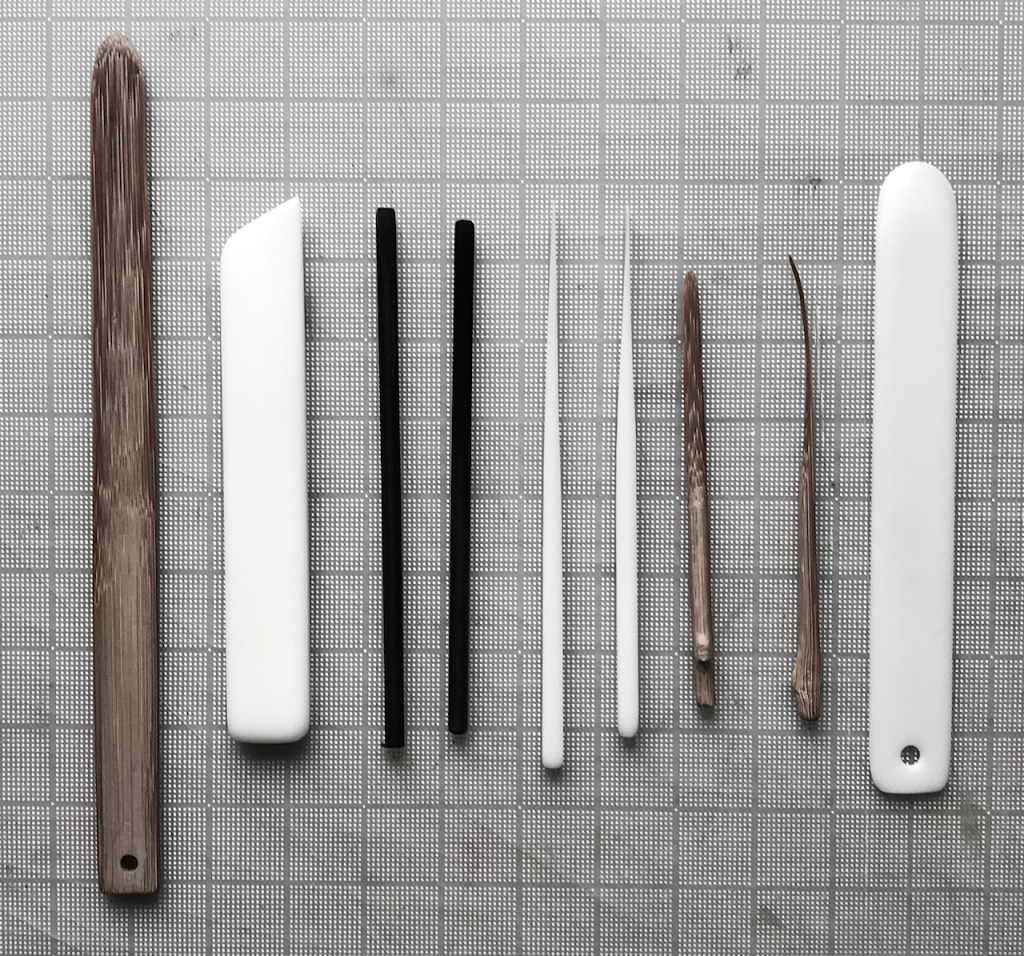
Some versions of the tools you will make in this workshop.
Conservation Technician, Columbia University Libraries.
[ NOTE: I worked with Andreas beginning in the early 1990s at Columbia University’s Conservation Lab. Once they reopen, he will soon be completing 60 years of service! ]
2. My four knives which I use in different situations, they differ in size and sharpness. Two are like the one above. What is good is about them is they have a certain amount of flex which I need when I’m peeling binders board from the back of the end sheet. In order to save original end sheets (often maps or other decorative designs), I have to go from the back of the end sheet. This involves peeling different types of binders boards, with different densities. and made of different materials. A sharp knife is needed to peel away the back of the end sheet.
I made this replica of Andreas’s rigid dull knife from memory. I think the shape was caused by 50+ years of work and resharpening, given the thickness of the spine of the blade.
The other two are smaller and have a more rigid back of the blade (see below). They are good for cleaning the book spines. When I clean the back of the books, a dull knife like these is good because it is a scraping action and not a cutting one.
3. Scissors, a standard bookbinder’s model with one blunt end.
4. Micro-spatula, a Caselli, of course.
5. Sanding block, which is helpful when tip-ins are done. The sandpaper block is used on any bits of paper that sticks out.
I could list others, but those are ones that I use most.



 Peachey Conservation