Fish gelatin: Spreading the word about a book conservator’s new friend

Written by Ashleigh Ferguson Schieszer, Special Collections Conservator and Co-Lab Manager of the Preservation Lab of the University of Cincinnati. Reblogged with permission. Originally published 27 November 2023.

Last year around this time, the lab was fortunate to bring in book conservator and toolmaker, Jeff Peachey for a week-long intensive workshop to learn leather rebacking. While I always expect to walk away with new anticipated skills as advertised by the workshop, I’m ALSO always pleasantly surprised by the tangential tips and tricks shared along the way.  In the case of Peachey’s workshop, there were many!

One of my favorites was his use of a fish gelatin. While adhering spine linings to our text blocks, Peachey pulled out a small baggie of fish gelatin he brought with him to the workshop.  He poured the dry flaky powder into a small jar, added room temperature cold water, and mixed it until a liquid-y consistency.  He then added strained wheat starch paste to the gelatin and mixed with water until he was happy with the consistency.  He estimated it was a 40:60 ratio of gelatin to paste. 

Jeff Peachey taught a workshop at the Preservation Lab in Oct. 2022 where he first introduced us to a low-bloom fish gelatin for book conservation that didn’t require heat for use.

If you’ve ever used gelatin before, you might be wondering – how is it possible to mix the gelatin without heating?  That’s the beauty of this product – it has a high molecular weight with low bloom strength and is produced from cold water fish which gives it this ability.  It might not be the strongest of the films with a 0-bloom strength, but for a book conservator doing paper repairs that need to be reversible yet strong, this combo still had an amazing tack when dry!

Peachey explained he first heard about the gelatin on a lab tour at the Weissman Center. He recalled Alan Puglia might have been the one who originally investigated the adhesive for pigment consolidation of hundreds of manuscripts for a show. The mention of a high molecular weight Norland fish gelatin was shared during a talk given at the American Institute for Conservation’s 44th annual meeting.  The talk was titled, The Challenge of Scale: Treatment of 160 Illuminated Manuscripts for Exhibition,” by Debora D. Mayer and Alan Puglia.

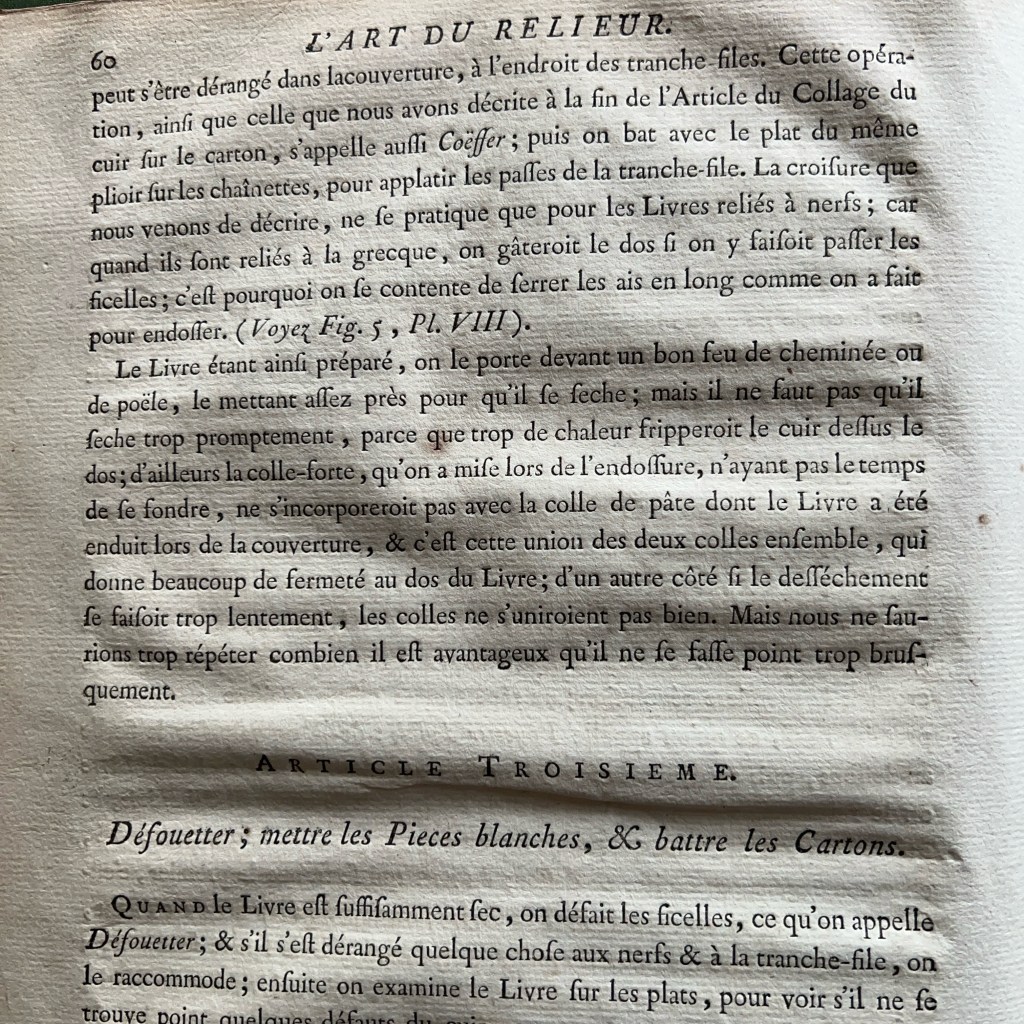
Peachey also doesn’t take credit for mixing the gelatin with wheat starch paste. He notes that even in Dudin’s 18th century manual, it discusses the “union” of paste and glue in the last paragraph below.

“It is the union of the two pastes [hide glue and flower paste] which gives a great deal of strength to the back” Dudin, 1772

By the end of the week-long workshop, I had fallen in love with the properties of how well it adhered.  By itself, the fish gelatin had a long working time and didn’t stick until it was nearly dry – but when mixed with wheat starch paste, it combined the best of both worlds.  There was both the initial tack from the paste and a strong adhesion from the gelatin after dry.  I wasted no time in ordering my own sample supply.

Over the past year, I’ve slowly incorporated the fish gelatin in treatments and testing more applications. 

Ashleigh Ferguson Schieszer uses the 40:60 mixture of fish gelatin and wheat starch paste to hinge encapsulations into an album, ensuring the heavy encapsulations with paper hinges stay adhered.

I first successfully used it to hinge-in heavy encapsulated sleeves into an album containing lung cross sections. After ultrasonically welding a paper hinge into an encapsulated sleeve, I applied the mix of wheat starch paste and fish gelatin to adhere the hinge to the scrapbook stubbing and had wonderful success.  I was able to adhere with confidence that the encapsulation would stay in place and was able to avoid disbinding and resewing.  At one point during treatment, I found I needed to reposition a hinge.  I am happy to report the mixture was as easily reversible as wheat starch paste alone!

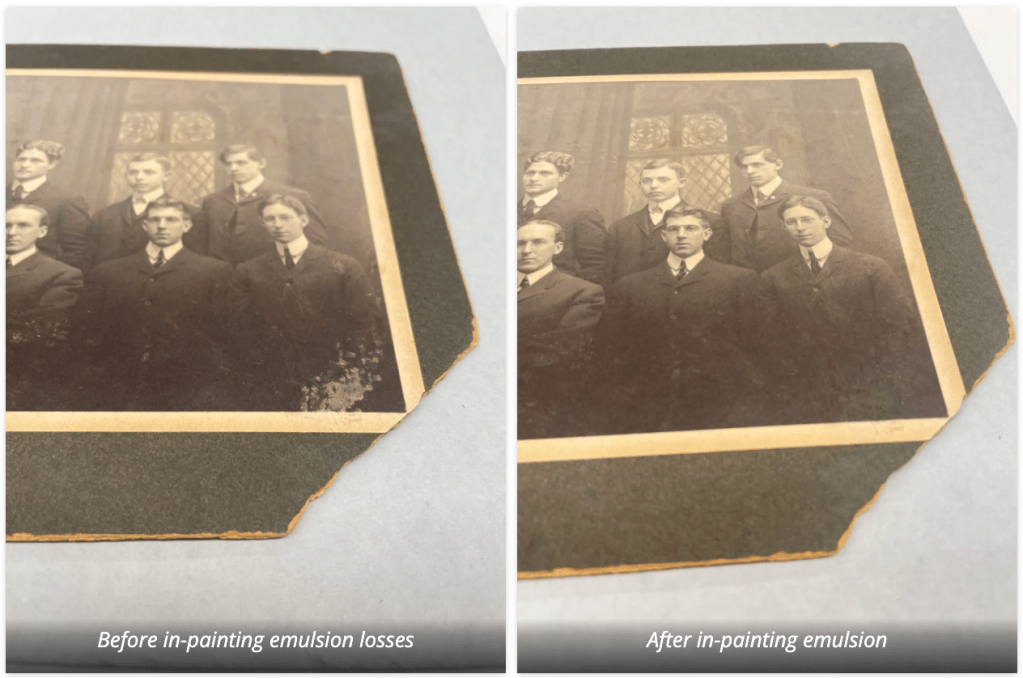
Most recently, I played around with using it for photographic emulsion consolidation. I used it first as a barrier layer before inpainting, and then to add sheen to in-painted photograph regions that were originally matte in comparison to the surrounding gelatin coating. It seemed extremely easy to apply and clean up was less messy than other photographic gelatins I’ve used in the past.  The sheen was just the right amount of gloss I needed without being overly shiny.  And, best of all, no heat required.

Examples of photographic condition issues where the fish gelatin was tested: flaking emulsion was consolidated and a barrier layer was applied before inpainting.

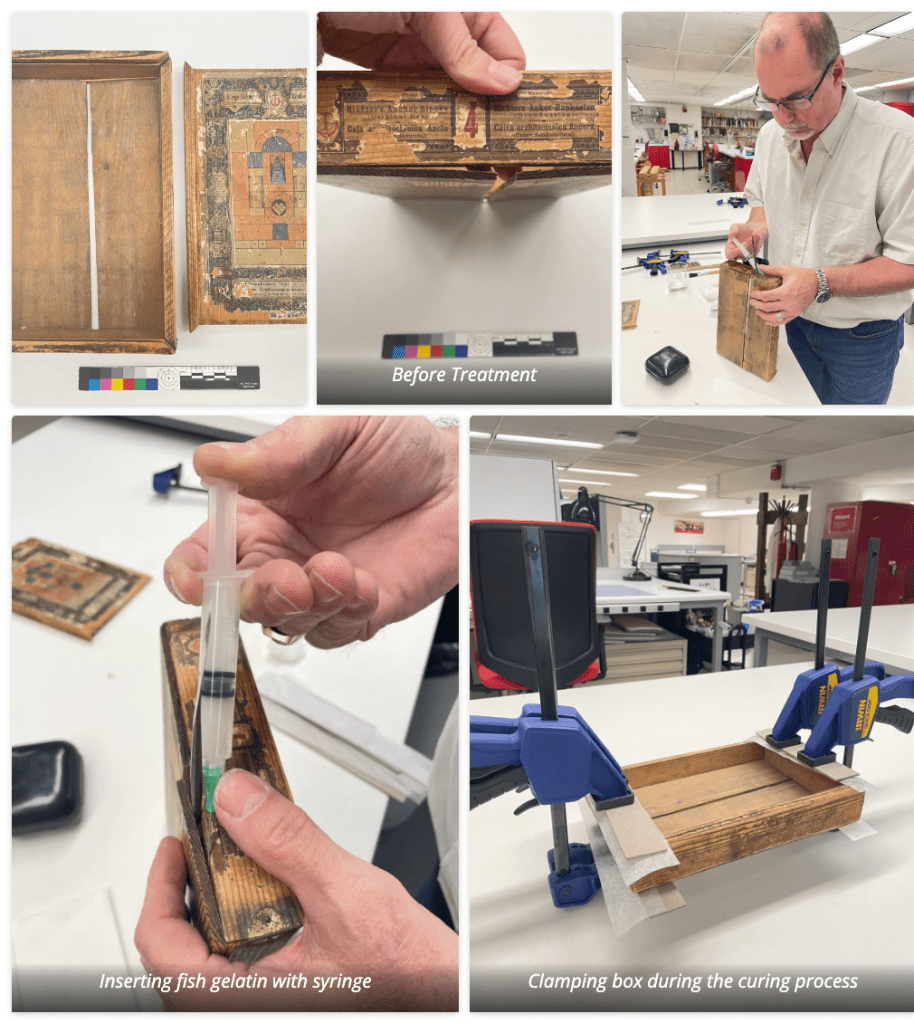
We’ve also used the gelatin to stabilize breaks in a wooden box originally used to house a Richter’s architecture game from the early 20th century. Jeff Peachey’ main use is to line spines. He’s found it not only has better adhesion than straight paste, but makes the spine feel slightly more solid and resistant to torsional forces

Applying fish gelatin to adhere spine linings

In the future, I imagine this gelatin would have excellent potential in media consolidation. In all these uses, I couldn’t be more thrilled to not have to pull out my baby bottle warmer to set a beaker of gelatin on.  As a result, there was no fuss in worrying about how long the gelatin was heated and if it was losing its properties due to heat!

Example of using a baby bottle or coffee warmer to re-heat pre-made gelatin during typical use

In terms of shelf life, the dried granules can be kept indefinitely like unmixed wheat starch paste.  Once mixed, Jeff suggests that he’s found the adhesive properties hold up for about a week in the fridge; however, it does begin to smell fishy after just a day. So unlike wheat starch paste, if you’re adverse to the fishy odor, you’ll only want to make up as much as you’re planning to use for one day. 

Interested in getting your hands on some?

I found the product used at Weisman is no longer supplied by Norland, but I was able to track down what appears to be the same product through AJINOMOTO NORTH AMERICA, INC.  If you’re interested in trying it, message Henry Havey, the Business Development Manager of Collagen & Gelatin at haveyh@ajiusa.com to request a sample of High Molecular Weight (HMW) dried fish gelatin. 

They provided me with a 500- gram sample at no cost and confirmed it was a Type A fish gelatin with a zero bloom strength. Henry Harvey can also provide a pricing quote should you be interested in ordering a full supply which comes in 25 kg packs. They also provided the following product data info sheets.

Fish gelatin sample acquired by the lab in a 500 gram sample bag

While I still covet my isinglass cast films I created from boiling dried fish bladders, as well as our mammalian photographic grade type B gelatin, this HMW fish gelatin is a welcome addition I’ve added to my tool kit.

Ashleigh Ferguson Schieszer [CHPL[] – Special Collections Conservator, Co-Lab Manager

Bibliography

Dudin, M. The Art of the Bookbinder and Gilder. Trans. by Richard Macintyre Atkinson. Leeds: The Elmete Press, 1977, p. 51. (Originally 1772)

Nanke C. Schellmann, Animal glues: a review of their key properties relevant to conservation, Reviews in Conservation, No. 8, 2007, pages 55-66

Foskett; An investigation into the properties of isinglass, SSCR Journal ; The Quarterly News Magazine of the Scottish Society for Conservation and Restoration, Volume 5, Issue 4, November 1994, pages 11-14

World Sturgeon Conservation Society, A Quick Look at an Ancient Fish, 4th International symposium on sturgeon, Oshkosh, Wisconsin, July 8-13, 2001 https://www.wscs.info/publications/proceedings-of-the-4th-international-symposium-on-sturgeons-iss4/

Soppa, Karolina; Zumbuhl, Stefan; and Hugli, Tamara,  Mammalian and Fish Gelatines at Fluctuating Relative Humidity, AIC 51st Annual Meeting, 2023

Stainless Steel Trindles for Sale; and, Where did the Word “Trindle” Come From?

A pair of stainless steel trindles.

Trindles are used for flattening the spine of in-boards bindings after the boards are laced on, and prior to cutting the foreedge in a plough. This gives a smooth foreedge, without “stepping” of the signatures, which can result when rounding and backing after cutting. I recently designed some modern trindles in stainless steel. Essential for historical models and modern fine binding. 7 x 1.5 inches.

Available to purchase here.

End of sales pitch.

What’s up With the Word “Trindle”?

Usually, when a lecture or article begins with a dictionary definition of a particular term, I eye the closest exit or quickly switch tabs. After reading Arthur Green’s historical, technique based article on in-boards edge cutting and trindles in the new Suave Mechanicals 7 I found myself wondering about the origins of this unusual word.

My first stop: Mr. OED! The two volume quarter-scale print version with magnifying glass in a slipcase was one of the few books I brought with me in an overstuffed VW bug when I moved to NYC in 1989. Anyway — according to the dictionary — the word “trindle” has been around for centuries, most of time referring to proper names, or an object that is round or cylindrical.

From a google ngrams search, there is a reference dating from 1695 mentioning “trindle-pins” which may be some sort of fastening device for ships or buildings. This may lend credence to Green’s argument that Dirk DeBray’s use of long needles to flatten the spine are earliest trindles. For me, these two tools, while performing more-or-less the same function, are morphologically too different to be called the same name. Not every tool used to hit a nail is a hammer.

An early reference to trindles in Google Books. Source

Within English bookbinding literature, the earliest reference is found in Parry’s 1818 The Art of Bookbinding. They are simply described as “… two flat pieces of iron made the size and form of a folding -stick, to place between the back and boards of the book, before cutting the fore-edge (pp. 1-2). Folding sticks of this time are usually described as about 6-7 x 1 inches, and made from wood, ivory or horn. Trindles are one of the few tools Parry not only names, but describes how they is used. An implication they were uncommon at this point in time?

A few years earlier, the 1813 Circle of Mechanical Arts describes trindles without using the word, instead simply mentioning the technique as “… introducing 2 pieces of thin iron 4 or 5 inches long near the head and tail of the book, between the paste-board and the back…” (p. 77) Sounds like a trindle to me!

Two button sticks from my collection. The one on the top is roughly 7 x 1.5 x .039″

The top of the image is the quintessential trindle shape, roughly 6.75 x 1.5, and made by the English firm Bodil Parker brass foundry. They are quite thin and deflect when used to flatten the spine of a book, resulting in a foreedge that is less round than the spine when removed. The one on the bottom is more sophisticated, and has an English patent number that I can’t find information on. (Can anyone help?): “Patent No 116972/17” The various curves around the edges fitting around brass buttons of various diameters. The legs of this one would make it very difficult to use in bookbinding.

An American(?) hinged button stick in my collection. Super flexible.

In the 20th century, museums and manufacturers generally refer trindles as button sticks (or less commonly, button guards). They tend to be associated with military use, dating to around WWI, and made from brass. Brass — as opposed to the thin iron usually mentioned in bookbinding literature — makes sense in that it would not scratch the buttons, since they are made from the same material.

Google ngram for Trindle, which may or may not refer to bookbinding, declines right around the time the guillotine, out-or-boards schoolbook binding styles, and publisher’s cloth case binding becomes predominant, and trindles would have no longer been necessary. Hum. Source

Questions remain. Did bookbinders coin this term in the second quarter of the 19th century? Was it used in the trade commonly earlier? Why would binders create a new term for the more common term “button stick”? Is it workshop slang? Bookbinding does have its own idiosyncratic colloquial terminology. For example, most trades use the term “tommy bar” for a long tightening rod, which bookbinders call a “press-pin”. The search continues. Happy trindeling.

New Design Delrin Hera. Two Versions. Just in Time for a Holiday Gift 2021!

This is one of my most used tools. It almost always seems to be in my hand while working.

The white version is very flexible at the tip, making it ideal for delicate tasks, lifting fragile materials, pigment consolidation, and pressure sensitive tape removal. The super thin, translucent tip bends to almost 90 degrees, allowing precise control of downward pressure while sliding under the tape carrier. It is also perfect for gently releasing tissue repairs from remay or hollytex.

The black version of Delrin is stiffer than the white, and the tip of this tool is thicker and stronger. It is useful for lifting, inserting adhesive, smoothing repairs, general smooshing, scoring, folding, marking, holding repairs in place, rebacking, etc… . Other uses. 

If you can’t decide between the two versions, the only reasonable option is to purchase both. The non-reflective surface is easy to photograph. Delrin does not rust and is food safe. But I doubt it tastes very good. Delrin, approximately 7 x .25 x .25″

PURCHASE HERE

NB: if you are interested in learning to make your own tools, we will make both of these (and 8 other tools) in upcoming Delrin and Bamboo Toolmaking workshops. More info here!