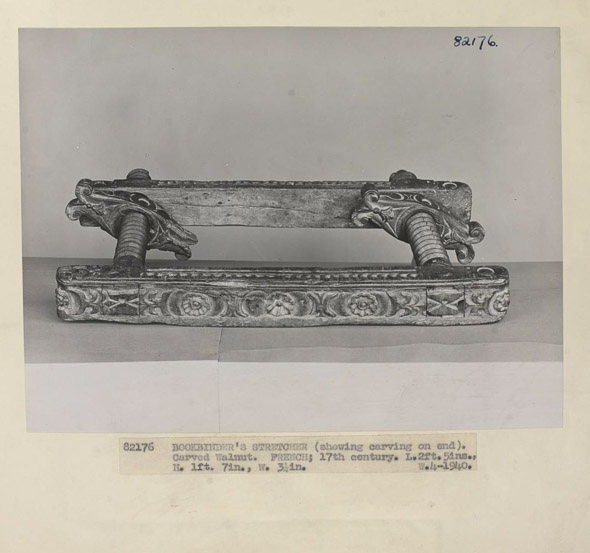
It would be nice to have a book stretcher on occasion, though. Need to turn an octavo into a quarto? No problem! But was this really a book press, or a press intended for some other purpose? The 29 inch long cheeks are very, very thin in profile, and I imagine would deflect quite a bit even with just hand tightening.
Hats off to the V&A has a very progressive large image use policy. You can download them instantly, share them widely, and even use them for publication. There are almost 750,000 searchable images on the V&A site. Let’s hope all institutions free their images.
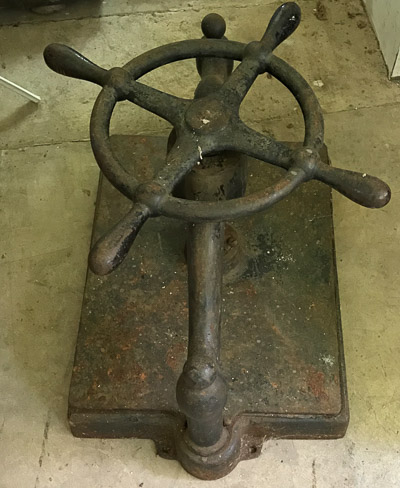
Mark Anderson, Furniture Conservator at the WInterthur/ University of Delaware Program in Art Conservation, is fixing up a copy press for their Book Conservation Lab. At first glance, it is a large but typical press, though with a nice hand-wheel with spokes extending beyond the rim, useful for extra leverage or pretending to be a captain steering a ship.
Copy press usually have a steep thread pitch, which is great to move up and down rapidly, but they generate a lot of friction when tightening, therefore can’t generate as much pressure as a real book press. This is compounded by a common tendency of not attaching them to the bench. There is a reason almost all presses — like the one below — have four holes cast into the base, in order to screw into the bench! I guess that by having to hold a press with one hand, and tighten it with the other, the total compressional force is reduced by 25% or more.
Large copy press. Photo: Mark Anderson
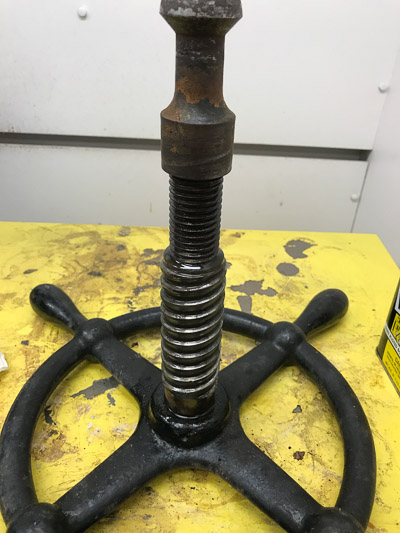
Once Mark took apart the press to clean it, he noticed an unusual aspect: the central screw had two different screw pitches and diameters on it. Apparently the finer thread is internally threaded into the larger one, though it is currently frozen.
Two different thread pitches and diameters. Photo: Mark Anderson.
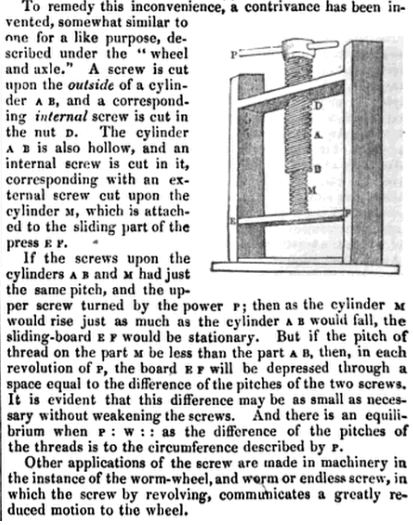
A similar style of screw is mentioned in the 1843 Practical Mechanic and Engineer’s Magazine. There may be earlier examples. Even today, external threads are sometimes referred to as male, and internal threads as female. In a surprisingly contemporary note, the writer in 1843 recommends that this coarse language should be abolished.
Source: The Practical Mechanic and Engineer’s Magazine, Volume 2, p. 204.
Although Mark’s example is inoperable at the moment, presumably the larger external coarse thread raises and lowers the platen quickly, and at the same time the internal thread moves more slowly, due to the finer pitch. But when the press firmly tightened, the smaller internal thread kicks in to apply more pressure. Fast operation and lots of pressure would be ideal for a copy or book press.
Source: The Practical Mechanic and Engineer’s Magazine, Volume 2, p. 204.
For this to work, the finer thread needs to be affixed to the platen, as in the image from The Practical Mechanic and Engineer’s Magazine. In the press Mark is working on, it looks like it spins in the top of the platen, like most copy presses. An alternative explanation might be that the finer threads were left over from a different project, or cut wrong? But if this mechanism works as advertised, why wasn’t this a more popular mechanism for copy and book presses? Hopefully he can get the screw unfrozen and we can find out.
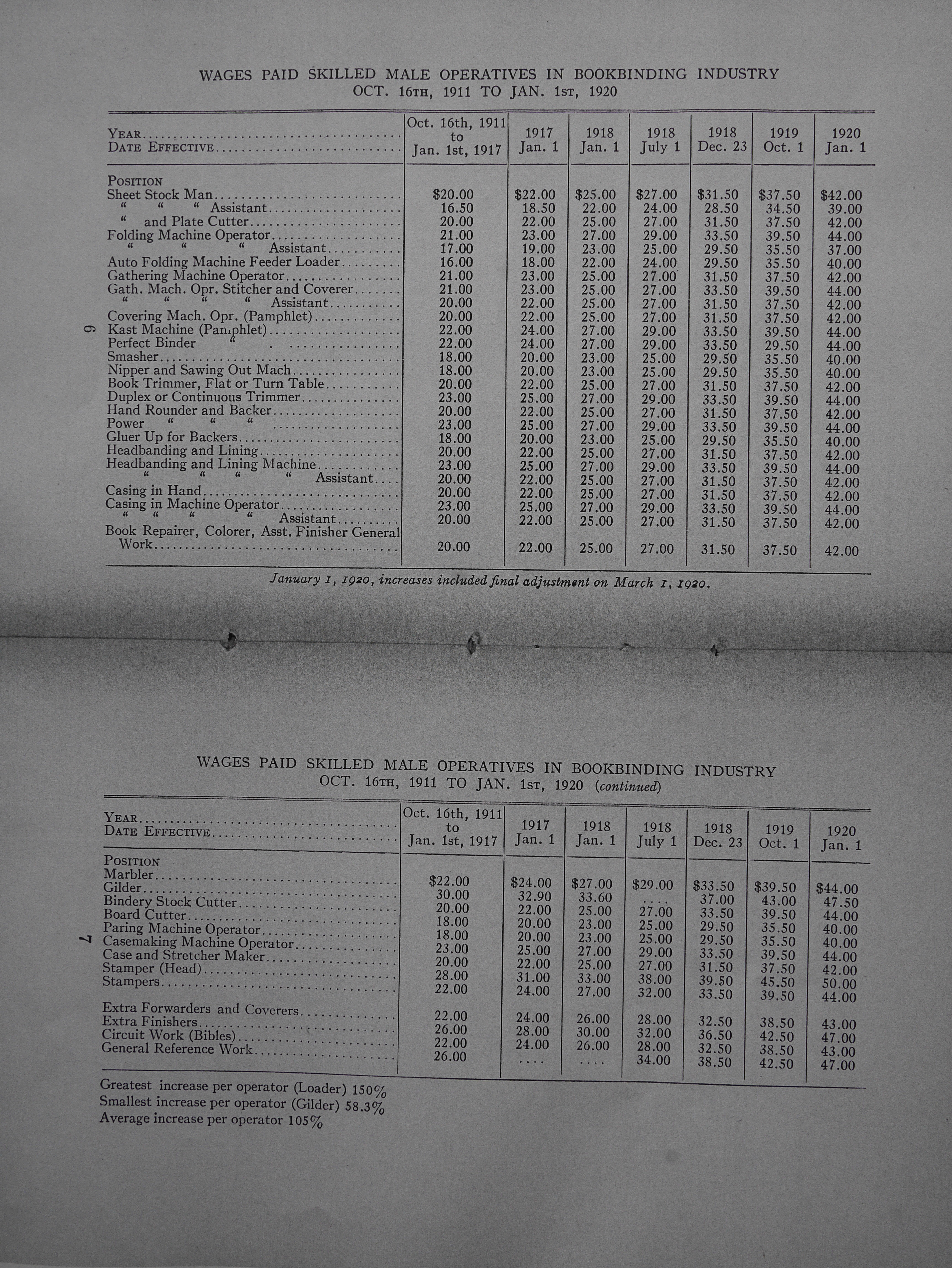
It is often claimed that the most skilled, and highest paid position in a bookbindery was the finisher. However, in 1920, the J.F. Tapley Co. paid the head stamper $50 a week, while an extra finisher earned a bit less, $47. Even the casing-in machine operator earned $2 more than the hand casing-in position, at $44 a week. Wages varied between $37 and $50 for skilled male work. At least for this company, machine operation was apparently valued more highly than hand work, likely because it was more profitable. All the workers are referred to as “operatives”, whether engaged in machine or hand work.
The argumentative title of this company produced pamphlet, “Why the present high costs of bookbinding?” indicates some defensiveness and weariness when asked this question. I can totally relate. And since I work alone I can’t blame it on rising employee wages. The pamphlet cites increases in other costs, such as materials, as additional factors. The rise in wages between 1917 and 1920 is startling, but apparently there were no increases between 1911 – 1917.
Why the present high costs in bookbinding? J.F. Tapley Co.: New York, 1920. Bernard C. Middleton Collection of Books on Bookbinding, Cary Collection, Rochester Institute of Technology.
Below is the breakdown for the women operatives. Women’s positions in trade binderies were very stable at least since the eighteenth century. This is a surprising to me, given how much books changed during this time. They primarily did the folding, gathering, sewing, and laying-on of gold. The highest paid woman’s position was the head gold layer, at $27.50.
Women also operated the machine that replaced their traditional hand work. I can’t quite understand why the work itself was more gendered than operating a machine. Usually men operated the machines in factories at this time.
Why the present high costs in bookbinding? J.F. Tapley Co.: New York, 1920. Bernard C. Middleton Collection of Books on Bookbinding, Cary Collection, Rochester Institute of Technology.
Of course there were many women hand bookbinders making fantastic books around this time. One of my favorites is Sybil Pye, and her hallucinatory take on traditional book design still looks fresh today. She was an aunt of David Pye, the wood carver, turner, and craft philosopher. David Pye’s “Nature and Art of Workmanship” is a common entry text for bookbinding students interested in exploring larger questions of Craft. The circle grows smaller.






 Peachey Conservation