Layered Adhesives: How to Reduce PVA Use by 80% on Paper-backed Bookcloth

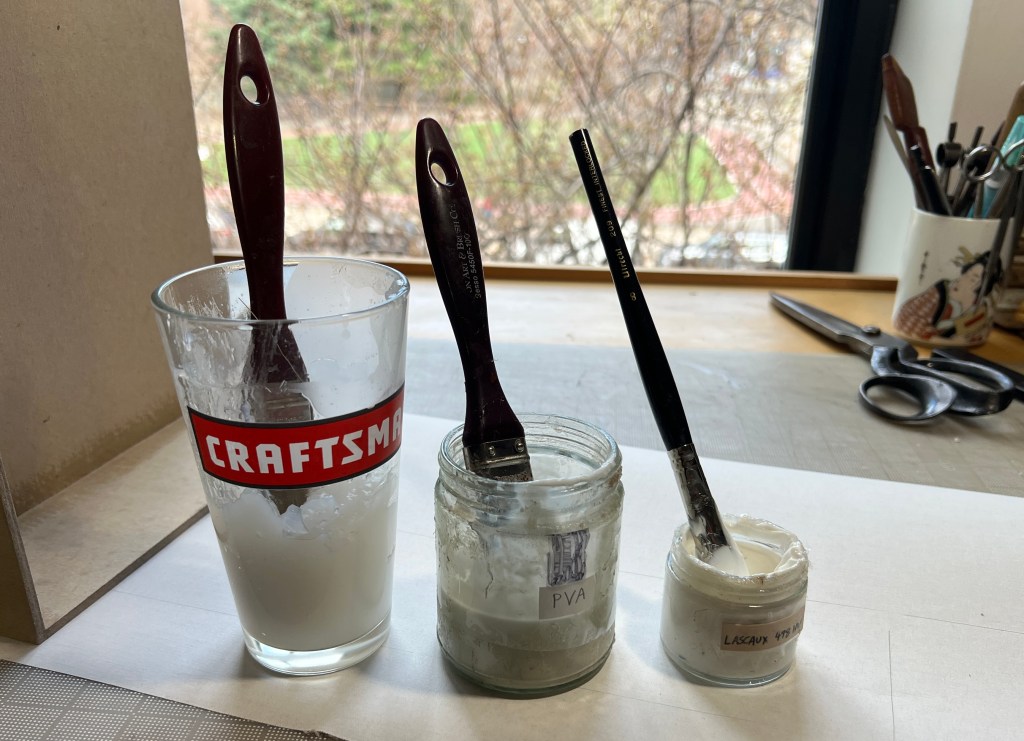
Fig. 1. The adhesives used in this post. Left: Aytex P wheat starch paste. Middle: Jade 403N PVA. Right: Lascaux 498HV. A simpler variant just uses paste and PVA.

PVA (PVAc, Polyvinyl Acetate) is the adhesive most commonly used in book conservation to make cloth covered drop-spine boxes. Most of my clients prefer these to other types of boxes. For large and heavy books there are few other options.

While PVA is convenient and sometimes necessary for boxmaking, offgassing is a concern. The Library of Congress ( LC poster) found PVA is still offgassing after 6 years! Apart from potential damage to objects, it’s a plastic; most of us are trying to use as little as possible. The offgassing from PVA will not cause instant flaming death for books, it’s not ideal for longterm storage. Books with copper alloy bosses and clasps are especially vulnerable. Box structures like a cradle box, which have many layers of cloth–adhesive–board are most likely offgassing much more than a standard box. The Library of Congress study found that even a box made with 90% paste and 10% PVA still offgasses enough to fail the Oddy test. However, the concentration was much less than straight PVA. As I understand it, testing is ongoing, including other of adhesives like EVA.

There is not a single convenient and cost-effective substitute for PVA. What to do?
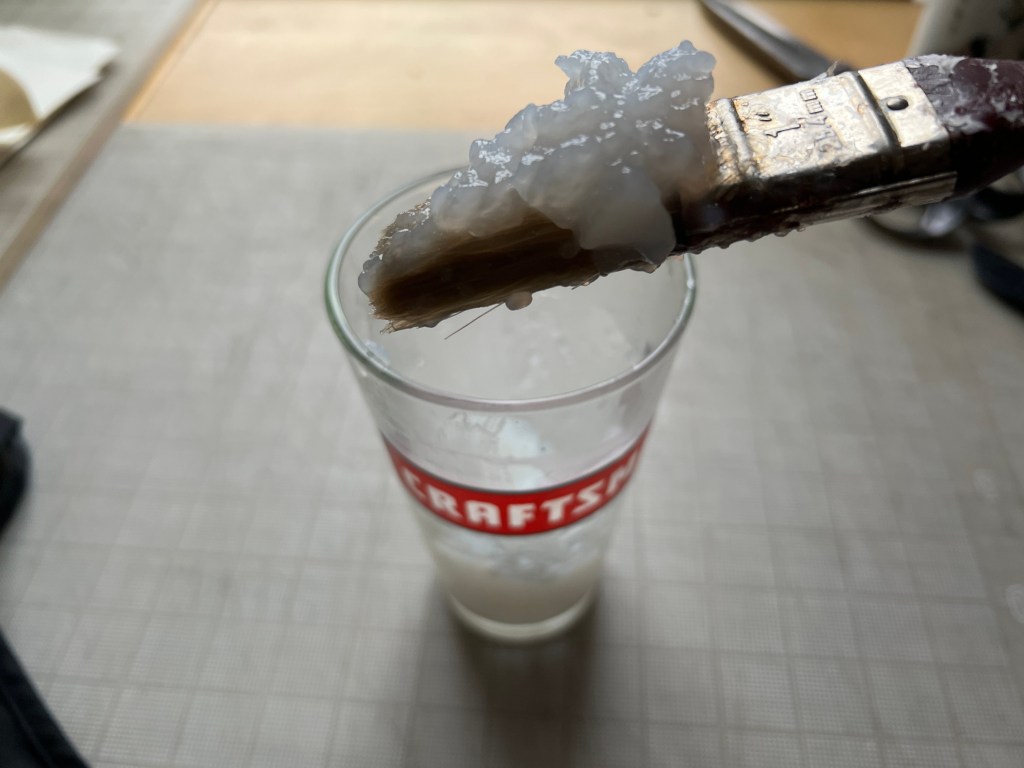
Fig. 2. Thick Aytex P wheat starch paste. For this purpose, straining is not necessary, the lumps get smoothed out on when pasting out. Or you can use your fingers. This is the way bookbinders traditionally used flour paste. Paper conservators, please don’t freak out.

Paste is difficult to work on paper backed bookcloth because of the slowness of drying, problems with adhering edges and turn-ins, bubbling during drying, unpredictable stretching, and weak cloth-to-cloth bonds. An example of cloth-to-cloth bonds are when the trays are attached to the case of a drop spine box, so two outsides of the cloth need to stick together. Lascaux 498HV (an acrylic) is expensive, dries quickly, but also forms a fairly weak exterior face cloth-to-cloth bond. PVA is, well, PVA. I’ve heard of several different approaches, sometimes involving methyl cellulose, but they all pre-mix the adhesives together. 

In my Layered Adhesive technique, different brushes are used for each layer directly on the cloth instead of mixing adhesives together before application. It sounds a little like amateur hour — I know — but allow me to explain. Each layer of adhesive performs a different function. I’ve been using this technique on all my boxes since 2023.

PVA use is reduced by about 80%. Paste provides most of the adhesion, small amounts of Lascaux add extra tack to prevent unadhered areas at turnins, corners and board edges. I’ve found PVA is still necessary when attaching the walls to the base of the trays, and when attaching the cloth covered trays to the case. I’ve only used this technique with Halflinnen cloth because I use it all the time. I imagine other paper backed cloths would be suitable, possibly with some modification.

A simpler variation just uses paste and PVA, instead of Lascaux in some areas. Even this cuts down on PVA consumption considerably.

THE TECHNIQUE 
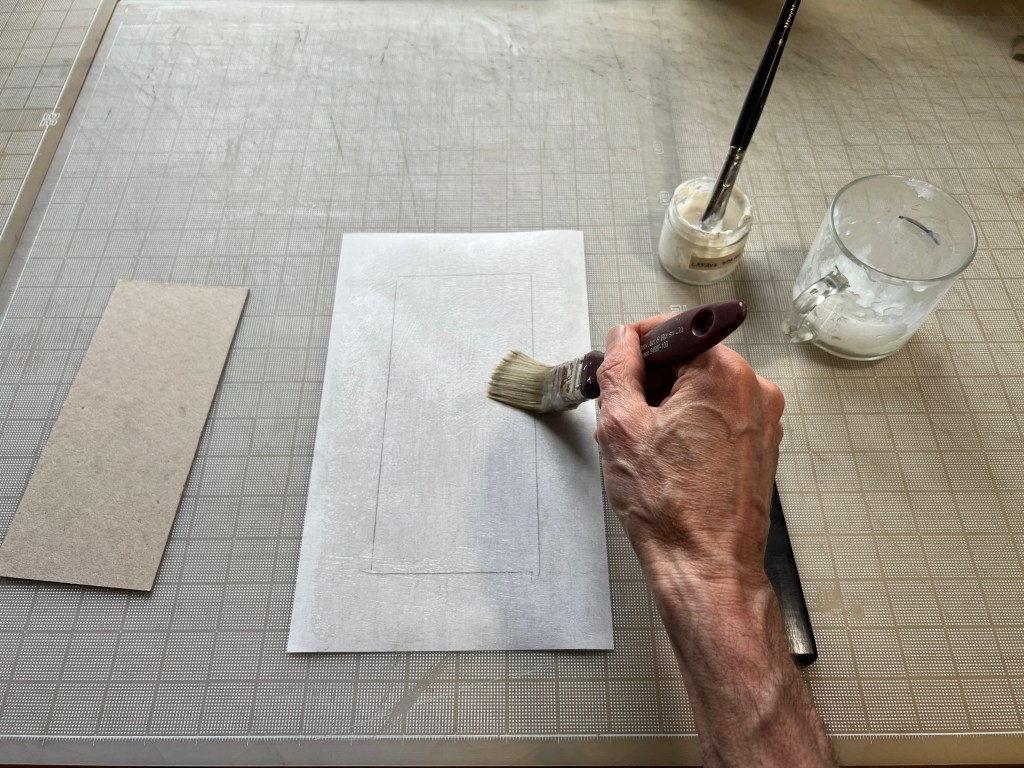
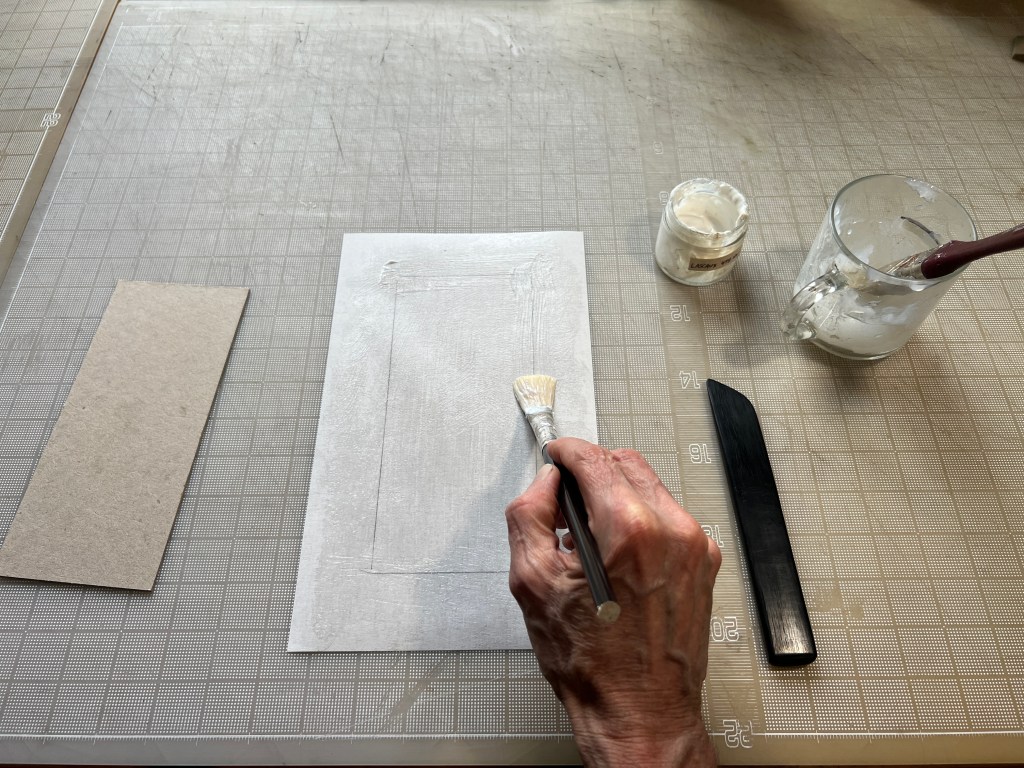
Fig. 3. Coating the Halflinnen cloth with paste. Note the thick paste. A tiny jar of Lascaux 498HV uses a  separate container and brush.
Fig. 4. Adding a layer of  Lascaux on the edges of the board. The paste thins the Lascaux and adds more open drying time. The Lascaux greatly helps adhesion when turning in, preventing bubbles, etc… Stretching the cloth is still a problem, so it needs to be handled carefully.

OVERVIEW OF THE LAYERED ADHESIVE TECHNIQUE

  • Paste, Lascaux, and PVA all use separate brushes and are kept in separate containers.
  • Paper to board, and board to board adhesion uses thick (6g starch per 100ml water) wheat starch paste
  • Corners and board edges get a thin coat of Lascaux 498HV on top of the paste. This makes them easier to adhere than paste alone, and I find there are less problems with delamination or bubbling during drying. The Lascaux gets diluted when applied on top of the paste.
  • If making a 3 piece case, for example, use paste then put a little Lascaux 498HV on the head, tail and foreedge turn-in areas. Similarly, when casing-in, use paste then add a strip of Lascaux 498HV on the edges of the pastedown, where it overlaps the cloth turn-ins on the case.
  • When making drop-spine box trays, I find the strength of PVA necessary to attach the walls to the base.
  • When attaching the cloth-covered trays to the case, use paste, with a coat of PVA on top, at the edges, again at the exterior cloth-to-cloth attachments.

ADVANTAGES 

  • Paste is cheaper than PVA
  • Paste is better for the environment
  • Less PVA equals less offgassing
  • Paste stiffenens the cloth/board much more than PVA; I like the feel. It is also perfect for stiffening the wedges in a cradle box
  • The cloth is easier to smoosh together at joins and blends nicer
  • Paste flattens the fibers on the cloth so it feels smoother
  • Paste works wonderfully for adhering double walls together; a little slip then bam they stick
  • There is less waste than premixing paste with other adhesives
  • Paste has a long open working time
  • Ideal for cradle boxes with many cloth/adhesive layers

DISADVANTAGES

  • Paste has a long open working time
  • Uses more brushes, longer cleanup
  • There is a small learning curve, and it takes more time when working compared to PVA. Then again, if you are charging by the hour….
  • May not work for other bookcloths without modification
  • Cross contamination with paste of other adhesives, need to use up in a few days
  • This technique is likely more suited to making a one-off boxes, rather than production

SUPPLY SOURCES

Halflinnen paper backed book cloth. Colophon Book Arts Supply: https://www.colophonbookarts.com/paperboard/rohhalbleinen With commendable transparency the manufacturer provided information on the paper-to-cloth adhesive, which is a PVA (!) specifically Brand VA518 from Intercol (https://www.intercol.info/pva-glue/) Warning: This PVA can be reversed with an errant blob of paste left to soak in. Just saying. 

Jade 403N PVA. Conservation Resources. https://www.conservationresources.com/shop/jade-403n-adhesive/

Lascaux 498HV. New York Pigment Company. Recently formed by former employees of Kremer Pigments, which has closed. They are Kremer’s NY distributer. https://www.newyorkpigmentco.com/products/lascaux%C2%AE-acrylic-glue-498-hv

Aytex P Wheat Starch Paste. Polistini. https://polistini.com/products/wheat-starch-aytex-p

FURTHER RESEARCH

This isn’t perfect, but using less PVA is better than using more, right? I’m curious if others have found different workable techniques to cut down on PVA when used on bookcloth? Have you been able to eliminate it completely?
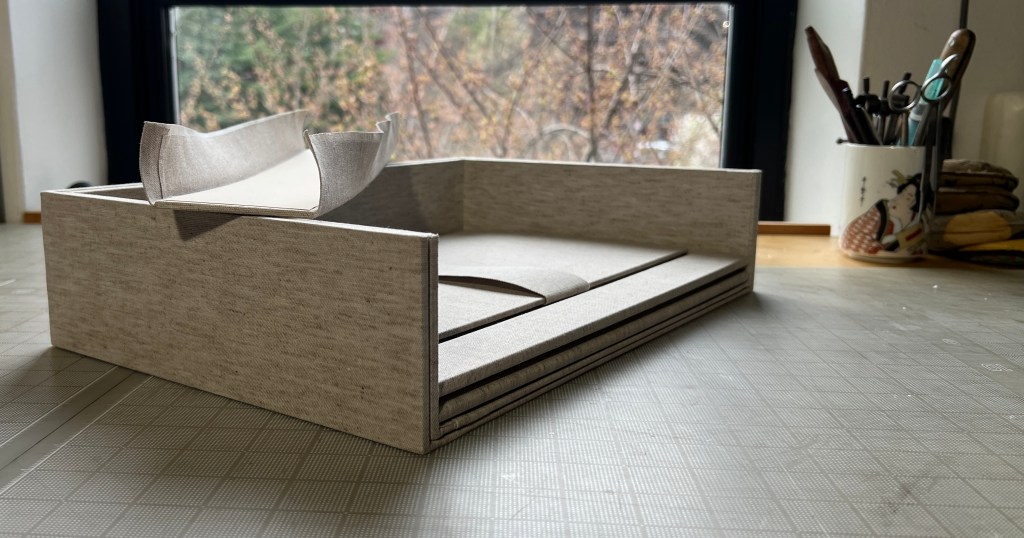
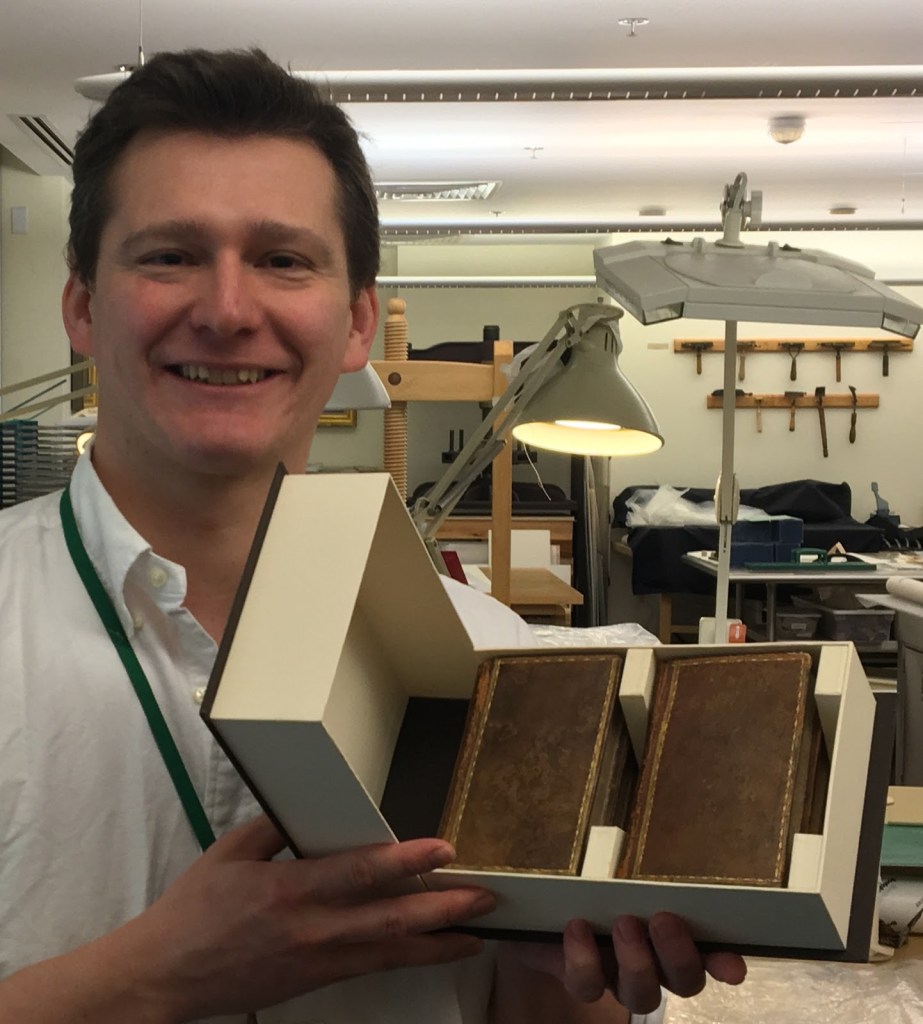
Fig. 5. An in-process cradle box, using the layered adhesive method. I just need to make the case and glue everything together. The flat spinepiece is an improvement from Annie Ujifusa, the wedge pull mounting (at the bottom) is Mitchel Gundrum’s idea, and I’ve started making these 5cm wide bookcloth pulls for ease of opening. Laminated with PVA of course!

Thoughtful Deconstruction or Inappropriate Intervention?

“Thoughtful Deconstruction refers to the conscious removal of elements of a bound item to show physical aspects that were previously hidden. In this presentation I will make the case that book conservators should consider employing this approach to carefully selected bound objects so that they can then be used to foster teaching and scholarship.” —Todd Pattison, 2026 (1)

Todd, first of all I want to let you know how much I have personally benefited from your book history scholarship, and respect your conservation and bookbinding work. On top of all that you are a good egg! You have generously contributed to many organizations, and are justifiably prominent in the field. 

Given your contributions, influence, and stature — and at the risk of sounding like a scolding schoolmarm — this “thoughtful deconstruction” approach is all the more disturbing. I totally support the practice of conservators interpreting objects. I totally support preserving evidence of use and existing damage in books. I totally love seeing what the insides of books look like. I totally do not support conservators taking apart books to accomplish these goals! Obviously one can do whatever they want with their own books. But advocating this as an approach for book conservators, as you did in your March 17 presentation New England GBW Chapter and in your article 2025 Suave Mechanicals 9 article, makes me uncomfortable. (2)

Have you considered how thoughtful deconstruction relates to our American Institute of Conservation Code of Ethics? Several areas are problematic: it compromises physical integrity (Article II), it prioritizes scholarship/education over preservation (Article III), and it adversely affects function (Article VI). As a Professional Member in AIC, it is also my responsibility to promote the Code of Ethics (Article XIII).

Why physically deconstruct now? Why not wait for not-to-distant future imaging or other technologies to answer your questions? What information can be important enough to compromise the integrity of an (even damaged) book? Just because a book is slightly damaged or has little current market value, does it give us free rein to intervene further?

Altering a book during the course of a treatment —which will prolong the object’s life — is different than deconstructing a structure for scholarship or education. I would also like to point out that removing a pastedown entirely is extremely unusual in current rare book conservation practice, given how invasive it is. I don’t think I’ve done it since the 1990s. Typically only the spine edge is lifted an inch or so to insert a hinge.

I have a confession. In my article in SM9, I also show an image of a lifted pastedown and removed leather on one of my own books in 2014. In retrospect, it really wasn’t necessary, but it was interesting to see that the slips were not deplyed or frayed, and that the inner face of the board squares were colored with vermillion. I think I just wanted a cool looking photo. You might say I wasn’t thoughtful enough. And at least the way I did it, it is not close to 100% reversible; which may be the case for many other people’s deconstructions as well. At this point I would rather have it intact, but like many projects I doubt I will have time to get back to replacing it.

How do we ensure careful selection of items to be deconstructed? Towards the end of your article, you mention “taking apart a volume that is destined to be destroyed and turning it into one that can teach, illustrate, or illuminate … seems a worthy thing to consider ….”  I don’t think most of us would disagree; however, determining which books are essentially valueless becomes a slippery slope. Take your case study in SM9 of The Token and Atlantic Souvenir, 1834. Even if the title page and a couple of plates are missing, and you got the book for free, I consider this 192 year old book to be valuable cultural property: it is a rare embossed binding, signed by the binder, signed by the engraver, there is only one for sale on ABE for $8,500 (most of the value is from a John Quincy Adams signature), just 24 are listed in WorldCat, and it is important enough to be included in Wolf’s From Gothic Windows to Peacocks 1825 – 1855, 170.

I bet books that could be deconstructed without disagreement  – say a 20th c. publishers’ binding with thousands of virtually identical extant examples – will reveal little interesting information. Books that do contain interesting innards maybe shouldn’t have been deconstructed in the first place.

Todd, please, listen to me, I’m on my knees, I’m praying that you have the strength to conquer this demon of dissectomania. You can stop turning more books into #pattisoncondition, just lay down your bookbinder’s knife, and overturn your board soaking tray!

NOTES

1. Todd Pattison, from BOOK_ARTS-L Listserv, March 3, 2026 “**REGISTRATION OPEN** THOUGHTFUL DECONSTRUCTION: A Webinar with Todd Pattison”.

2. Todd Pattison “Thoughtful Deconstruction” in Suave Mechanicals Vol. 9, (Ann Arbor: The Legacy Press, 2025): 554-580.

Evan Knight’s Tips for Becoming a Book Conservator

I get asked this question quite frequently, and fortunately, Evan Knight gave a great answer on the AIC Membership Forum. He agreed to republish an expanded version of his original post here. Lots of solid advice. Thanks Evan!

I can relate to this question. Been there. It may seem possible to become a conservator based on experiences alone, but I think that route is more expensive, riskier, and more time-consuming than pursuing graduate school. At least that was my calculus when I decided to pursue a career in the field.

Like any craft or trade, it takes years of practice and study to get ‘good’—that is, to consistently perform ethical, effective, and elegant conservation treatment. Although some trades and/or their unions have apprenticeship pathways into their fields, ours does not. So finding paid local opportunities in the field can be challenging (at any level)—especially for entry-level positions. They just don’t come up very often. Granted, on your own, you might be able to study conservation and take occasional workshops, but they can only take you so far. Workshops don’t bestow certain skills—in my opinion, they can provide excellent training, but it is complementary to your bench work. And academic study, while important too, doesn’t adequately prepare you to perform quality craft work either.

About this field more generally, my advice is that all paths into and through conservation will be a constant hustle. Often very rewarding, but a struggle, nonetheless. Money issues will never go away, even in grad school and afterwards. I had to have second jobs for years, before, during, and after grad school, and anecdotally, several colleagues–some extremely experienced and responsible conservators–don’t make six figures. So the road is challenging and the ceiling can be limited for many of us: something to consider if you might eventually intend to live in a high-cost-of-living location, buy a home, raise a family, take vacations, etc. But such is the nature of our field, and it’s not that different from other related professions in the arts and humanities, and even roles in academia. For better and worse, performing high quality work on exceptional objects is often our greatest motivation and results in our greatest fulfillment.

I was given somewhat similar advice: that I’d never make deluxe money — yet I was still compelled to pursue conservation for books, prints, and archives, even though my undergrad focused on humanities and history. So I went about getting conservation experience, knocking down graduate school pre-req’s, and becoming a competitive candidate for graduate schools.

Early in my 20s, I had a day job in a totally different field, and clung to it as longer than reasonable(!), while finding initial volunteering opportunities on the weekends (at a high-end book bindery) and one day a week at a conservation lab (at an art museum library). I read a great deal of art historical / print history books, and took workshops in box making, book binding, even fly-tying, plus a couple intermediate drawing courses. It’s great that you’re in a city like Chicago — opportunities for hands-on experience in conservation or closely related fields tend to be located near great collections. Whatever collection formats you might wish to learn about or work with, Chicago certainly has ’em. Connect via email and phone with any lab you learn about and let them know where you’re at. Try AIC’s “Find a Conservator” tool, or if you’re a member, the professional directory, and of course, your own internet research into museums, special collections repositories, etc. They might not have something for you right away, but then follow up six months or sometime later; or maybe they can only host volunteers on a certain day of the week. Remember that hosting a volunteer or intern can take significant time and effort on their part, and sometimes they can’t swing it. Private conservation studios can ramp up and down based on certain large projects or grants — as a “technician” or intern or what have you. But without any experience, it might not be realistic either (chicken / egg situation)—though still worth a shot in my opinion. In my experience, most everyone I met in my journey was willing to at least talk with me, help me out if they could, or point me to other opportunities.

To be a competitive candidate for conservation grad school you will need significant academic pre-requisites in addition to conservation experience. Each program has different pre-req’s so learn what they are and plan to ‘fill in’ what you don’t yet have because those are non-negotiable. Chemistry is typically the biggest hurdle. I personally went through 2 years of chem after my undergrad (4 courses in total), which went fine, but I took them at rigorous and expensive schools, which in retrospect wasn’t the most cost-effective choice. I thought Ivy League chemistry would be really useful in the long run of my career but in my experience, they weren’t: save your money and find nearby public options. Long story short, it will likely take a couple years until you will be a competitive candidate, so plan accordingly how you might make it all work – financially, academically, and experientially.

I’m sharing my response publicly because the dearth of reasonable opportunities at all levels, but especially those at the entry-level, is a profession-wide issue. It seems, to me at least, that most paths into and within our great field require a great deal of time and money at many career stages (not just pre-program), and a laser focus on the profession from an early age. Healthy industries have pro-active employers and active affiliate organizations that systemically cultivate equitable access for opportunities for their workers at every stage of their careers. I don’t know that we’re so healthy and equitable, but I know that many do care, and have worked hard to improve this in our field.

I’m happy to support your journey and wish you luck: slow and steady is my advice, honestly assessing your career interests and prospects periodically along the way (it’s ok to move on from something; or to specialize in something – it’s all a part of growing personally and professionally), while of course to continue earning income in whatever ways that make sense!

Other Resources

AIC’s how to become a conservator

AIC’s 2014 Salary Survey

Evan Knight looking quite proud of his innovative double drop spine box!

Evan Knight is the Preservation Specialist with Massachusetts Board of Library Commissioners since Dec 2018 and Proprietor of Knight Art Services LLC since 2021. He is a Peer-reviewed Professional Associate of the American Institute for Conservation (PA-AIC). Previously, he was an Associate Conservator of bound and unbound materials at the Boston Athenaeum, with prior conservation employment at the Northeast Document Conservation Center, the Library of Congress, the Benson Latin American Collection at the University of Texas, and the Municipal Archives of New York City. Additional internships undertaken at the Harry Ransom Humanities Research Center-Book Conservation Lab, Biblioteca Ludwig von Mises (Guatemala), Buffalo Bill Center for the West, and the Metropolitan Museum of Art-Watson Library.