Conservation of the Journal of the American Institute for Conservation: Results of a Survey and Treatments

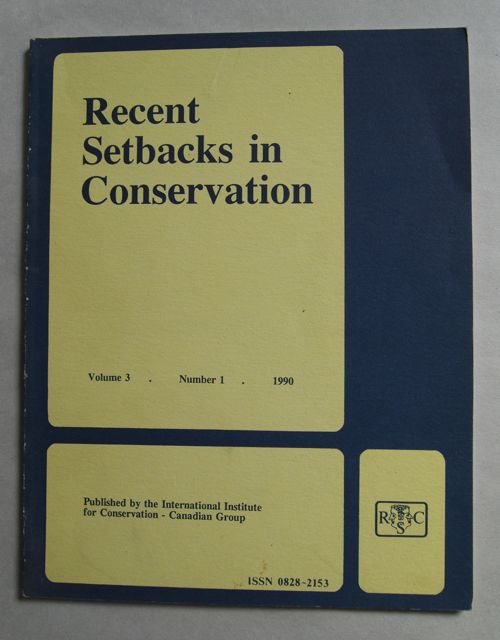
A paper copy of Setbacks, Vol. 3., No. 1., 1990. Oddly, this paper volume is easily accessible in my library, while the more recent, online digital only version is difficult, if not impossible to find.  All three early volumes are indispensable.

I originally published the article linked to below in “Recent Setbacks in Conservation Online” in 2004.  In the intervening years, many of the problems discussed are, regrettably, as yet unresolved. Sadly, Setbacks Online seems inactive and inaccessible. Please be aware that the conservation techniques mentioned in this article are possibly somewhat dated, and are presented for historical and informational purposes only, and the author takes no responsibility for their efficacy or lack thereof. Caveat Conservator!

.
.
.
.

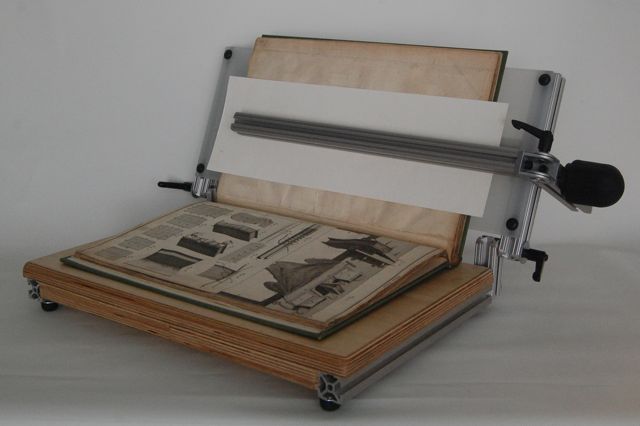
In-situ Book Conservation Fixture

Added 15 March 2016: A newer version of this fixture: https://jeffpeachey.com/2016/03/15/improved-book-fixture/


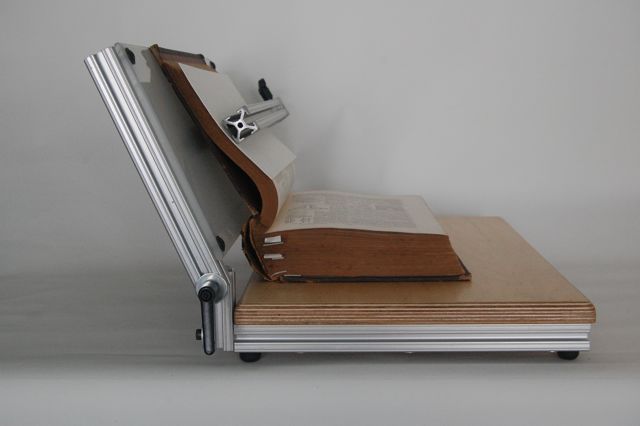
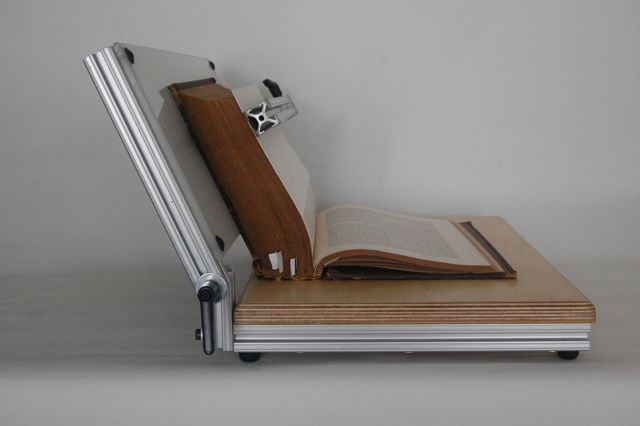
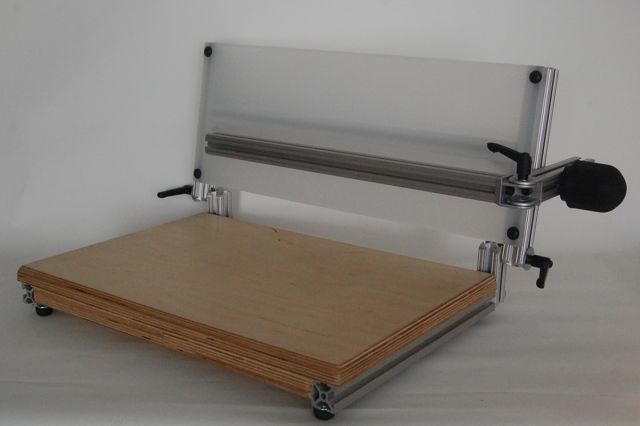
A jig guides a tool, whereas a fixture supports the workpiece – in this case is a bound book. Increasingly, much of a book conservator’s work involves working in-situ without disbinding a textblock. This fixture safely and securely supports the parts of the book not being worked on while treating pages. The idea for this fixture was originally developed by Raymond Jordan, Senior Book Conservator at Trinity College, Dublin (for an image of his version in use, see Preservation and Conservation in Small Libraries, ed. Hadgraft and Swift, 1994), with additional improvements by Chela Metzger, Conservator of Library Collections at Winterthur Museum, Delaware.

Many conservators construct impromptu assemblages, but this fixture professionally, safely, and securely holds printed books and manuscripts, even those with heavy wood boards, bosses and other furniture. It supports the text-block and board, so that the spine and sewing structure is not stressed while work is done on the pages; repairing tears, media consolidation, flattening dogeared corners, dry cleaning, etc…. It can also be used to support the text-block when flattening warped or distorted vellum bindings. Text-block are rarely planar: working in-situ enables the conservator to repair tears that conform to the natural undulations of a particular place, on a particular page. The hinged bar allows the pages to be quickly turned, yet is braced so it cannot fall down onto the page. Perfect for books with fragile sewing, brittle pages, or any time gentle, secure support is needed when working on bound items. It simplifies and speeds up the treatment process when many pages of a text-block need attention.

The bed size is 12 x 17 inches, a heavy anti-tipping 1.5” thick, and the maximum supplied thickness books is 6 inches. Fits octavo through folio books. If a thicker book is encountered, extension pieces can be purchased for a nominal charge. This support can be used with oversize books with slight modifications, instructions included. Adjustable arm levers allow a full range of clamping angles, no tools necessary. The front page bar is hinged to allow quick page turns. The uprights hinge from 0 degrees (parallel to the bed) to 180 degrees. Constructed out of aircraft grade plywood with a 1.5” thick base to resist tipping, polypropylene and clear anodized 6105-T5 aluminum. Custom sizes available.

In-situ Book Conservation Fixture   $750.00

The Use of Parchment to Reinforce Split Wooden Bookboards

I was quite pleased to receive the new Journal of the Institute of Conservation, Vol. 33, No. 1, 2010, since Alexis Hagadorn and I have an article included in it titled “The use of parchment to reinforce split wooden bookboards, with preliminary observations into the effects of RH cycling on these repairs”

Here is the abstract:

Split wooden boards are a common problem in early book bindings, and treatment can be complicated by the need to disturb original components as little as possible. A technique used to reinforce or rejoin fully or partially split wooden boards using parchment has been evaluated. A reinforcing parchment strip has sometimes been employed to treat cracks in wooden musical instruments and examples of reinforcing strip repairs to wooden bookboards have also been observed. The books considered in this article presented an opportunity to use this technique and make observations about its merits. With favourable results but some questions, the authors undertook a systematic study of this method, considering and comparing several options for re-joining split wooden boards. Samples of some common repair techniques were made and subjected to relative humidity cycling to compare how each method might withstand extreme RH fluctuations at a constant temperature. The response of reinforcing strip repairs to RH changes showed a negative impact on join adhesion within the sample group, which may indicate that modifications are necessary to improve this technique. When re-examined after three years, the treated boards were intact and stable.”

It took over four years from the start of the project until the revised manuscript was accepted for publication, but it is gratifying to see the results of our research, and images of a couple of my treatments in a peer reviewed journal.  Unfortunately, the journal is not available online yet, although I have heard it is in the works.  And if you are not a member of ICON, this single issue costs, gulp, $228.oo!