Book Conservation in the US and the UK

The practice of book conservation not only changes over time, but some of the ethics, underpinnings and treatments vary in different countries.  In November 2009, I had the opportunity to install a board slotting machine in England, teach a three day workshop on its use, and give a presentation on the history of board slotting.  During the course of a week,  I had time to talk shop with conservators from a number of institutions, and recorded some of my impressions from these conversations.

THE JOB SITUATION

Currently, it seems slightly better in the UK than in the US.  No one I spoke to experienced hiring freezes or a forced four day work week during the summer, like many institutional conservators experienced here.  Many of the jobs in the UK are short term or part time, but these were often to get renewed.  Because of their National Health Care system, this employment uncertainty is much more doable than here.   It is a nightmarishly difficult, and sometimes impossible, to rapidly change health care providers here.

Salaries, traditionally lower, seem to be catching up and in some cases equal to what a conservator would make here in the US. Perhaps this is due to ICON’s efforts to establish minimum accepted salary standards.  The cost of living is higher, however.  Salaries for conservators in private practice, however, seem to lag well behind the US, likely because of a much longer craft oriented bookbinding tradition that competes for rebinding and restoration type jobs. Overall,  there seemed to be a less alarming reallocation of funding for digital projects at the expense of treatments. Perhaps the bulwark of a longer tradition of caring for cultural objects provides a buffer against the current rush, at least here in the US, to digitize everything by noon tomorrow.

Because there are so many older books in Europe, the general public considers them commonplace and functional, rather than treasured relics.  I’m not suggesting Europeans don’t value their cultural heritage, but for them, a 19th century book is not all that old; additionally these books can be somewhat slighted because they are a product of technology, not craft.

Conservators tended to be much more international than here.  I’ve met conservators working in the UK from the US, Canada, Serbia, New Zealand, France and Italy. Additionally, I have to confess a degree of jealousy when examining the overall age and quality of materials that my English peers were treating–generally they get to work on better stuff.

EDUCATION

Once again, possibly due to the demise of the Kilgarlin Center,  more Americans are choosing to get their conservation training in England.  Camberwell and West Dean both seem to have bumper crops of new students.  There is even a US/ UK alliance between North Bennet Street School and West Dean, though I am unclear if it is official or not: complete the rigorous two year NBSS program, with its emphasis on bookbinding craft skills, then enter into the 2nd. year MA at West Dean for conservation training. It is almost like training in the US is back to where it was in the early 1980’s, with potential conservators forced to devise their own conservation education based on a variety of sources–bookbinding courses, on the job training, internships, an MILS and countless short term workshops.  In some ways this is nothing new– book conservators have always had to be proactive in their education. Given the lack of new, entry level jobs, coupled with the lack of training opportunities and the decrease in funding for treatments, I am growing increasingly apprehensive about the future of book conservation.  Books are rapidly loosing their unique status as interactive, movable functional objects, and becoming more like any other museum object. Will  future book conservators only learn how to safely house and display them?  Will future book conservators be trained in the various MA art conservation training programs; Buffalo, The Institute of Fine Arts, Winterthur, Queens?  The conservators I have met from these programs have been top notch, highly skilled and very professional.   Since book conservation, historically, has been so closely linked to its craft roots, emerging initially in the working library, not in a museum setting, should we consider the preservation of these craft skills a necessary part of an overall book conservation training program?  In many ways, this shift in book conservation education mirrors the shift of the societal role of books themselves.

HEALTH AND SAFETY

The EU also brought in stringent (and to my mind sometimes ridiculous) health and safety rules.  Board shears (called ‘board choppers’ in the UK) are retrofitted with a large Plexiglas fin, similar to a Kuttrimmer, to prevent users from putting their head under the blade to align material to be cut.  This often results in a nasty cut on one’s forehead when, out of habit, one tries to align the material under the blade.  Even a Tormek (slow speed water cooled grinding stone) had to be outfitted with an ’emergency’ on-off switch.   Since it is possible to touch the wheel when it is in motion without abrading your skin, I am suspicious about the necessity for this switch.  Quite fortuitously, UK conservators never use sharp knives and scalpels, otherwise they might be required to wear kevlar gloves, a thick leather apron and safety glasses!

TEA TIME

The sacrosanct ritual of tea time seemed to promote employee bonding and encourage a general sense of well being,  as well as providing a respite from the sometimes tedious nature of performing  conservation treatments. In general, Europeans have a more nuanced understanding of work. One gets the sense that the workplace was made for people, not people made for the workplace. I suggest this attitude be more widely emulated here, and vow to start with my studio!

SIMILARITIES

Many of the frustrations expressed are quite similar on both sides of the pond.  The most common being the lack of time to actually do treatments, given the amount of administrative duties.  Another is the amount of time that exhibitions and loans take, often to the detriment of treating serious, complex problems on other books.  And there is a persistent sense–sometimes spoken, sometimes unspoken– that book conservators, because they work with their hands in a profession closely related to a craft,  are somewhat closer to shoemakers than other museum professionals.

Most book conservators, attracted to this low paying field for a variety of reasons, are personable, intelligent, practical, curious, decent people.  They are the kind of colleagues  one chooses to socialize with outside of professional obligations, often sharing a love of good food, as well as a deep, often thankless commitment to preserving the most perfect and durable technological invention of all time:  the book.

I suspect there are many familiar with both the US and UK conservation worlds, and am interested to hear some other comparisons and perspectives.

The American Institute for Conservation has also compiled information about conservation education.

Temporary Binding

temporal binding


pin

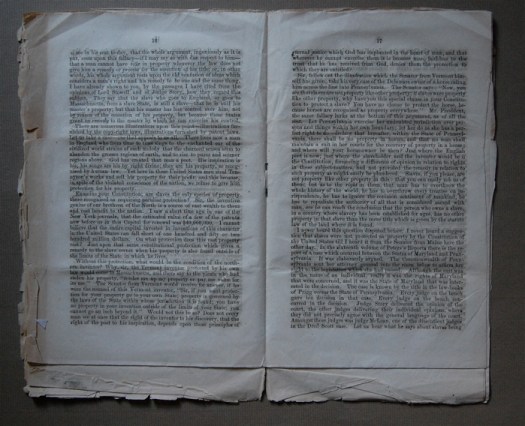
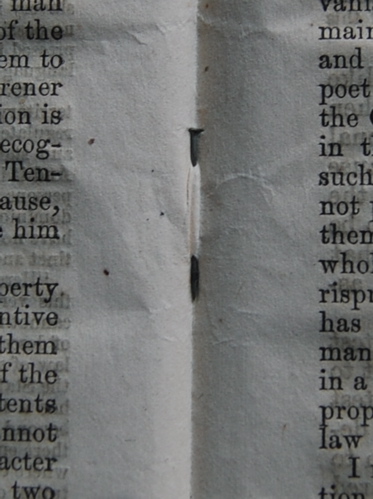
The terminology may be debatable, but I doubt there is a simpler method of “binding” a pamphlet.  These 32 pages were printed  in 1858, and presumably the pin was inserted around that time as well.  A pin may be less damaging than a staple, since the ends of a staple turn in on themselves and often pierce the inner folio.  Both staples and pins are prone to rust, though pins are more easily reversed.  If the head of a pin is too large, it can damage the adjoining pages.  Pamphlets from this time are often side stitched in a figure of eight style, which restricts opening. Some of the horizontal creases in the paper may have happened when the pin was inserted 150 years ago.  Of course, sewing through the fold is the best method of attaching pages together.

In this case, however, the pin was not causing any apparent damage, the owner (thanks for permission to post these images!) and I decided to leave it in place.  Later, I will do some minor surface cleaning, flattening and paper repairs.

Perhaps because pins were on my mind, last weekend I purchased a box of  NOS at the Hell’s Kitchen Flea Market . I was intrigued by the fact that the pins were not described as merely plated, double-plated, triple-plated, but were in fact “Superplated”.  

After opening the box  and seeing them gleam, I decided this is to be a truthful description– well worth the $2 price.

pin box


pins inside

Comments on Clarkson, Conservation and Craft

Book conservation, possibly more than any other conservation discipline, consists of a skill set that is closely linked to its craft roots. Conservators must not only be able to intellectually understand the mechanics, chemistry and history of book structure, but also need the hand skills to actually do bookbinding: performing, for example, a full treatment where a text needs to be rebound in a style sensitive and sympathetic to its structural requirements and time period. So what prompted Christopher Clarkson to write,  “European hand bookbinding practice does not form the best foundation on which to build or even graft the principles of book conservation.” (Clarkson, 1978)

 Although written 30 years ago, these words are still extremely provocative. In a very narrow interpretation, the phrase “ European hand bookbinding practice” could mean typical trade bookbinding practice, and the statement is entirely uncontroversial— not every book should be rebound and of course a 10th century manuscript should not be stuffed into a typical late 19th century trade binding! (1) But what if Clarkson is pointing towards a broader reading, establishing a dichotomy between bookbinding and book conservation, potentially even between a craft and a profession?  Given the close relationship of the two, how could they be separated?

 A few clues can be found elsewhere in the same volume of The Paper Conservator.  This issue begins with a policy statement, noting four basic purposes of publication:

“1.  To conserve the traditional crafts of conservation… .  2.  To stimulate the craftsmen to develop a methodology with which to record their techniques and experience… . 3. …extending knowledge about craft techniques in closely related fields… . 4. To assemble a reference source of craft techniques for trainee conservators.” (My italics) (McAusland, 1978)

 These multiple references to craft are perhaps even more shocking that Clarkson’s original quote, and somewhat explain his need to propose a break with the past, at least in a philosophical context.  It appears that in 1978 that book conservation was considered a craft, or at least craft was a large part of it. But professionalism was on the rise at the same time; Paul Banks was elected President of AIC in 1978 (a first for a book conservator) and his The Preservation of Library Materials was published the same year.  Did a rise in professionalism necessitate a break with craft tradition in order to escape habits, both in thought and praxis, built up over centuries?

 I am certain that if I mentioned “the craft of conservation” in 2008, I would be greeted by suspicion, jeers and critical blog posts from my peers. Today, conservators have, to a large degree, distanced themselves from that dirty little word—craft– at least in their own minds.(2)  This distancing seems to be the core message in Clarkson’s statement, as a necessary first step. In order to rationally and objectively approach a conservation treatment, it was necessary to step outside of the preconceptions of a craft tradition, and attempt to examine the book and the goals of the treatment from the outside.  Sometimes a conservation treatment might closely resemble how a bookbinder might repair a volume; sometimes it might be radically different.

 How can the craft of the bookbinding be preserved in a professional context that has struggled to escape its craft based roots? Are there dangers, however, of completely refuting the craft of bookbinding while formulating a new theory of conservation?  Almost 1,700 years of mostly unwritten craft skills have been passed on during the history of bookbinding.  Many structures and techniques have been abbreviated, forgotten and lost. Some have been rediscovered later, existing as primary evidence in book structure, or extrapolated through praxis.  A conservator could start a treatment, with no knowledge of bookbinding technique, but if the treatment was at all complex, it seems the conservator, even if ignorant of craft technique, would end up reinventing it. Maybe this is how the craft will survive.

 As books cease to be viewed as primarily a vehicle for transmitting textual information, and move closer to object-type status, I predict the physical information their materials and construction contain, and their visual appeal will become increasingly valued. (3) Paradoxically, we may have to wait until books no longer fulfill their original function (to be read) before we fully value the craft skills that created them, and then will have to rediscover those skills. 

 In another 30 years, perhaps, the field of book conservation will be mature enough to reexamine its relationship to craft. Hopefully some of the craft skills will still be present or rediscovered, and might be reincorporated into some future conception of conservation.

NOTES:

1.  Ironically, this style of binding, with all of its structural faults, remains the ideal of fine hand bookbinding in most of the public’s imagination. 

2. Most of the public, unfortunately, uses the terms bookbinder, master restorer and conservator interchangeably. A paramount task for conservation is to educate the public on these differences.

3.  In the past year or two, I have noticed more private collectors wanting a cradle for their book so that it can be safely displayed in their home.  


REFERENCES

Clarkson, Christopher. “The Conservation of Early Books in Codex From: A Personal Approach: Part 1.” The Paper Conservator Vol. 3 (1978): 49.

McAusland, Jane. “Manual Techniques of Paper Repair” The Paper Conservator Vol. 3 (1978): 3