A Sordid Tale Involving a Book Conservator and an ebook Reader

“The ebook reader is devil spawn, the product of an unholy union between book and machine.”

Jeff Peachey–July, 2009

Last week, in a stark reversal of previously held convictions, I purchased a kindle 2 ebook reader.

Initially inspired by a number of upcoming talks I will be giving concerning the future of books and conservation, I have been reading and thinking about ebook readers for a while, especially in terms of how they might augment, change or supplant paper books.  This machine is emblematic of the societal changes regarding the distribution, consumption and value of books.  It can also evoke ire in those who are firmly enamored with paper books.

So I am slightly ashamed, after wrestling with the dilemma to purchase one or not for a few months, that  I realized, with an intensity almost religious in its conviction, that I wanted one– immediately.  Purely in the interests of research, I told myself.  Last Monday, at 9:17 am I logged on to Amazon and purchased one.  I’m even more embarrassed to admit I succumbed to the same day delivery option for Manhattan.  Who in their right mind would wait 5-9 days for free delivery, I reasoned.  I wanted this machine now.  During the day, I was embarrassed yet again, by how excited and eager I was to get my kindle. At 2:26 that afternoon the machine arrived.

After charging the battery, my first thought was to make some sort of case to  hide protect it.  This proved more challenging than initially envisioned.  A number of designers and computer case makers have fabricated various holders, hinged book-like portfolios and envelopes, but none of these seemed satisfactory, since I found the machine very comfortable when held naked.  I ended up making a slipcase  lined with Volara, which works for now.

The next step was to inform some of my friends and colleagues that I had bought this reading machine.   Not surprisingly, I received a variety of responses, ranging from “WHAT!”  to “WHAT THE…!” to “ARE YOU CRAZY?!!” to “OH_MY_GOD!”  After downloading a number of free books, I settled on my first purchase; “Erewhon”, by Samuel Butler.  It is a novel describing  a future civilization that only has knowledge of machines through reading about them in books.

I must confess that I like the kindle, but have only used it for a week.

THE BAD

*It is another expensive portable electronic device that I have to remember to recharge.

*I keep wanting to scroll, but the machine can only turn pages.

*The page turns are much faster than earlier versions, but still pretty slow, and still accompanied by a split second seizure inducing reversal of text and background.

*ebooks themselves seem overpriced to me- around $10. Since there is no production, distribution and minimal storage costs, $5-$7 would seem more in line with the profit margin on paper books.

*There is no secondary marketplace for ebooks.

*Rapidly “flipping” through to find specific pages is difficult.

*It is strange to read everything in the same font- Caelicia.

*It is strange to read everything on the same “page”.

*The formatting and kerning are quite variable and often very bad.

*The footnotes on the books I have are not in hypertext, so it is awkward to first go back to the table of contents, then to the notes, then page through each to find it.

*The 6 inch screen seems small in relation to the size of the machine. Not that many words-per-page even with a small font size.

*I still find the machine itself a little distracting to the reading process.  Maybe it is just a matter of me getting used to it. It invites me to fiddle with buttons and check the web.

*Occasionally the screen glares in a strong light source.

*The “text to speech” voice is annoying and virtually unlistenable.

*I wish the background of the screen were a little whiter.

*Many books and  journals are not available.

*I don’t like the idea of an ebook readers.

THE GOOD

*It seems well made, the buttons have a nice inward click.  Easy to hold with one or two hands.  Good ergonomics.

*Lighter than an average book of the same size. And obviously, much lighter than 1,500 books.

*Purchased books are backed up by Amazon, and can be shared on other formats, like the iphone or computer.  Even bookmarks and notes are shared.

*It is very convenient not have to think about what book to take when I go out.

*The choice of five font sizes is invaluable for the over 40 crowd.

*It is fantastic to use while eating, lying flat, taking up half the table space of a paper book.

*The eink is clear and easy to look at for long periods of time. Better “print” quality than many common mass market paperbacks.

*There are thousands of free, public domain books available.

*It it a wonderful size for reading in the car or on the subway.  It is very easy to turn the pages on a packed train while standing.

*The battery life is great. I’ve used it constantly for a week, and haven’t turned it off, only recharging it once.

*The free 3G web browser works reasonably well for mobile optimized websites.

*It will help clear up scarce bookshelf space.

*An average book downloads in less than a minute.

*I imagine it will be perfect when traveling- no worries about running out of books, and a lot less weight.

I will avoid the already somewhat tiresome “is the kindle better than a book” debate for now, at least until I’ve had a couple of months to use it.  Suffice to say, there are many issues.  But the ebook reader itself may already be heading towards obsolescence.   A couple of ebook blogers are nervous that the tablet computer, which Apple will possibly introduce later this week, may replace their traditional ebook reader, and are growing anxious and defensive about it. Technology races onward.


Book Conservation in the US and the UK

The practice of book conservation not only changes over time, but some of the ethics, underpinnings and treatments vary in different countries.  In November 2009, I had the opportunity to install a board slotting machine in England, teach a three day workshop on its use, and give a presentation on the history of board slotting.  During the course of a week,  I had time to talk shop with conservators from a number of institutions, and recorded some of my impressions from these conversations.

THE JOB SITUATION

Currently, it seems slightly better in the UK than in the US.  No one I spoke to experienced hiring freezes or a forced four day work week during the summer, like many institutional conservators experienced here.  Many of the jobs in the UK are short term or part time, but these were often to get renewed.  Because of their National Health Care system, this employment uncertainty is much more doable than here.   It is a nightmarishly difficult, and sometimes impossible, to rapidly change health care providers here.

Salaries, traditionally lower, seem to be catching up and in some cases equal to what a conservator would make here in the US. Perhaps this is due to ICON’s efforts to establish minimum accepted salary standards.  The cost of living is higher, however.  Salaries for conservators in private practice, however, seem to lag well behind the US, likely because of a much longer craft oriented bookbinding tradition that competes for rebinding and restoration type jobs. Overall,  there seemed to be a less alarming reallocation of funding for digital projects at the expense of treatments. Perhaps the bulwark of a longer tradition of caring for cultural objects provides a buffer against the current rush, at least here in the US, to digitize everything by noon tomorrow.

Because there are so many older books in Europe, the general public considers them commonplace and functional, rather than treasured relics.  I’m not suggesting Europeans don’t value their cultural heritage, but for them, a 19th century book is not all that old; additionally these books can be somewhat slighted because they are a product of technology, not craft.

Conservators tended to be much more international than here.  I’ve met conservators working in the UK from the US, Canada, Serbia, New Zealand, France and Italy. Additionally, I have to confess a degree of jealousy when examining the overall age and quality of materials that my English peers were treating–generally they get to work on better stuff.

EDUCATION

Once again, possibly due to the demise of the Kilgarlin Center,  more Americans are choosing to get their conservation training in England.  Camberwell and West Dean both seem to have bumper crops of new students.  There is even a US/ UK alliance between North Bennet Street School and West Dean, though I am unclear if it is official or not: complete the rigorous two year NBSS program, with its emphasis on bookbinding craft skills, then enter into the 2nd. year MA at West Dean for conservation training. It is almost like training in the US is back to where it was in the early 1980’s, with potential conservators forced to devise their own conservation education based on a variety of sources–bookbinding courses, on the job training, internships, an MILS and countless short term workshops.  In some ways this is nothing new– book conservators have always had to be proactive in their education. Given the lack of new, entry level jobs, coupled with the lack of training opportunities and the decrease in funding for treatments, I am growing increasingly apprehensive about the future of book conservation.  Books are rapidly loosing their unique status as interactive, movable functional objects, and becoming more like any other museum object. Will  future book conservators only learn how to safely house and display them?  Will future book conservators be trained in the various MA art conservation training programs; Buffalo, The Institute of Fine Arts, Winterthur, Queens?  The conservators I have met from these programs have been top notch, highly skilled and very professional.   Since book conservation, historically, has been so closely linked to its craft roots, emerging initially in the working library, not in a museum setting, should we consider the preservation of these craft skills a necessary part of an overall book conservation training program?  In many ways, this shift in book conservation education mirrors the shift of the societal role of books themselves.

HEALTH AND SAFETY

The EU also brought in stringent (and to my mind sometimes ridiculous) health and safety rules.  Board shears (called ‘board choppers’ in the UK) are retrofitted with a large Plexiglas fin, similar to a Kuttrimmer, to prevent users from putting their head under the blade to align material to be cut.  This often results in a nasty cut on one’s forehead when, out of habit, one tries to align the material under the blade.  Even a Tormek (slow speed water cooled grinding stone) had to be outfitted with an ’emergency’ on-off switch.   Since it is possible to touch the wheel when it is in motion without abrading your skin, I am suspicious about the necessity for this switch.  Quite fortuitously, UK conservators never use sharp knives and scalpels, otherwise they might be required to wear kevlar gloves, a thick leather apron and safety glasses!

TEA TIME

The sacrosanct ritual of tea time seemed to promote employee bonding and encourage a general sense of well being,  as well as providing a respite from the sometimes tedious nature of performing  conservation treatments. In general, Europeans have a more nuanced understanding of work. One gets the sense that the workplace was made for people, not people made for the workplace. I suggest this attitude be more widely emulated here, and vow to start with my studio!

SIMILARITIES

Many of the frustrations expressed are quite similar on both sides of the pond.  The most common being the lack of time to actually do treatments, given the amount of administrative duties.  Another is the amount of time that exhibitions and loans take, often to the detriment of treating serious, complex problems on other books.  And there is a persistent sense–sometimes spoken, sometimes unspoken– that book conservators, because they work with their hands in a profession closely related to a craft,  are somewhat closer to shoemakers than other museum professionals.

Most book conservators, attracted to this low paying field for a variety of reasons, are personable, intelligent, practical, curious, decent people.  They are the kind of colleagues  one chooses to socialize with outside of professional obligations, often sharing a love of good food, as well as a deep, often thankless commitment to preserving the most perfect and durable technological invention of all time:  the book.

I suspect there are many familiar with both the US and UK conservation worlds, and am interested to hear some other comparisons and perspectives.

The American Institute for Conservation has also compiled information about conservation education.

A Drop Spine Cradle Box

Peter Waters, in the introduction to “Boxes for the Protection of Rare Books: Their Design and Construction” established seven basic precepts for designing a protective enclosure in 1982.  It is an excellent analysis of what a good book box should be, and is worth quoting in entirety:

“1. A good box should place the closed volume under light pressure so that is is unlikely to expand, become distorted, or shift position if the box is shaken or dropped.

2. The box should be strongly constructed so that if it sustains a blow any damage to the volume within will be minimized. (Shipping boxes need to be stronger and are not considered here.)

3. Materials used for making boxes should be of the highest permanence and durability, with appearance playing a lesser role than it would in the design of “presentation” boxes.

4. As far as possible, a book box, when assembled and covered, should be a single unit.  Telescopic designs, for example, or boxes with inner sleeves and separate covers can confuse a user who must return each of several visually identical volumes to its own box.

5. The design and location of the label on a closed box should indicate clearly whether it should be shelved vertically or horizontally and how it should be opened. The method of opening and closing a box should always be simple and obvious.  Inadequate directions for opening are potential sources of damage to the book.

6. When possible, a book box should be designed so that the user must remove it from the shelf and place it on a table to open it and must remove the volume with both hands.  A slip case or telescopic case tempts a user to hold it with one hand while removing or replacing the volume with the other hand, which is potentially harmful to the book.

7. With few exceptions, a box design should restrain a user from opening the volume within the box.”

I would add two additional guidelines:

8.  It should be cost effective and simple to construct.

9. Ideally, there should be no abrasion when removing or replacing the book  in the box.  Practically, this is often impossible.

cradle1

Fig 1: A drop spine box with an integral cradle.

With these precepts in mind, I designed a box with an integral cradle. For collectors who read their books (not unheard of!), it is often ideal; most don’t want the hassle of storing or locating rare book room style wedges, and some open their books inside drop spine boxes anyway.  This cradle could also be useful for book artists that want some control over how their books are displayed in an exhibition. In certain circumstances, it might even be useful in an institutional setting.  Dedicated cradles with variable degrees of opening are optimum for consultation and display, but sometimes this is not possible.

I based this box/cradle on one  I saw in  Montefiascone, Italy, this past summer and it was made by Nicholas Hadgraft. His version used velcro to attach the left wedge into the outer tray, but after some experimentation I changed this.  The basic idea, of hinging the cradle platform near the spine was his, I think.  I’ve also heard about a version that automatically raises the cradle, but haven’t seen one yet– I’d be happy to add an image or diagram to this post if anyone has one to share. After thinking, experimenting and making various models, I reached the point where further simplifications created more complications.  I’m sure there are many variations and hope there are potential improvements.

diagram1

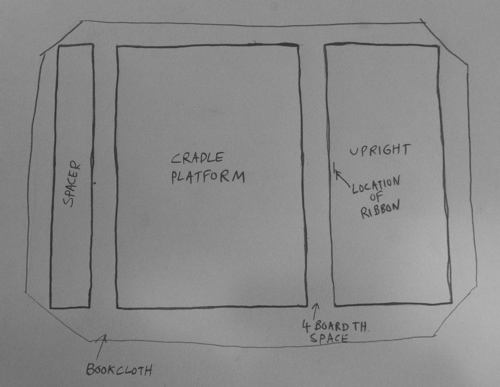
Fig 2: Diagram of the layout for a wedge.

The construction is easy and straightforward.  Basically, the two wedges are made, attached together,  then measured with the book to determine the dimensions of the inner tray. After that, the box is constructed as usual.  The construction of drop spine boxes is well documented, so there is no reason to repeat it here.

First, determine the angle of the desired opening for the book.  Then cut the three pieces of board- a spacer, the cradle platform and the upright.  The width of the upright will determine the angle of the cradle. A hinge spacing of four board thicknesses worked well with Iris cloth, but a thicker cloth might need additional space.  When measuring the book, I feel a somewhat “loose” box prevents abrasion of the book edges, when inserting and removing the book, which I feel causes more damage than if the book moves a few mm inside the box. About  one centimeter is a reasonable gap between the spacer and the upright when it is folded flat– it allows for some flexibility in construction, yet adequately supports the book when it is stored.  Then the three pieces are covered like a case binding, and lined.

diagram3

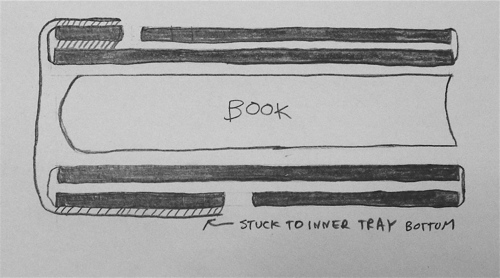
Fig. 3: End view of the book and two wedges, ready to be measured for the tray.

Another important consideration is to add about one spine thickness to the height of the upright in the outer tray, in order to keep the overall angle of each wedge roughly similar to each other. Since the book could eventually be used in a wide variety of page openings, it seemed reasonable to keep the angle of the uprights roughly even.

The wedges were attached to each other by a double layer of book cloth, glued back to back. A variety of materials seem to work for  lining the platform depending on the fragility of the book covering material– I’ve used paper, cloth, volara and polyester felt.  The trays need to be lined before they are measured with the book. It is possible to construct the wedges and spine piece from one piece of cloth, but measuring for a proper fit is fairly difficult and more time consuming, and then the spacers need to be made from separate pieces of cloth.

Note that on the right side wedge, the spacer is glued to the bottom on the inner tray.  This allows the wedge to open, and his prevents the cradle from shifting and collapsing when it is open.  The spacer on the left wedge is glued to the bottom of the cradle platform. This allows it to open independently from the drop spine box, consequently the spine width is closer to the ideal than if the wedges are hinged to the trays.

cradle-in box

Fig. 4: View of the cradle when opening the box.

I try to make the cradle platform fit fairly tight in the inner tray, so that its friction can be used to create slight compression on the book.

One potential drawback is that it effectively doubles the thickness of a standard drop spine box, adding an additional 4 board thicknesses, plus lining materials, but presumably this is more of a concern for institutional, verses private collections.

cradle-first flap

Fig. 5: The box and cradle open, but the uprights not yet raised.

The location of the pull ribbon is quite important, and unfortunately there is no ideal solution.  If it is placed about halfway up in the height, it makes it easy to pull it to 0pen the upright.  But in this position, it can slip under the platform when closed.  If the ribbon slips under the right wedge, it can be very difficult to retrieve (DAMHIKT). For now, locating this closer to the top, or to keep it from slipping by sewing through the hinge, as illustrated here,  seem the best solution.

I trust that Peter Waters would have considered this box as an “exception” to his rule #7, otherwise I plead guilty as charged.

cradle

Fig 6: Competed box with integral cradle in position.